 support@bizdata360.com
 +1-650-283-1644
 AI Enabled Data Integrations and AnalyticsAI Enabled Data Integrations and Analytics

TDLR / Key Takeaways
AI data integration merges artificial intelligence with data connectivity for seamless, automated workflows.
It minimizes manual effort and speeds up data transfer between disparate systems.
Key technologies include machine learning, natural language processing (NLP), predictive analytics, and intelligent automation.
Platforms like eZintegrations™ offer no-code, real-time integration across SaaS, ERP, CRM, APIs, and databases.
AI integration is critical for 2026 to enhance agility, ensure data quality, and modernize IT infrastructure.
In today’s data-saturated world, IT leaders face a growing challenge: integrating data from hundreds of sources in real time to drive insights, automation, and decision-making. Manual processes are outdated, traditional tools are too rigid, and the speed of innovation waits for no one. A recent IDC study estimates that by 2026, the global datasphere will grow to 175 zettabytes, making efficient data integration more critical than ever.
Meanwhile, over 80% of enterprise data is unstructured, requiring intelligent solutions to process and connect it. AI data integration is a modern approach that combines automation, intelligence, and scalability to unify enterprise data like never before.
According to a 2024 Gartner report, 60% of organizations will adopt AI-driven data integration tools by 2026, up from just 20% in 2022 highlighting a massive shift toward smarter, self-optimizing systems. This blog explores how AI is reshaping the future of data integration, the benefits it brings, the technologies driving it, and what IT decision-makers need to know to stay ahead.
Data integration is the process of combining data from multiple systems, applications, and sources into a unified, usable format. It powers everything from business intelligence dashboards to automation workflows and digital customer experiences.
Traditional data integration involves:
But as data volumes grow and system diversity expands, legacy tools often struggle to keep pace.
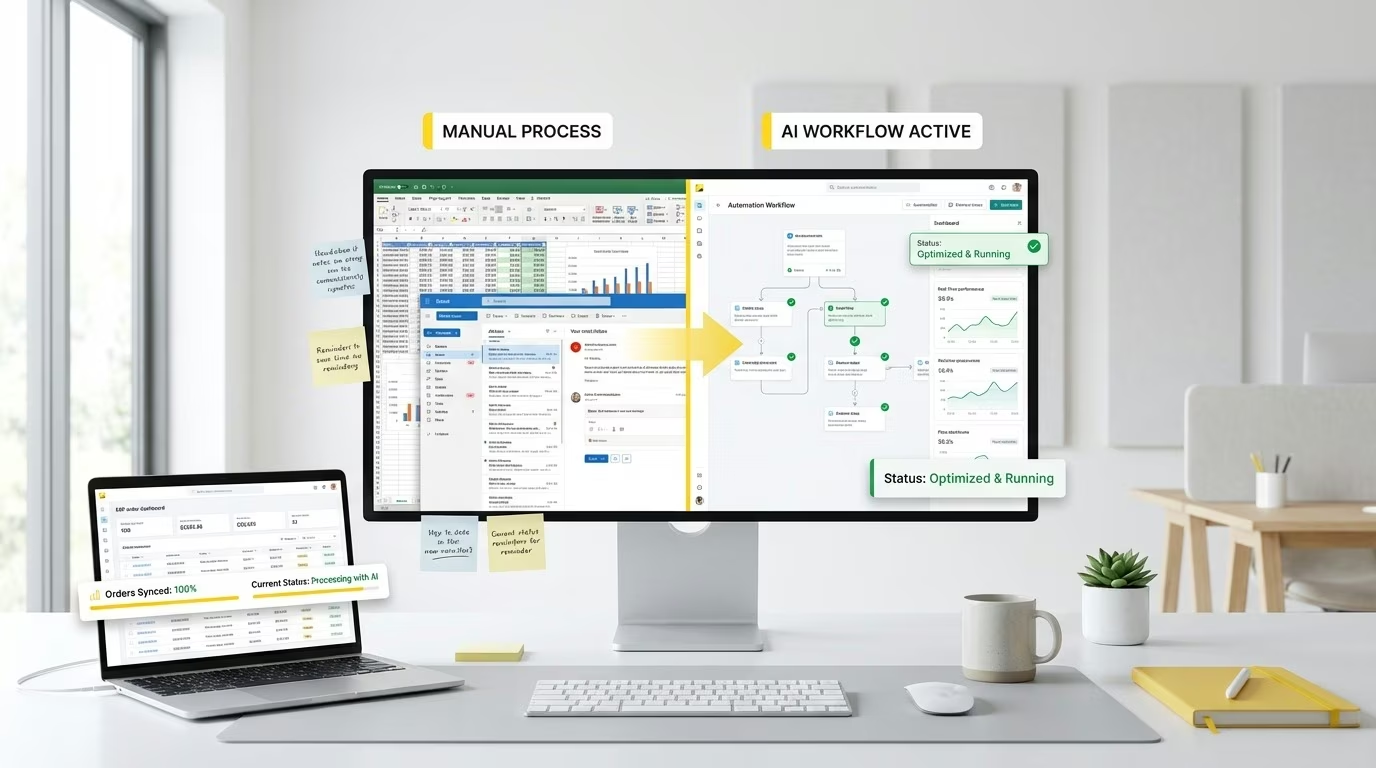
AI data integration refers to the use of artificial intelligence technologies to automate, optimize, and scale the data integration process. It replaces repetitive, rule-based logic with intelligent automation that learns from data behavior, adapts to schema changes, and supports real-time decisioning.
Unlike traditional methods, AI data integration:
In short, it offers a smarter, faster, and more scalable way to make data integration seamless.
Despite decades of evolution, traditional data integration still presents major challenges:
Connecting legacy systems, APIs, cloud services, and on-prem environments can take months and require significant developer effort.
2. Lack of Real-Time Capabilities
Many legacy ETL tools are batch-based, making it hard to support modern use cases like personalization or fraud detection.
3. Manual Schema Mapping
Changes in data formats or structures often require human intervention, delaying projects and increasing error risk.
4. Data Quality Issues
Without AI, identifying duplicates, outliers, and inconsistencies requires time-consuming manual data cleaning.
Adopting AI-driven data integration brings tangible advantages to enterprise IT teams:
AI enables continuous data syncing across systems, improving agility and responsiveness.
Machine learning automates schema mapping, anomaly detection, and transformation logic.
AI models flag outliers, suggest enrichments, and even correct data quality issues in-flight.
Deploy integration faster with fewer resources by using intelligent automation.
AI adapts to growing data volumes and complexity without the need to re-engineer pipelines constantly.
Here’s how AI is revolutionizing the modern data integration landscape:
Platforms like eZintegrations™ are leading the way by embedding AI throughout their no-code integration pipelines. IT teams can build and manage integrations in hours instead of weeks, all while improving visibility, performance, and governance.

Learns from past data mappings to predict how new data fields should be integrated.
Users can define integrations using natural language, lowering the barrier for non-technical users.
Emerging gen AI models can suggest or generate transformation logic, even generate documentation automatically.
Proactive error detection and self-healing integrations improve reliability.
Retail
AI-powered integration syncs inventory and POS data in real time to manage supply chains efficiently. For example, a global retail brand uses eZintegrations™ to improve its e-commerce operations by integrating inventory data, leading to lower costs and greater order accuracy.
Finance
Real-time fraud detection is possible by integrating transactional data across platforms. A fintech startup leveraged AI to merge banking APIs with risk scoring models, cutting detection time by 60%.
Healthcare
AI ensures HIPAA-compliant syncing of patient data across EHR and analytics systems. A hospital network implemented AI pipelines to merge lab, patient, and treatment records to improve diagnosis accuracy.
In industries where split-second decisions matter (finance, retail, cybersecurity), real-time AI data integration is a competitive advantage. It:
eZintegrations™ supports real-time pipelines out of the box, allowing enterprises to act on fresh data without delay. Best AI Data Integration Services for IT
eZintegrations™ – Tailored for complex enterprise environments, offers a visual designer, real-time AI processing, and flexible API support. eZintegrations™ stands out for teams looking for a faster path to value with minimal overhead.
AI-based data integration is only getting more powerful. Here’s what to expect:
Forward-looking companies are already investing in platforms like eZintegrations™ to build future-proof data strategies.
As AI continues to evolve, several trends are reshaping the landscape of data integration:
More enterprises are adopting data fabric, where AI acts as the glue between distributed data sources, offering a unified, real-time view of business information.
AI models trained specifically for sectors like healthcare, manufacturing, or finance will drive more accurate and relevant data processing.
Cloud-native, AI-powered integration as a service platform like eZintegrations™ are emerging as preferred choices over on-prem tools due to their scalability and agility.
The shift toward low-code/no-code platforms powered by AI empowers business users to create integrations without relying solely on IT.
With AI playing a greater role in data handling, the need for transparent and governed AI models is growing. Look for platforms that provide explainable AI features and auditable data flows.
AI-generated synthetic data will increasingly be used to test data pipelines, helping avoid production risks while enhancing test coverage.
Organizations will increasingly adopt modular, composable integration architectures where AI orchestrates connections dynamically based on business needs.
The move toward AI data integration isn’t just a trend, it’s a transformation. By adopting intelligent, scalable, and real-time integration platforms, IT leaders can unlock the full value of their data.
eZintegrations™ offer a future-proof foundation with a no-code, AI-enhanced architecture built for the needs of modern enterprises. and platforms like Goldfinch AI offers no-code, AI-driven automation that integrates seamlessly across SaaS, ERP, CRM, APIs, and databases to streamline your business processes in real time.
Book a free demo of eZintegrations™ and discover how your organization can simplify customer data integration, streamline operations, and accelerate innovation.
FAQs on AI Data Integration
What is AI data integration?
AI data integration is the use of artificial intelligence to automate how data is collected, processed, and shared between systems.
How is it different from traditional data integration?
Unlike manual or rule-based integration, AI integration uses intelligent automation to learn, adapt, and handle complex data flows without constant human input.
What are the benefits of AI in data integration?
It boosts speed, reduces errors, improves data insights, and enables predictive decision-making.
Do I need coding knowledge to use AI data integration platforms?
No. Platforms like eZintegrations™ offer a no-code, drag-and-drop interface for building integrations.
Which industries benefit most from AI data integration?
Finance, retail, healthcare, manufacturing, logistics, and any data-intensive industry can benefit significantly.
Is AI data integration secure?
Yes, when implemented on secure platforms, it follows compliance and encryption standards for enterprise-grade data handling.
Compare eZintegrations to Zapier and Workato.
eZintegrations™ focuses on AI-driven data workflows and enterprise-grade automation, unlike Zapier or Workato, which mainly handle app-based task automation.
What pricing tiers does eZintegrations offer?
It offers flexible, usage-based pricing with one free integration bridge for the first month.
How eZintegrations handles document extraction?
It uses AI Document Understanding to extract structured data from unstructured files.
Is there a free trial or demo for eZintegrations?
Yes, a free trial with one integration bridge is available for new users.
What security and compliance features does eZintegrations have?
It’s SOC 2, GDPR, and HIPAA compliant with end-to-end encryption and secure data handling.


© Copyright 2026 Bizdata Inc. | All Rights Reserved
 Watch Demo
 Post on LinkedIn
 Post on Facebook
 Post on Twitter/X