 support@bizdata360.com
 +1-650-283-1644
 AI Enabled Data Integrations and AnalyticsAI Enabled Data Integrations and Analytics

Paper-heavy processes are costing companies more than just time. According to McKinsey, employees spend nearly 20% of their time searching for internal information, and 50% of enterprise content is duplicated or misfiled. In the digital-first world, this is unsustainable.
Enterprise document automation solves this by using AI and integration tools to eliminate bottlenecks in document workflows. Whether it’s sales contracts, invoices, legal documents, or HR forms, automation streamlines how content is captured, processed, and stored across your tech stack.
This blog is for professionals looking to modernize document handling in their organization without buying a new document management system. We’ll explore the essentials, challenges, and opportunities of automation and how eZintegrations™ and Goldfinch AI can help you unlock enterprise efficiency.
Document automation refers to the process of using software to create, extract, route, and store digital documents with minimal human input. It replaces repetitive, error-prone manual tasks with streamlined, consistent workflows. Businesses can automate the handling of PDFs, forms, images, and other digital documents to ensure faster turnaround and better data consistency.
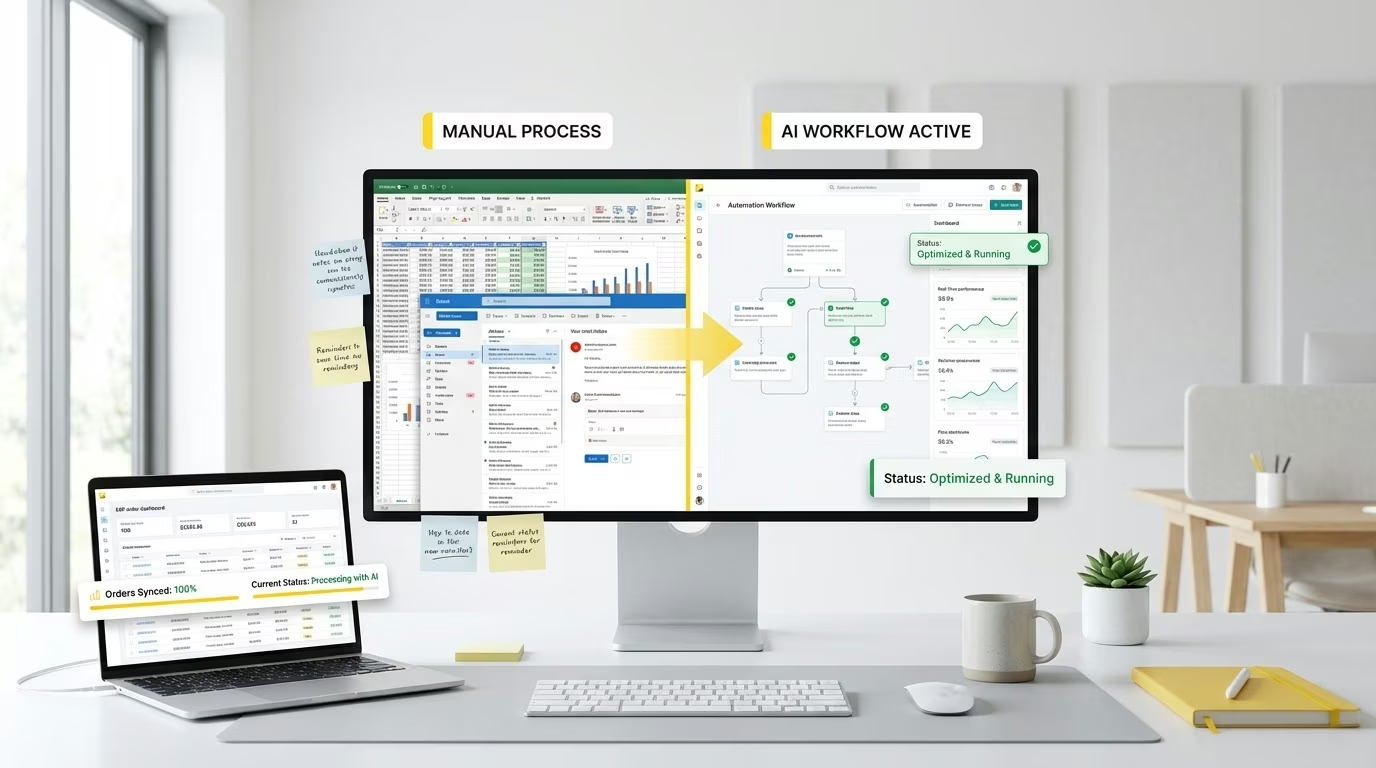
A practical example helps ground the concept. Consider how sales teams manage contracts. Without automation, this typically involves receiving a signed PDF from a client, manually copying the data into a CRM, and updating an invoicing system. With automation, all these steps happen instantly and without manual input-saving time and reducing errors.
Result? No copy-paste. No delays. No errors.
Implementing document automation can yield significant returns across departments. It ensures documents are processed quickly, information is accurate, and workflows are scalable. The benefits go beyond convenience- they impact compliance, customer satisfaction, and cost control.
Greater Scalability: Handle document spikes during busy periods with ease
As with any digital transformation, enterprise document automation can encounter roadblocks. These challenges often stem from legacy systems, unstructured content, or organizational change resistance. However, understanding and preparing for them is the first step to successful adoption.
Solutions like eZintegrations™ overcome these issues through no-code connectivity, smart parsing, and granular user permissions.
Enterprises process thousands of documents daily, from customer records to regulatory filings. Automating these workflows can transform operations, reduce errors, and speed up decision-making. AI adds an extra layer of intelligence by classifying, validating, and routing data in real time.
In enterprise environments, volume and compliance requirements make automation a necessity. AI-powered enterprise document automation ensures:
An Enterprise Document Management System (EDMS) is software that stores, manages, and secures business documents. These systems provide centralized access to information, ensuring teams can collaborate and retrieve content efficiently. Common EDMS tools include SharePoint, Box, and UCM Cloud.
While these tools excel at storage and collaboration, they do not automatically extract or route data. That’s where automation platforms like eZintegrations™ come in-bridging the gap between document storage and business applications.
Document processing automation focuses on converting incoming documents into structured, usable data. It is especially useful for high-volume use cases where speed and accuracy are essential. This approach uses OCR, machine learning, and rules-based logic to manage content from end to end.
It includes:
Also Check out: What is Document Parsing? Guide to Automating Data Extraction
Successful document automation follows a clear lifecycle. By breaking down the process into phases, organizations can better identify where to deploy tools and streamline operations.
Each phase can be automated with tools like eZintegrations™ and enhanced by Goldfinch AI’s parsing capabilities.
Document automation is evolving beyond simple data extraction. As AI capabilities mature, businesses will see more intuitive, intelligent systems that understand context, respond to users, and learn from interactions. The shift toward large language models (LLMs) is particularly transformative.
Here’s what to expect:
As organizations adopt hybrid work models, the need for seamless, scalable document automation will only grow.
When deployed together, eZintegrations™ and Goldfinch AI form a complete, AI-powered solution for enterprise document workflows. Rather than replacing your document management system, they enhance it-bringing intelligence and automation to your existing tools.
Example: Parsing resumes from a Dropbox folder and populating fields in an ATS, while archiving copies to SharePoint.
Enterprise document automation is not about replacing people- it’s about empowering them. With AI and integration platforms, your business can eliminate manual bottlenecks and scale with confidence.
Whether you’re managing invoices, contracts, or compliance documents, tools like eZintegrations™ and Goldfinch AI can modernize your document workflows without replacing your existing systems.
Book a free demo of eZintegrations™ today to see how you can unlock efficiency, accuracy, and real-time insight from your enterprise documents.
No. Platforms like eZintegrations™ work alongside tools like SharePoint and Box to automate processes and enhance functionality.
Yes. Goldfinch AI includes OCR that can read handwritten content with high accuracy.
Absolutely. eZintegrations™ offers encrypted data transfer, audit trails, and access control features.
Many integrations can be set up in less than a day with the visual workflow builder.
Contracts, invoices, tax forms, resumes, legal agreements, claims, onboarding files, and more.
6. Which is the best tool for Enterprise Document Automation?
eZintegrations™ AI Document Understanding is the best tool for enterprise document automation.


© Copyright 2026 Bizdata Inc. | All Rights Reserved
 Watch Demo
 Post on LinkedIn
 Post on Facebook
 Post on Twitter/X