 support@bizdata360.com
 +1-650-283-1644
 AI Enabled Data Integrations and AnalyticsAI Enabled Data Integrations and Analytics

Every day, businesses process millions of documents: invoices, claims, contracts, emails, forms, and more. 90% of enterprise data is unstructured, and most of it lives in documents. According to McKinsey, automating document workflows can reduce processing costs by up to 40% and cut turnaround times by 70%.
Yet, traditional document processing is time-consuming, error-prone, and often still manual. That’s where Intelligent Document Processing (IDP) enters the picture, bringing AI-powered automation to transform how organizations handle unstructured and semi-structured data.
Whether you’re a tech leader, a data architect, or an automation champion, this 2026 guide will walk you through what IDP is, how it works, its benefits, use cases, emerging trends, and other insightful topics.
Document processing refers to the foundational methods of handling physical or digital documents throughout their lifecycle. It includes capturing, extracting, validating, storing, and routing information within various business systems. Historically, this process has required significant manual input, especially when dealing with unstructured or paper-based formats.
Common examples include scanning invoices, entering data from forms, or validating contracts. While automation tools like OCR have helped, traditional document processing still demands frequent human oversight.
Intelligent Document Processing (IDP) is the AI-driven advancement of traditional document automation. It combines technologies like machine learning (ML), natural language processing (NLP), and computer vision to not just read documents but to understand and act on them.
Unlike older systems that rely on rigid templates or rule-based logic, IDP is capable of recognizing document types, extracting data regardless of format, and learning from user corrections over time. It processes structured, semi-structured, and unstructured content from PDFs and spreadsheets to emails, scanned images, and handwritten notes.
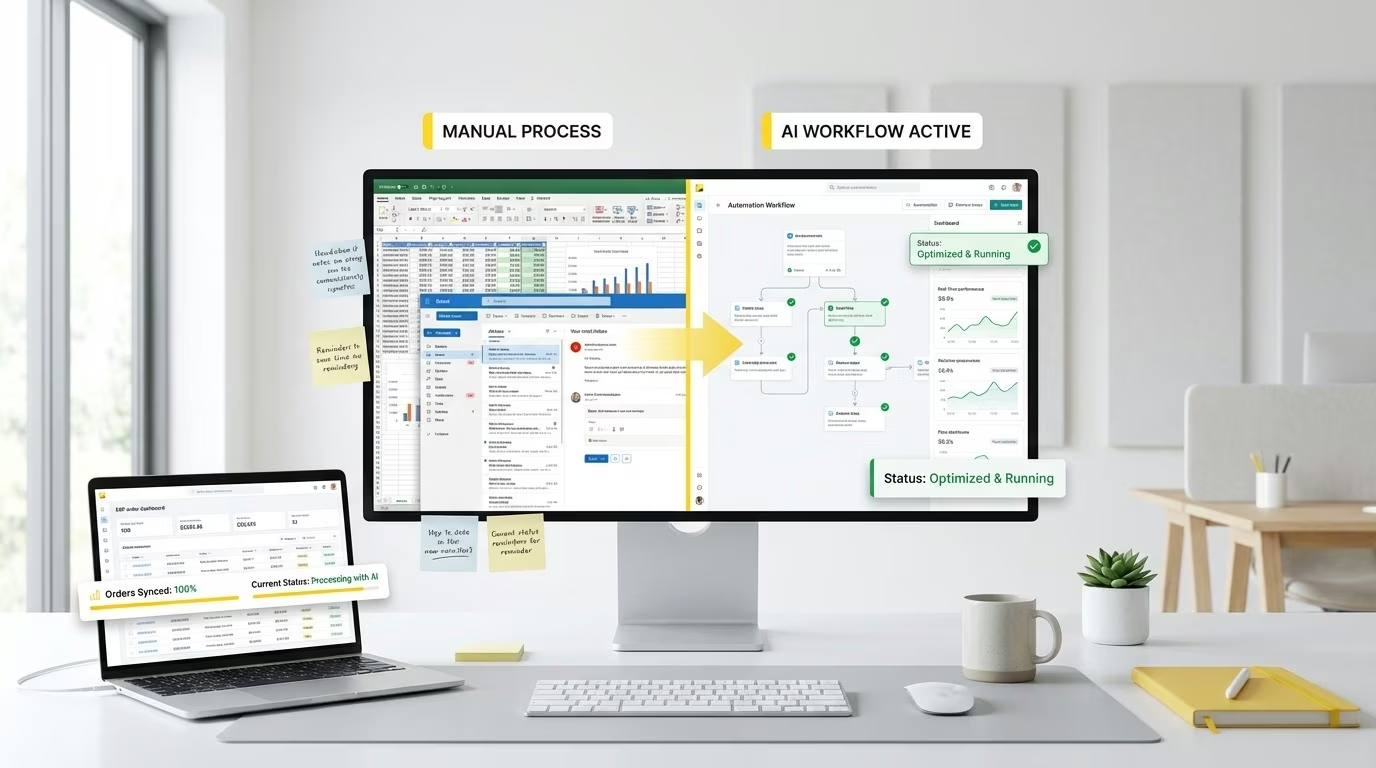
IDP eliminates the inefficiencies of manual processes and enables organizations to gain value from previously untapped unstructured data. It becomes an intelligent layer that connects your documents to business outcomes.
IDP systems follow a series of steps from document intake to outputting clean, validated data. AI plays a central role in interpreting document content.
IDP combines several technologies to extract meaning and structure from complex documents. Each plays a unique role in enabling automation.
The IDP workflow is a structured pipeline that ensures each document goes through consistent stages for accuracy and compliance.
Each step in IDP is carefully designed to transform raw input into actionable insights. This step-by-step model ensures reliability and scalability.
The adoption of IDP delivers significant business value, particularly for document-intensive industries.
Implementing IDP comes with its own hurdles. Understanding these can help build more effective strategies.
Artificial Intelligence (AI) powers Intelligent Document Processing by enabling systems to understand and interpret documents beyond simple keyword matching. Unlike traditional methods, AI can grasp the context, semantics, and intent behind the data, allowing for more accurate extraction and processing. This context-aware decision-making helps the system differentiate between similar terms based on meaning, improving overall accuracy.
AI models continuously learn from corrections made by human reviewers, which helps them improve over time and adapt to new document types or formats. This learning capability reduces errors and minimizes the need for manual intervention as the system becomes smarter.
Additionally, AI enhances document routing by making intelligent decisions about where and how documents should be sent within a workflow. This ensures faster processing, reduces bottlenecks, and optimizes business operations.
Goldfinch AI uses advanced deep learning and NLP models to adapt to any business document without custom training from scratch.
Also Check out:
Enterprise Document Automation with AI-Driven Workflows
What is Document Parsing? Guide to Automating Data Extraction
Automated Document Processing (ADP) focuses on processing structured documents using predefined rules and templates. Intelligent Document Processing (IDP) goes beyond AI technologies like machine learning and natural language processing to handle unstructured and semi-structured documents, enabling more flexible and accurate data extraction. Essentially, IDP is a smarter, more advanced evolution of ADP. Understanding the evolution from ADP to IDP highlights why AI-led processing is superior.

Choosing the right IDP platform depends on your enterprise needs, document types, and integration capabilities. Here are the best Intelligent Document Processing Software/Solutions
IDP has diverse applications across industries, streamlining repetitive, document-heavy tasks. Organizations of all sizes can unlock efficiencies by automating routine document workflows, improving accuracy, and accelerating decision-making. Below are some of the most impactful use cases across sectors:
The healthcare industry produces a high volume of sensitive documents, from medical forms to insurance claims. Manual processing introduces delays, risks of non-compliance, and data silos. IDP transforms these workflows by enabling faster, more accurate handling of critical patients and administrative data.
UiPath Document Understanding is an intelligent document processing solution that combines robotic process automation (RPA), artificial intelligence (AI), and machine learning (ML) to automate the extraction, classification, and validation of data from various document types. It helps organizations handle large volumes of unstructured and semi-structured documents with minimal human intervention. UiPath’s modular framework supports flexible workflows where humans can review and validate data, ensuring high accuracy in complex processes.
This platform is widely used by enterprises looking to automate repetitive document-related tasks such as invoice processing, claims management, and contract analysis.
Examples of UiPath Document Understanding
UiPath offers a robust structure for automating document handling. Their framework includes AI and human validation components.
The future of IDP is being shaped by next-gen AI capabilities and real-time automation trends.
Combining integration and AI, eZintegrations™ and Goldfinch AI simplifies and accelerates IDP adoption for enterprises.
eZintegrations™ enables seamless connection to ERP, CRM, and cloud services without writing code. It provides the foundation to connect IDP tools into enterprise workflows easily.
Goldfinch AI brings advanced NLP, OCR, and zero-shot learning models that require minimal training, making IDP smarter and faster.

In 2026, businesses that embrace Intelligent Document Processing will outperform those that don’t. From streamlining claims to enhancing compliance, IDP is no longer optional. It’s essential.
Book a free demo of eZintegrations™ today and see how it pairs with Goldfinch AI to supercharge your business workflows.
What is intelligent document processing (IDP)?
IDP is the use of AI, OCR, and ML to extract, classify, and validate data from documents automatically.
What does IDP mean in AI?
IDP stands for Intelligent Document Processing, using AI to automate complex document workflows.
What is the difference between IDP and OCR?
OCR converts text in images to readable characters. IDP goes further by understanding, validating, and using the data.
What is IDP processing?
It refers to the full pipeline of capturing, analyzing, and integrating document data using AI-driven automation.
What is UiPath Document Understanding used for?
It’s used to classify and extract data from documents, automate workflows, and integrate with RPA for end-to-end automation.
What is the role of Intelligent Document Processing in automating business workflows?
IDP automates data extraction and validation from documents, reducing manual work and errors while speeding up processes like invoice and claims handling.
How does Intelligent Document Processing handle different document formats and types?
IDP uses AI technologies like OCR and machine learning to extract data from PDFs, scanned images, emails, and handwritten notes with high accuracy.
What are the key challenges businesses face when implementing Intelligent Document Processing?
Challenges include managing varied document formats, ensuring accuracy, system integration, handling exceptions, and scaling the solution effectively.


© Copyright 2026 Bizdata Inc. | All Rights Reserved
 Watch Demo
 Post on LinkedIn
 Post on Facebook
 Post on Twitter/X