Why Are Manual Packing List Documents a Shipping Liability?
Manually created packing list documents are a hidden risk in global logistics. Errors in item counts, descriptions, weights, or HS codes not only delay shipments but also create customs compliance problems. Inaccuracies can trigger supply chain bottlenecks, missed SLAs, and client dissatisfaction. Human-entered data, especially when done under tight timelines, results in a growing list of inconsistencies. With eZintegrations™ AI Document Understanding, enterprises can eliminate these risks and create resilient, synchronized packing processes.
What Is a Packing List Document?
A packing list is a key logistics document that outlines the contents of a shipment. It includes itemized details such as:
Product descriptions
Quantities
Dimensions and weights
Serial numbers
Packaging type
Shipping marks
HS codes (for customs)
It serves as a communication bridge between the warehouse, logistics team, customs, and the buyer. Accuracy and consistency are essential, as even minor mismatches can result in hold-ups, fines, or rejected deliveries.
What Causes Shipping Errors Due to Manual Packing Lists?
Shipping errors are often the result of overlooked details or disconnected systems. Manual document creation and validation introduces multiple points of failure:
Typos and duplication: Staff entering hundreds of product SKUs inevitably make mistakes.
Version control issues: Multiple packing list versions create confusion.
Missing line items: Manual copying may skip items listed in the sales order or invoice.
Unstructured formats: Excel or PDF formats vary across teams or vendors.
No validation rules: Human checks can’t match the speed and consistency of automated logic.
Even a single error in quantity or dimension can cascade into rejections, penalties, or urgent reverse logistics costs.
What Are Packing List Document Challenges?
Packing list documents are essential to international shipping and customs processes, but they often create hidden inefficiencies. Manual preparation, inconsistent formats, and disconnected systems lead to costly delays and compliance risks. These challenges multiply across suppliers, warehouses, and logistics partners, especially when high volumes are involved. Here are the most common packing list document challenges:
Manual data entry: Human errors during entry can result in wrong quantities, weights, or product codes.
Unstructured formats: Packing lists created in Word, Excel, or PDF lack a standard layout.
Missing data fields: Essential details like HS codes, net weight, or country of origin are often omitted.
No system integration: Packing lists aren’t synced with ERP or inventory platforms, leading to mismatch issues.
Version control issues: Multiple revisions circulate across departments with no single source of truth.
Delayed approvals: Manual routing for signoffs slows down shipment preparation and dispatch.
Poor customs compliance: Inconsistent formatting and missing codes lead to customs delays and penalties.
Lack of audit trial: Paper-based or untracked digital files don’t meet modern audit or traceability standards.
These challenges not only affect operational efficiency but also increase the likelihood of shipment holds, return logistics, and reputational damage. Automating packing list documentation with eZintegrations™ AI Document Understanding can eliminate these bottlenecks, creating a faster, error-free, and compliant shipping workflow.
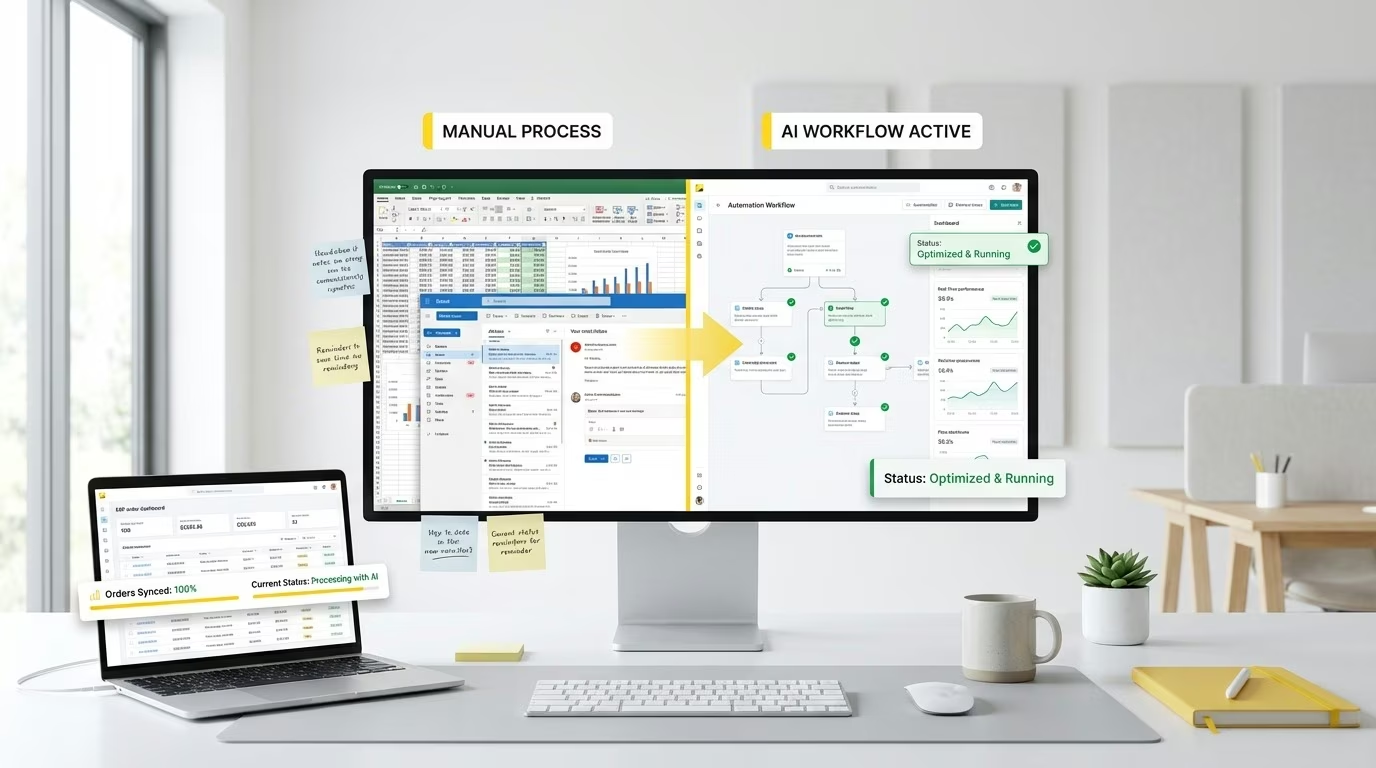
How Does eZintegrations™ AI Document Understanding Automate Packing Lists?
AI-powered extraction: Converts scanned PDFs, Excel, and handwritten lists into structured fields
Contextual understanding: Identifies item hierarchies, packaging structure, and order dependencies
Automated validation: Flags inconsistencies against PO, SO, or invoice data
System sync: Updates ERP, WMS, TMS, and customs systems in real time
Document transformation: Converts unstructured files into machine-readable XML or JSON formats
Result: Faster customs clearance, error-free shipments, and better customer satisfaction.
What Are the Business Benefits of Packing List Document Automation?
Packing list automation provides measurable outcomes across shipping, compliance, and productivity metrics.
Error reduction: Reduces data-entry mistakes by over 90%
Faster processing: Cuts document handling time from hours to seconds
Improved compliance: Ensures regulatory formatting and required data fields
Real-time tracking: Keeps shipping and inventory systems in sync
Fewer returns: Correct items and labels mean fewer order disputes
Customs confidence: Complete and accurate lists reduce red flags
This isn’t just operational efficiency; it’s risk mitigation at scale.
How Is Packing List Automation Linked to Inventory and ERP Systems?
In today’s integrated supply chains, packing lists aren’t standalone files. They’re a critical part of broader fulfillment processes. Automating them ensures seamless ERP and inventory synchronization.
Live inventory sync: Automated systems validate stock against what’s packed
ERP field mapping: Extracted data auto-populates shipment records
TMS coordination: Packing data flows into transportation management systems
Alert systems: Errors or mismatches trigger immediate notifications
Warehouse automation: Packing lists feed into scanning and pick-pack systems
eZintegrations™ enables two-way data flow between documents and platforms, ensuring no part of the supply chain operates in isolation.
What Industries Benefit the Most from Packing List Automation?
Industries with high-volume, high-complexity shipping operations gain the most from automating packing lists:
Manufacturing: Handles thousands of parts with specific serial numbers
E-commerce: Requires rapid order fulfillment and accurate packaging
Pharmaceuticals: Needs regulatory-compliant packing and traceability
Electronics: Involves multi-level assemblies and sensitive components
Automotive: Includes BOM-level precision and international customs
These industries often deal with strict SLAs and costly penalties for late or inaccurate shipments. eZintegrations™ Document Understanding brings intelligent automation with zero code.
Why Are Customs Authorities Prioritizing Digital Packing Lists?
Digital customs clearance processes are accelerating globally. Governments now prefer machine-readable documents for faster risk profiling.
Structured data: Required by customs for automated cargo clearance
HS code validation: Errors here trigger manual inspections
Country of origin rules: Automated packing lists maintain consistency
E-invoicing linkage: Helps customs reconcile invoice and packing list
Audit readiness: Digital logs support faster trade compliance reviews
eZintegrations™ AI Document Understanding ensures packing lists are always customs-ready, formatted to country-specific templates.
What Are the Core Capabilities of eZintegrations™ AI Document Understanding?
Visual Data Extraction: Reads tables, forms, stamps, logos, and handwriting
Context-Aware NLP: Understands item grouping, descriptions, and order logic
Document Classification: Identifies packing lists from mixed file uploads
Prebuilt Templates: Includes standard templates for logistics and supply chain
Integration Hooks: Connects instantly to Oracle, SAP, Netsuite, Salesforce, or custom APIs
Audit Trail: Tracks every transformation, flag, and edit for compliance
All without requiring IT code or developer support.
What Are the Risks of Not Automating Packing Lists?
Delayed shipments: Errors stall logistics and hurt SLAs
Costly returns: Mislabeling or wrong item dispatch leads to customer churn
Customs penalties: Incomplete or inaccurate data causes fines
Inventory misalignment: Wrong counts affect reordering and forecasting
Loss of trust: Repeated errors damage B2B relationships
Enterprises that rely on global distribution can’t afford these risks. Automation turns packing lists from a weak link into a strategic asset.
How to Get Started with eZintegrations™ AI Document Understanding?
Define Key Fields: Select relevant fields like SKU, quantity, weight
Map Systems: Connect to your ERP, WMS, TMS, or customs portals
Train AI Models: Optional fine-tuning for complex formats
Run Tests: Validate results across workflows
Deploy: Go live within days, not months
Try eZintegrations™ AI Document Understanding for free or Book your free demo now.
Conclusion
Packing list document automation is no longer optional for global logistics leaders. The cost of manual errors, from customs delays to broken trust, is too high. With eZintegrations™ AI Document Understanding, organizations gain speed, accuracy, and total visibility across the fulfillment lifecycle. This is not just about reducing costs. It’s about increasing shipping resilience in a world where every delivery matters. Try eZintegrations™ AI Document Understanding for free or Book your free demo now.
FAQ (Frequently Asked Questions)
What is a packing list document?
A packing list is a document that details the contents, quantity, and specifications of items included in a shipment.
Why do shipping errors occur in packing lists?
Errors often arise from manual data entry, inconsistent formats, and lack of validation across systems.
How does document automation help with shipping accuracy?
AI extracts and verifies packing list data, syncing it with ERP and inventory systems to eliminate human errors.
What systems can eZintegrations™ connect to?
eZintegrations™ integrates with SAP, Oracle, NetSuite, Salesforce, and over 1000 enterprise systems via the API marketplace.
Is eZintegrations™ easy to deploy?
Yes, the platform is no-code, with plug-and-play integration. Most businesses go live in days.
 support@bizdata360.com
 +1-650-283-1644
 AI Enabled Data Integrations and Analytics


 Watch Demo
 Post on LinkedIn
 Post on Facebook
 Post on Twitter/X