 support@bizdata360.com
 +1-650-283-1644
 AI Enabled Data Integrations and AnalyticsAI Enabled Data Integrations and Analytics

Enterprises are sitting on mountains of data, but most of it remains locked away in silos. According to the reports, businesses waste 20–30% of their annual revenue due to data quality issues and poor integration.
For global organizations relying on multiple SaaS systems, ERPs, and CRMs, manual data mapping not only consumes time but also creates compliance risks, operational delays, and inconsistent insights.
This is where AI Data Mapping changes the game. In 2026, it’s no longer just a technical process, it’s the backbone of AI-driven workflows that power decision-making, customer engagement, and digital transformation.
If you’re an enterprise leader, IT professional, or data strategist, this guide will help you understand what AI Data Mapping is, why it matters, and how platforms like eZintegrations™ are helping enterprises turn chaotic, disconnected data into intelligent automation.
AI Data Mapping is the process of using artificial intelligence to automatically discover, align, and integrate data across different systems.
Traditional data mapping required manual schema matching and endless IT resources. AI now makes this process dynamic by learning from historical mappings, detecting patterns, and suggesting intelligent connections.
Instead of a repetitive, manual job, AI Data Mapping enables real-time synchronization of customer, financial, or operational data across platforms. This ensures enterprises have a single source of truth for analytics and decision-making.
The role of data in enterprises has shifted from being a support function to a strategic differentiator. However, the challenge lies in managing its volume, velocity, and variety. According to Gartner, 80% of data integration work is still spent on data preparation rather than analysis.
For enterprises, this means teams waste precious time fixing pipelines instead of creating value. AI Data Mapping eliminates these barriers by automating:
In short, it turns data integration from a bottleneck into a competitive advantage.
Enterprises struggle with several recurring issues in traditional data mapping. AI-driven approaches directly address these challenges:
With AI, these pain points are minimized through automation and continuous learning.
AI Data Mapping combines machine learning, pattern recognition, and semantic analysis to connect structured and unstructured data sources. The process typically involves:
This adaptive loop makes AI-driven mapping far more accurate and scalable than manual methods.
Healthcare
Integrating Electronic Health Records (EHR) across hospitals is a massive challenge. AI Data Mapping enables secure, standardized patient data flows for better care coordination and compliance with HIPAA and HL7 standards.
Finance
In financial services, reconciling transaction data across banks, accounting platforms, and regulatory bodies requires precision. AI mapping automates this process, reducing human error and accelerating audits.
E-commerce
Retailers selling across Amazon, Shopify, and ERPs struggle with mismatched product, order, and payment data. AI Data Mapping aligns these sources, giving a unified view of sales and settlement.
Supply Chain
Global manufacturers rely on multiple systems across procurement, logistics, and inventory. AI ensures real-time mapping of data across suppliers, warehouses, and partners for faster decisions.
eZintegrations™ is designed to simplify and scale AI-driven workflows, with AI Data Mapping at its core. Unlike traditional integration tools, it:
For enterprises, this means faster onboarding of systems, reduced IT dependency, and stronger compliance.
A global retail enterprise selling on Amazon Seller Central struggled with reconciling settlement reports across ERP and accounting systems. Manual data mapping meant delays and discrepancies in financial reporting.
By adopting eZintegrations™ AI Data Mapping, the enterprise:
This demonstrates how AI Data Mapping directly impacts operational efficiency and decision-making.
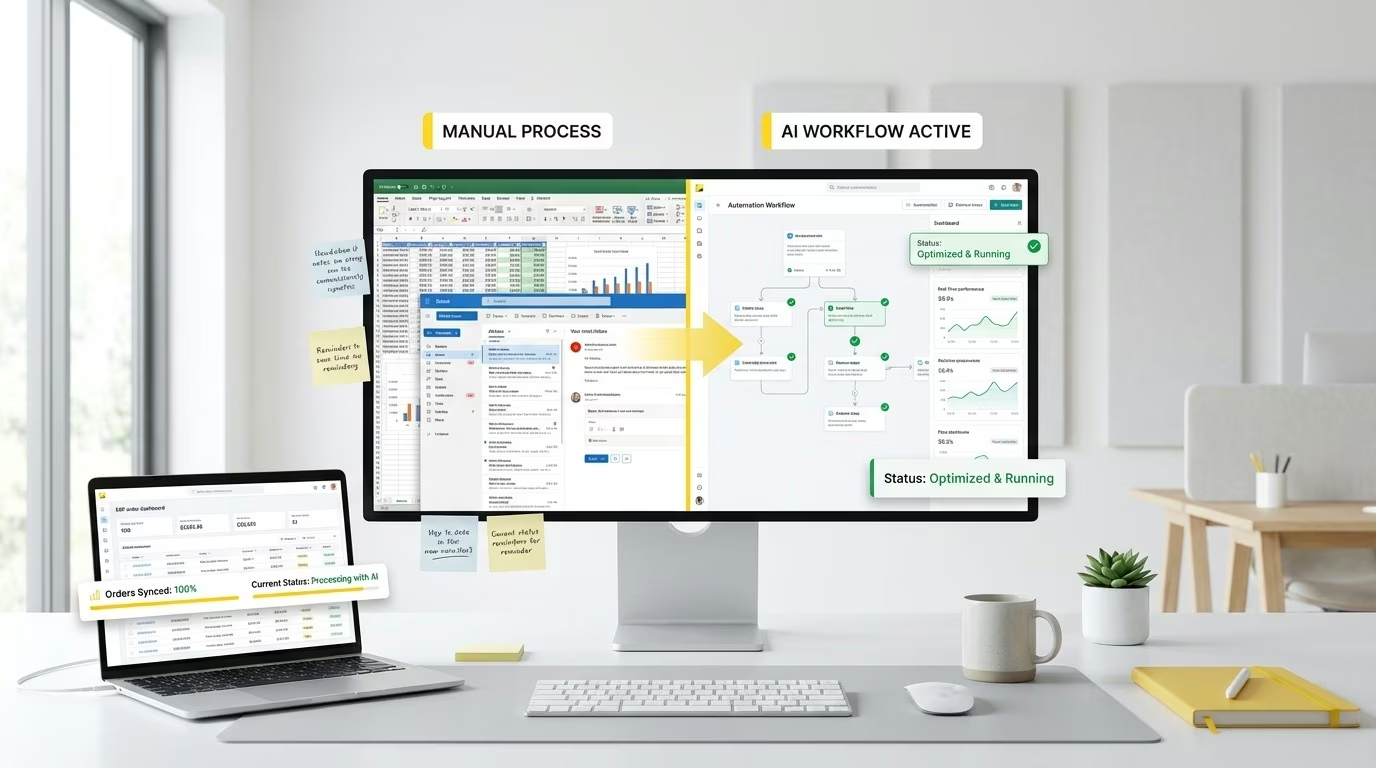
AI Data Mapping is faster, more accurate, and adaptive compared to traditional data mapping. While manual mapping is slow, error-prone, and difficult to scale, AI automates schema alignment, learns from past mappings, and adjusts to changes in real time.
This shift helps enterprises reduce costs, eliminate silos, and make data-driven decisions with confidence.

These trends signal that AI Data Mapping will evolve from being a backend task to a strategic enabler of intelligent enterprises.
Enterprises that continue to rely on manual data mapping are losing both time and opportunities. In 2026, AI Data Mapping is no longer optional, it’s a necessity for staying competitive, compliant, and customer centric.
With eZintegrations™, enterprises gain more than just automation. They unlock intelligent workflows, real-time insights, and a connected ecosystem that scales as they grow.
Ready to experience AI-driven data mapping? Try eZintegrations™ for free or Book a free demo today and see how your enterprise can eliminate silos and accelerate growth.
Q1. What is AI Data Mapping in simple terms?
AI Data Mapping is the process of using AI to automatically align and integrate data across systems, reducing manual effort and errors.
Q2. How is AI Data Mapping different from ETL?
ETL extracts, transforms, and loads data. AI Data Mapping specifically focuses on the schema alignment and relationship-building process, making ETL faster and smarter.
Q3. Is AI Data Mapping secure?
Yes. Platforms like eZintegrations™ support encrypted data transfer, compliance standards, and secure cloud deployment.
Q4. Which industries benefit most from AI Data Mapping?
Healthcare, finance, retail, e-commerce, and supply chain industries are leading adopters due to their complex data ecosystems.
Q5. Does AI Data Mapping require coding?
Not with modern platforms like eZintegrations™. They provide no-code, visual interfaces for mapping.


© Copyright 2026 Bizdata Inc. | All Rights Reserved
 Watch Demo
 Post on LinkedIn
 Post on Facebook
 Post on Twitter/X