 support@bizdata360.com
 +1-650-283-1644
 AI Enabled Data Integrations and AnalyticsAI Enabled Data Integrations and Analytics

Generative AI is no longer experimental. It is quickly moving into production across industries. According to recent reports, nearly half of U.S. employees say their productivity and efficiency have improved thanks to using AI.
Yet many organizations face hurdles when scaling from pilot projects to enterprise-wide adoption. Infrastructure management, unpredictable costs, and data integration challenges are common pain points.
This is where Amazon Bedrock comes in. It provides a fully managed way to access foundation models without the burden of setting up servers or maintaining infrastructure. For business leaders, developers, and IT teams exploring AI applications, Amazon Bedrock is a powerful entry point into generative AI.
Amazon Bedrock is a managed service on AWS that gives you access to a wide range of foundation models from providers like Anthropic, Stability AI, Meta, and Amazon’s Titan models. You interact with these models through a single, consistent API.
In practice, this means teams can build and scale generative AI applications without worrying about GPU provisioning, server management, or complex infrastructure. You choose the model you need, send your request, and receive results.
Amazon Bedrock works by giving you access to multiple foundation models through a single API. Instead of setting up servers or provisioning GPUs, you simply call the Bedrock API, select a model, and send your prompt or data. The service handles heavy lifting behind the scenes.
The workflow typically looks like this:
With Bedrock, the complexity of managing AI infrastructure is removed, making it easier to focus on building applications that deliver real business value.
Amazon Bedrock takes away the need to manage infrastructure. With just an API call, you can generate text, build agents, or work with embeddings. This drastically lowers the barrier to entry for enterprises experimenting with generative AI.
Depending on the use case, you can select from Amazon’s Titan models, Anthropic’s Claude, Stability AI’s text-to-image models, or others. This flexibility ensures that you are not locked into a single model provider.
Amazon Bedrock includes important tools:
AgentCore is a modular framework that helps you design agents with components such as memory, runtime, and observability. Flows provides a visual interface to connect prompts, guardrails, and knowledge bases in a simple drag-and-drop style. Together, they help build more sophisticated agent workflows.
Amazon Bedrock pricing offers three main options:
Fine-tuning, embeddings, and storage are billed separately, which makes cost planning essential.
Organizations often spend significant resources managing servers for AI workloads. Amazon Bedrock eliminates this with its fully managed service.
Experimentation with AI can become expensive quickly. Bedrock’s flexible pricing allows teams to start small and scale up as demand grows.
Generative AI systems can produce biased or unsafe outputs. Bedrock’s Guardrails feature reduces this risk, making results safer and more reliable.
Building intelligent agents usually requires complex coding. AgentCore and Flows simplify this by providing pre-built modules and a visual workflow builder.
Most enterprises need to connect AI to their own data sources. Bedrock integrates with knowledge bases and retrieval-augmented generation, but eZintegrations™ makes this process seamless and automated.
While Amazon Bedrock provides models and tools, many enterprises struggle with data pipelines. That is where eZintegrations™ adds value.
This combination allows businesses to create AI systems that are accurate, up to date, and scalable.
Amazon Bedrock provides enterprises with a scalable way to harness generative AI without heavy infrastructure investments. It enables quick experimentation and safe deployment, while reducing costs and risks.
By pairing Bedrock with eZintegrations™, businesses unlock an end-to-end AI workflow that automates data integration, orchestrates knowledge bases, and maintains governance. This combination ensures AI projects scale smoothly and delivers measurable results.
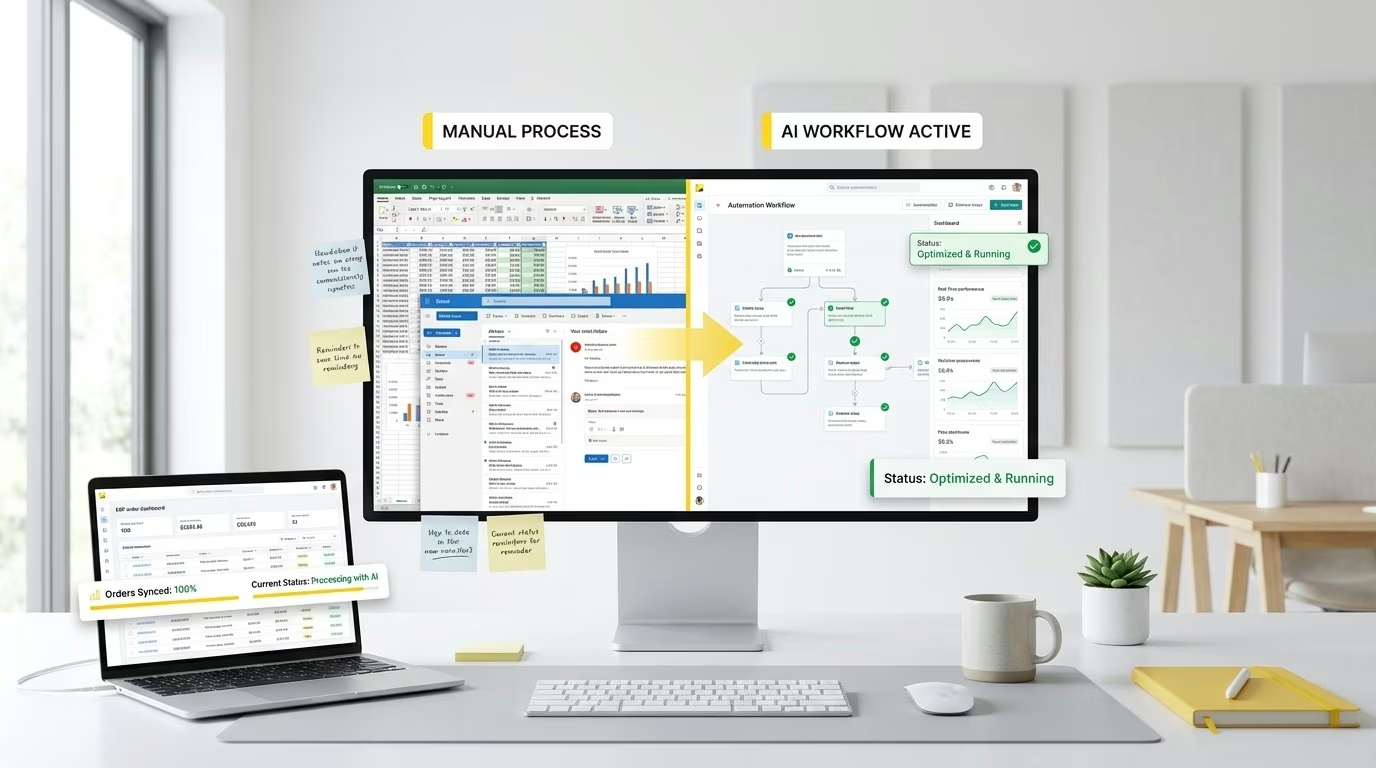
Ready to see it in action? Book a free demo of eZintegrations™ today and experience how AI workflow automation can transform your business.
Q1: What is Amazon Bedrock used for?
Amazon Bedrock is used to build and scale generative AI applications without managing servers.
Q2: How does Amazon Bedrock compare to SageMaker?
Bedrock focuses on providing ready-to-use foundation models, while SageMaker is designed for training and deploying custom machine learning models.
Q3: What is Amazon Bedrock pricing?
Pricing is flexible with on-demand, batch, and provisioned throughput options, plus additional charges for fine-tuning, embeddings, and storage.
Q4: What is Amazon Bedrock AgentCore?
As per AWS Documentation, AgentCore is a modular toolkit for building AI agents with identity, memory, runtime, and monitoring built in.
Q5: Where can I find Amazon Bedrock documentation?
AWS provides full documentation on how to use Bedrock models, APIs, agents, and features.
Q6. What does Amazon Bedrock do?
Amazon Bedrock provides access to industry-leading foundation models (FMs) and tools to build, customize, and deploy Gen-AI applications without managing infrastructure.


© Copyright 2026 Bizdata Inc. | All Rights Reserved
 Watch Demo
 Post on LinkedIn
 Post on Facebook
 Post on Twitter/X