 support@bizdata360.com
 +1-650-283-1644
 AI Enabled Data Integrations and AnalyticsAI Enabled Data Integrations and Analytics

## TL;DR
The debate between ERP Integration and Point-to-Point Integration has been ongoing for years. While Point-to-Point may seem simple at first, it quickly becomes unmanageable as businesses grow. ERP Integration provides a centralized, scalable solution that improves efficiency and accuracy. In this post, we’ll break down the differences, highlight the benefits of ERP Integration, and show how **eZintegrations** helps businesses gain a competitive edge.
## Introduction
According to Gartner, *“Enterprise resource planning (ERP) integration is a critical component of digital transformation.”*
Yet, many organizations still face a tough decision: whether to adopt a modern ERP Integration platform or rely on traditional Point-to-Point connections. This choice can have a long-lasting impact on efficiency, scalability, and overall business performance.
In this article, we’ll explore the challenges of Point-to-Point Integration, the advantages of ERP Integration, and how **eZintegrations** empowers businesses to streamline operations.
### Challenges of Point-to-Point Integration
At first glance, Point-to-Point Integration seems cost-effective and simple. However, as more systems are added, the complexity grows exponentially. Each new connection increases maintenance requirements, security risks, and the chances of human error.
This approach often leads to “integration spaghetti,” where businesses struggle to manage dozens of fragile connections between applications. Ultimately, Point-to-Point is not scalable for long-term digital growth.
### Benefits of ERP Integration
ERP Integration centralizes all connections within a single platform. Instead of managing dozens of one-to-one integrations, businesses rely on a unified hub that connects every system efficiently.
This streamlined approach reduces duplication, minimizes errors, and allows for easier scaling as the organization grows. Most importantly, ERP Integration enhances data visibility across the enterprise, enabling smarter, data-driven decision-making.
## Solutions
So, how can businesses leverage ERP Integration effectively? The answer lies in **eZintegrations**.
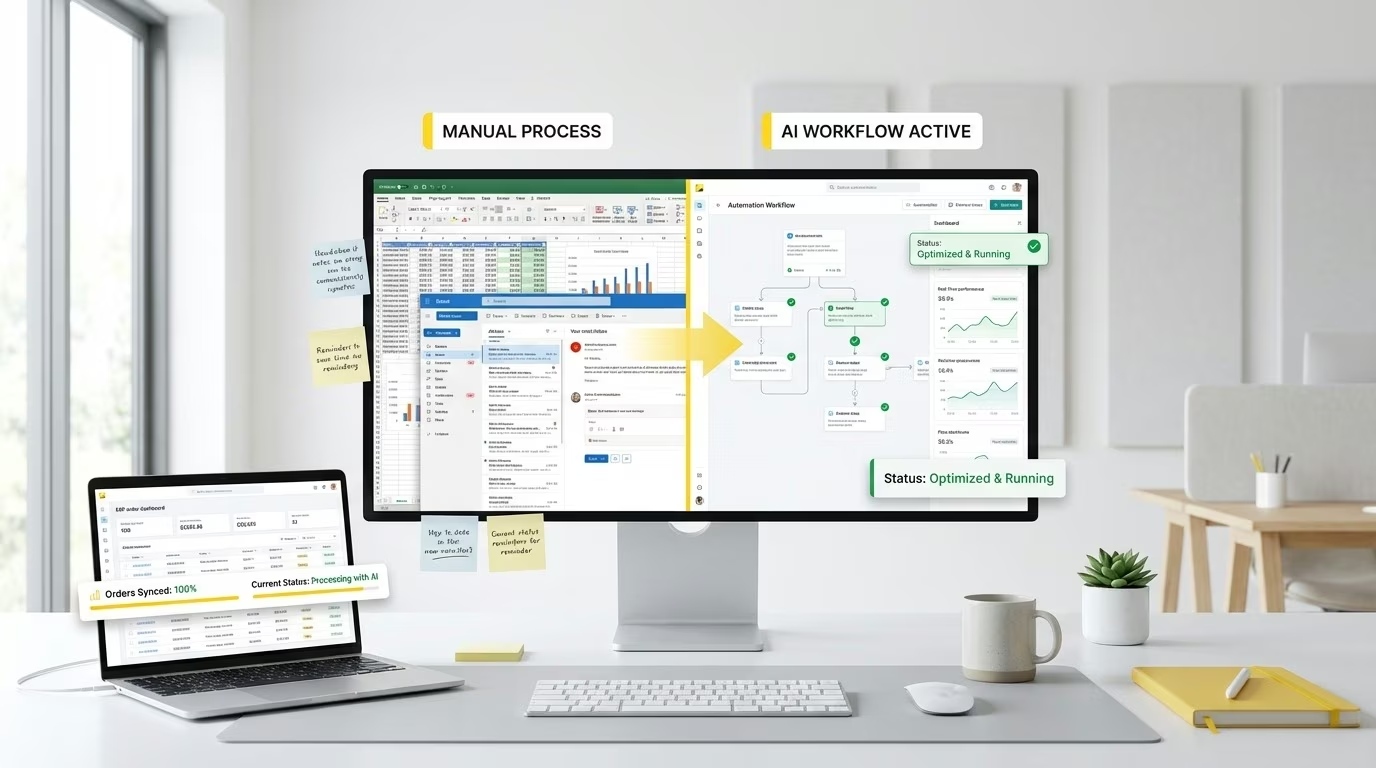
With eZintegrations, companies can automate complex workflows, reduce manual errors, and maintain real-time data synchronization across multiple systems. This ensures that business leaders always have access to accurate and up-to-date information, improving responsiveness and competitiveness.
### Step-by-Step Guide to ERP Integration with eZintegrations
Here’s a practical roadmap to adopting ERP Integration successfully:
* **Step 1:** Define your integration requirements and business objectives.
* **Step 2:** Select the right integration platform — prioritize scalability, security, and automation.
* **Step 3:** Implement and thoroughly test integrations to ensure seamless operations.
By following these steps, businesses can transition smoothly from fragmented Point-to-Point setups to a robust ERP Integration framework.
### Benefits of Using eZintegrations
With **eZintegrations**, organizations can:
* Eliminate manual errors through automation
* Improve operational efficiency and productivity
* Reduce IT costs by replacing multiple fragile connections with one stable hub
* Gain real-time visibility across all business systems
* Enhance customer satisfaction with faster, more reliable processes
## Benefits of ERP Integration
Some key business-wide advantages of ERP Integration include:
* **Improved efficiency** — streamlined workflows save time and resources
* **Increased accuracy** — centralized data reduces duplication and errors
* **Enhanced customer satisfaction** — faster processes and reliable data improve customer experiences
* **Better scalability** — businesses can expand seamlessly without reworking integrations
### Comparison of ERP Integration and Point-to-Point Integration
| Integration Method | Benefits | Drawbacks |
| — | — | — |
| **ERP Integration** | Centralized hub, efficiency, scalability, increased accuracy | Higher upfront investment |
| **Point-to-Point Integration** | Lower initial cost, simple for very small setups | Not scalable, error-prone, hard to maintain |
## Conclusion
While Point-to-Point Integration may work for small setups, it quickly becomes a bottleneck as businesses scale. ERP Integration, particularly with **eZintegrations**, provides a future-proof solution that enhances efficiency, accuracy, and scalability.
Businesses that embrace ERP Integration position themselves for long-term growth, innovation, and customer success.
## Call to Action
Ready to simplify your integrations and unlock growth? [Click here to learn more about eZintegrations](https://www.ezintegrations.com?utm_source=website&utm_medium=blog&utm_campaign=ai_document_understanding&utm_content=erp-integration-vs-point-to-point-integration).
## FAQ
**Q: What is ERP Integration?**
ERP Integration is the process of connecting multiple business systems into a centralized platform for efficiency, accuracy, and scalability.
**Q: What are the benefits of using eZintegrations?**
eZintegrations offers automation, real-time synchronization, improved accuracy, and reduced IT complexity.
**Q: How do I get started with eZintegrations?**
Simply define your integration requirements, select the platform, and implement and test your integrations with the support of eZintegrations’ expert tools.
**Q: What is the difference between ERP Integration and Point-to-Point Integration?**
ERP Integration connects all systems into one hub, ensuring efficiency and scalability, while Point-to-Point connects systems individually, making it difficult to maintain as the business grows.


© Copyright 2026 Bizdata Inc. | All Rights Reserved
 Watch Demo
 Post on LinkedIn
 Post on Facebook
 Post on Twitter/X