In 2026 enterprises are drowning in data. Worldwide data creation is projected to hit 181 zettabytes this year, rising by over 20% annually as organizations shift to cloud, IoT, and AI-first infrastructure. (Source) Amidst this deluge, many firms struggle to process, integrate and make usable sense of their data at speed. If you have large data lakes, disparate systems, or plan to power AI-driven analytics, understanding the ETL vs ELT difference is not optional; it is critical. This post is for data and analytics leaders, architects, and decision makers evaluating which data integration strategy will support modern AI workflows. In this blog we will explain what ETL and ELT are, inspect their pros and cons, show when each fits best (especially in AI contexts), and help you choose wisely for your data stack with a view toward automation, scalability, and leveraging a platform like eZintegrations™ to reduce complexity and accelerate results.
Key Takeaways
ETL (Extract, Transform, Load) moves transformed data into a target store, while ELT (Extract, Load, Transform) loads raw data before transforming each has strengths depending on data volume, speed requirements, and target architecture.
For traditional BI, structured data sources, and controlled pipelines, ETL remains reliable. For large, diverse, cloud-native datasets and AI/ML workloads, ELT often fits better.
A hybrid approach or modern integration platform like eZintegrations™ can combine the best of both, enabling scalable, maintainable, and automated AI workflows.
The right choice depends on data volume, latency needs, transformation complexity, compliance requirements, and downstream use (real-time analytics, AI training, reporting).
What is ETL vs ELT Definition?
What is ETL?
ETL stands for Extract, Transform, Load:
Extract data from source systems (databases, logs, applications).
Transform data into a clean, structured, analytics-ready format (normalize, cleanse, standardize).
Load the transformed data into a target system (data warehouse, analytics store).
This model has been widely used in traditional data warehousing for decades. It ensures that only clean, structured, reliable data lands in the warehouse are ready for reporting and analysis.
What is ELT?
ELT stands for Extract, Load, Transform:
Extract data from sources.
Load raw or minimally processed data directly into a data lake or data warehouse.
Transform data after loading, often leveraging the target system’s compute power (for example SQL-on-data-lake engines or scalable data warehouse compute resources).
With ELT, you keep the raw data in its original form, enabling flexibility for different transformation logic, later ideal for agile analytics and AI/ML experimentation.
Why ETL vs ELT Comparison Matters for Modern Data Demands?
Why data growth and AI require rethinking traditional data pipelines
Global data generation is exploding, and organizations are increasingly storing data in cloud environments.
Many firms adopt multi-cloud strategies and use a mix of structured, semi-structured, and unstructured sources (logs, events, IoT data, JSON, CSV, streaming data). According to industry reports, cloud-based ETL/ELT deployments have dominated and grown significantly.
For AI/ML workflows, you often need to retain raw data and apply different transformations for training, feature engineering, enrichment, or historical analysis something ELT supports more naturally than traditional ETL.
Why does choosing the right approach affect speed, cost, flexibility, and future readiness?
ETL pipelines may become bottlenecks when data volume increases dramatically or when you must support many different downstream consumers.
ELT allows storing raw data once, then transforming as needed which supports agility, iterative analytics, and AI workflows where transformation logic evolves over time.
A misfit for example, using ETL where ELT would be better can lead to slow pipelines, inflexibility, duplicated data, and maintenance overhead.
ETL vs ELT Pros and Cons
ETL Pros
Guarantees clean, transformed data into warehouses before loading ensures consistency and reliability.
Well-suited for structured data and regular reporting / BI workloads.
Tight control over transformations and data quality before data storage.
Historically mature tooling and processes, well understood by data teams.
ETL Cons
Takes time: transformation before loading can slow pipelines, especially with large or complex datasets.
Less flexible: once data is transformed and loaded, reprocessing raw data requires going back to sources or re-extracting.
Not ideal for unstructured/semi-structured data or evolving schema scenarios.
Harder to scale when data volume and velocity increase dramatically.
ELT Pros
Scalable and flexible: raw data loaded quickly; transformation can be scaled with compute resources in modern data warehouses or data lakes.
Supports diverse data types structured, semi-structured, unstructured, common in AI/ML workflows.
Enables agile analytics, experimentation, iterative feature engineering, and multiple transformation logic based on use case.
Reduces upfront pipeline complexity; faster ingestion of raw data which matters under heavy volume or real-time needs.
ELT Cons
Data lake / warehouse may accumulate raw/untransformed data (“data swamp”) if not managed carefully.
Requires target systems with sufficient compute and storage capabilities.
Without proper governance, data quality issues or schema inconsistencies may propagate downstream.
Transformations deferred until load means analytics-ready data is not immediately available.
When to Use ETL vs ELT in AI and Big Data Use Cases
When to use ETL
Use ETL when your source data is structured, stable, and relatively small to medium volume.
When your primary need is reliable, clean data for BI dashboards and regular reporting.
When compliance, governance, and data quality are critical, you want strict control over transformations before storing.
When using legacy data warehouses or on-premises infrastructure that may not efficiently handle raw load transformations.
When to use ELT
When ingesting large volumes of data at high velocity logs, events, IoT, streaming data, user-generated content, semi/unstructured data.
When you need flexibility for multiple use cases, analytics, data science, AI/ML training, and ad-hoc exploration.
When your target data warehouse or data lake offers scalable compute and storage (cloud-native, elastic).
When you expect transformation logic to evolve, or you want to preserve raw data for future reprocessing or for new use cases.
Example: ELT for AI Workflow
Suppose your company collects user behavior logs, application events, third-party data feeds, and CRM data. Using ELT, you:
Extract and load raw data into a cloud data lake (fast ingestion).
Later, apply transformations to curate training datasets, build features for machine learning models, or run analytics.
Retain original raw data so you can re-run transformations later with updated logic or new models.
This approach gives flexibility and speed for AI workflows exactly what modern data-driven companies need.
Real-World Trends Supporting ELT and Cloud-Native Data Integration
The data integration market is growing. The broader data integration market (which includes ETL and ELT) is expected to grow from about USD 17.58 billion in 2026 to USD 33.24 billion by 2030.
Cloud-based ETL/ELT deployments capture a majority share in modern data stacks, with about 66.8% market share in 2024 for cloud-based deployments.
Rapid data growth as seen in global data volume projections makes it impractical to rely solely on traditional ETL for AI-scale workloads.
Given these trends, modern businesses increasingly prefer ELT or hybrid models, especially when combining data integration with AI and machine learning workflows.
How eZintegrations™ Can Simplify ETL vs ELT Strategy
eZintegrations™ address modern data challenges and optimize AI-driven workflows. Here is how our platform helps you navigate the ETL vs ELT decision and implement scalable, maintainable data pipelines:
eZintegrations™ supports both ETL and ELT workflows giving you flexibility to choose the right approach per use case.
For large-scale data ingestion (logs, events, IoT, user behavior) we enable efficient ELT pipelines that load raw data quickly into cloud data lakes or warehouses.
Built-in transformations, orchestration, and automated data quality checks ensure that transformed data meets analytics, BI, and AI-training requirements.
Our platform is cloud-native and scalable, so compute and storage scale automatically with load perfect for big data and AI workflows.
For structured data use cases requiring clean, curated data warehouses (e.g. regulatory compliance, reporting) we support traditional ETL pipelines.
eZintegrations™ provides visibility, governance, and pipeline management preventing the “data swamp” risk common with unmanaged ELT.
By using eZintegrations™, companies can adopt a hybrid ETL/ELT strategy, aligned with business needs, data types, and future AI ambitions without overbuilding or locking into outdated architectures.
ETL vs ELT Architecture: Comparison
This architecture comparison helps decision makers quickly assess which path ETL or ELT aligns better with their data strategy.
When ETL vs ELT Which Is Better?
There is no one-size-fits-all answer. The right choice depends on your data volume, variety, velocity, transformation complexity, downstream use cases, storage and compute architecture, governance needs, and AI/analytics strategy. You should evaluate:
How much data do you generate daily or weekly (MB, GB, TB, PB)?
Are your data sources structured, semi-structured, or unstructured?
Do you need raw data retention for future reprocessing?
What is the target infrastructure: an on-premises warehouse, cloud data lake/warehouse, or hybrid?
What are the speed and latency requirements for ingestion, reporting, and AI model training?
How many different downstream consumers (BI, AI, ML, analytics) will use transformed data?
What is your governance, compliance, and data quality requirements?
If you require flexibility, scalability, and AI/ML readiness, ELT is likely better. If you need controlled, clean, governance-ready data for reporting, ETL remains viable. For many modern enterprises, a hybrid approach (ETL for some sources, ELT for others) is optimal.
How to Move Forward with ETL or ELT?
In the era of big data and AI-driven analytics, understanding the ETL vs ELT difference is no longer just academic. It is a foundational decision that shapes your data architecture, performance, scalability, and future flexibility. For many modern enterprises, especially those dealing with large, diverse, cloud-native datasets and AI workflows, ELT often emerges as the more scalable, flexible, and future-ready approach. However, ETL remains relevant in scenarios requiring structured data, strict governance, and stable reporting pipelines. With a versatile integration platform such as eZintegrations™, you do not need to choose strictly between ETL or ELT. You can implement both approaches as needed to build data pipelines that are clean, efficient, scalable, and AI-ready. If you are ready to transform your data infrastructure, streamline pipelines, and jumpstart intelligent analytics or AI workflows, we invite you to book a quick demo of eZintegrations™ today and see how easy data integration can become. Recommend Blogs:
What is ELT vs ETL? ELT (Extract, Load, Transform) loads raw data into the warehouse or data lake before transforming it. ETL (Extract, Transform, Load) transforms data first and then loads only the clean, structured data into the target store.
ETL vs ELT: Which one is better for big data? For big data with high volume, variety, velocity, and especially when dealing with unstructured or semi-structured data, ELT is usually better because it allows fast ingestion, scalability, and flexible transformation.
When to use ELT vs ETL? Use ELT when you need to ingest large raw datasets quickly, support AI/ML workflows, or maintain raw data for future reprocessing. Use ETL when data is structured, stable, and you need clean, governance-ready, analytics-ready data for BI and reporting.
When to use ETL? You should use ETL for structured, stable data sources; when data quality, governance, and transformation control are important; and when the target architecture expects clean data (e.g. traditional data warehouse, compliance).
What is the ETL vs ELT difference? The difference lies primarily in where and when transformation occurs: ETL transforms before loading while ELT loads raw data and transforms afterward. As a result, ELT tends to offer greater flexibility and scalability.
 support@bizdata360.com
 +1-650-283-1644
 AI Enabled Data Integrations and Analytics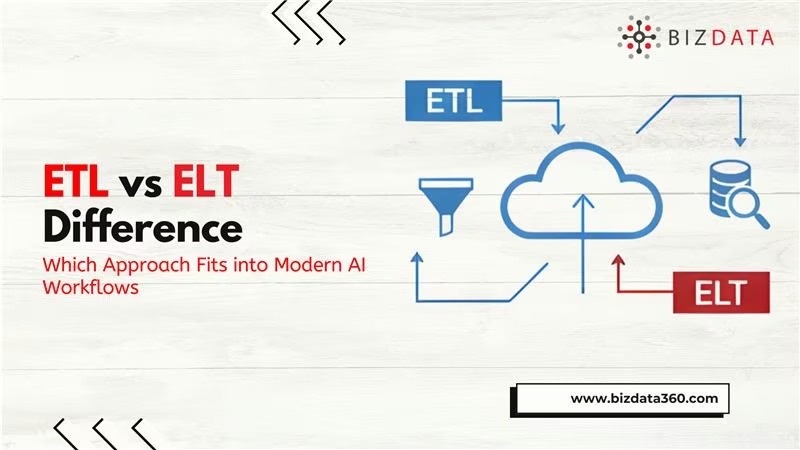


 Watch Demo
 Post on LinkedIn
 Post on Facebook
 Post on Twitter/X