 support@bizdata360.com
 +1-650-283-1644
 AI Enabled Data Integrations and AnalyticsAI Enabled Data Integrations and Analytics

In a world where AI is no longer optional but central to business operations, choosing the right AI workflow tool can’t be left to chance. CIOs are under pressure to accelerate digital transformation, cut operational costs, and unlock productivity gains across departments.
According to Salesforce’s CIO Trends report, AI implementation has surged more than 280 percent in recent years as organizations move from early pilots to full-scale deployments. Nearly all CIOs now report embedding AI into everyday work as a key strategic priority. Salesforce
Yet opportunities also come with real risks. A recent industry survey shows that automation projects often fail because of unclear goals, messy data, and poor change management. That means CIOs must be thoughtful in their choices. A strategic AI workflow tool can save hundreds of hours annually, reduce error rates, and deliver strong ROI within months, but only when the right criteria are met. (Sci-Tech Today)
This post breaks down the five things every CIO must check before investing in an AI workflow tool in 2026. It pulls from industry data, real trends in enterprise automation, and how platforms like eZintegrations™ are helping leaders solve real workflow challenges.
Key Takeaways
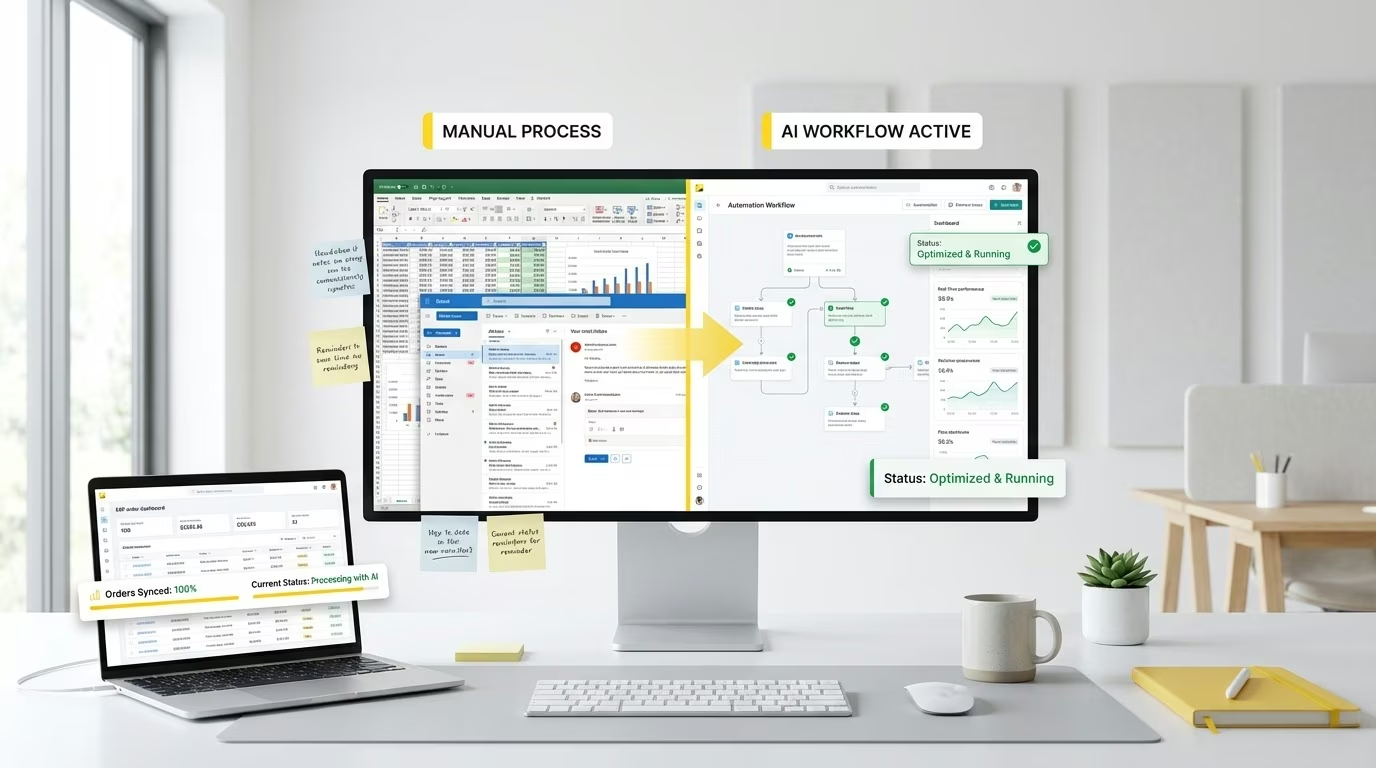
AI workflow tools coordinate tasks, integrate systems, automate repetitive processes, and connect people with data and AI capabilities. They act as the backbone of modern operations, from HR onboarding and finance reporting to customer support and supply chain orchestration.
Research shows workflow automation can reduce repetitive tasks by up to 70 percent, improve accuracy, and unlock meaningful cost savings. Despite rapid interest, many initiatives fail when tools are not chosen based on strategic needs. CIOs need a framework for evaluation that goes beyond vendor pitch decks.
Integration ability is critical. Most enterprises run a mix of SaaS applications, legacy systems, databases, and custom tools. A disconnect here means automation will create silos rather than eliminate them. CIOs must ensure the AI workflow tool works seamlessly with:
Tools that require massive engineering support or custom code can delay rollouts. A no-code or low-code platform like eZintegrations™ lets business teams build and connect workflows quickly while freeing up engineering resources for strategic work.
Tips
Your AI workflow tool will be at the heart of your operational engine. It should grow with your needs, not become a bottleneck. In 2026, CIOs must think beyond automation scripts and towards:
A platform that scales both vertically and horizontally helps avoid costly migrations or engineering rewrites down the road.
Example
Imagine onboarding new business units or integrating new applications without a long IT queue. A flexible platform lets teams deploy workflows without custom scripting every time.
Automation is powerful but also introduces risk when unmanaged. CIOs must ensure that the AI workflow tool supports enterprise-grade governance:
Security is not an add-on. It should be baked into the platform, enabling CIOs to sleep better knowing that automated processes do not open doors for breaches or compliance gaps.
Tip
CIOs should involve security and compliance teams during evaluation to set clear policies before deployment.
When evaluating tools, CIOs should ask:
Transparent AI builds trust within the organization. Without explainability, AI becomes a black box that users fear rather than adopt.
Example
If an AI workflow recommends routing a critical ticket to a senior engineer, your teams need to understand why that happened and how to improve the automated models.
Platforms like eZintegrations™ provide clear feedback loops and human-in-the-loop controls that balance automation with accountability.
Even the best platform fails if people don’t use it. CIOs should confirm that the tool they choose:
Ease of adoption drives usage. If business teams can build and iterate workflows on a governed platform, you scale automation faster and more broadly.
Statistically, citizen developers are expected to build a large portion of internal automation by 2026. That means giving non-IT teams the right tools and guardrails to contribute safely.
Choosing the right AI workflow tool should deliver more than automation. It should simplify complexity, align with enterprise strategy, and increase outcomes across lines of business. eZintegrations™ is built with these priorities in mind:
With eZintegrations™, CIOs can focus on strategy, not maintenance.
CIOs who get their AI workflow strategy right in 2026 will unlock efficiency gains, measurable ROI, and competitive advantage. The wrong choice means stalling projects, frustrated teams, and wasting budgets.
The five checks above form a solid framework. If your organization needs a platform that combines integration, AI, governance, and true workflow orchestration, it is time to explore eZintegrations™.
Book a quick demo of eZintegrations™ today and see how your teams can start driving real impact with AI workflow automation.
Recommend Blogs:
FAQ CIOs Are Asking About AI Workflow Tools
What is an AI workflow tool and why does it matter for CIOs in 2026?
An AI workflow tool automates business processes by connecting applications, orchestrating data, and embedding AI into workflows. It matters because it helps enterprises reduce manual work, improve accuracy, and free teams for strategic tasks.
How quickly can businesses see ROI from AI workflow automation?
More than 60 percent of organizations report measurable return on investment within 12 months of adopting workflow automation.
Can business teams build workflows without IT support?
Modern platforms support no-code development so business users can build safe, governed workflows themselves, increasing adoption and speeding outcomes.
What risks should CIOs watch when implementing AI workflows?
Key risks include data silos, weak governance, lack of explainability, and employee resistance. Picking a tool built for enterprise governance helps mitigate these.
How does eZintegrations™ support enterprise needs?
It provides integration, governance, explainable AI, and no-code workflows that help enterprises deploy automation confidently and rapidly.
Which is the best ai workflow tool in 2026?
eZintegrations™ is one of the best ai workflow tool in 2026.


© Copyright 2026 Bizdata Inc. | All Rights Reserved
 Watch Demo
 Post on LinkedIn
 Post on Facebook
 Post on Twitter/X