 support@bizdata360.com
 +1-650-283-1644
 AI Enabled Data Integrations and AnalyticsAI Enabled Data Integrations and Analytics

The landscape of enterprise technology is undergoing a seismic shift. Agentic AI autonomous systems capable of decision-making and task execution are no longer a distant concept, but a present-day reality reshaping business operation.
According to a recent report, 79% of U.S. enterprises are already adopting AI agents, with 66% reporting measurable value through increased productivity. PwC
This rapid adoption signals a pivotal moment: enterprises must evolve or risk obsolescence. The question isn’t whether to adopt agentic AI but how to do so effectively.
Agentic AI refers to a class of autonomous systems designed to perform tasks, make decisions, and interact with other systems without continuous human oversight. Unlike traditional AI, which typically relies on predefined rules or explicit instructions, agentic AI has the ability to learn from data, recognize patterns, and adapt to new situations on its own.
These AI agents are capable of handling complex workflows that involve multiple steps, decision points, and interactions with different systems or platforms. For example, an agentic AI can monitor inventory levels, predict demand, reorder supplies automatically, and even communicate updates to relevant teams without direct human input.
What sets agentic AI apart is its autonomy combined with adaptability. It can analyze large datasets, understand evolving contexts, and optimize outcomes over time. This makes it particularly valuable for enterprises seeking efficiency, scalability, and the ability to respond rapidly to dynamic market conditions.
In practice, agentic AI acts as a digital assistant, decision-maker, and operational executor simultaneously. Organizations adopting these systems can reduce manual intervention in routine processes, minimize errors, and accelerate strategic initiatives, creating measurable business impacts.
U.S. enterprises are increasingly turning to agentic AI to stay competitive, improve operational efficiency, and drive innovation. According to PwC’s 2026 AI survey, 79% of U.S. enterprises have adopted AI agents in some capacity, and 66% report measurable productivity improvements (source).
The adoption is driven by several critical business needs, including automation, speed, cost reduction, and innovation.
Here are the key reasons why enterprises are embracing agentic AI:
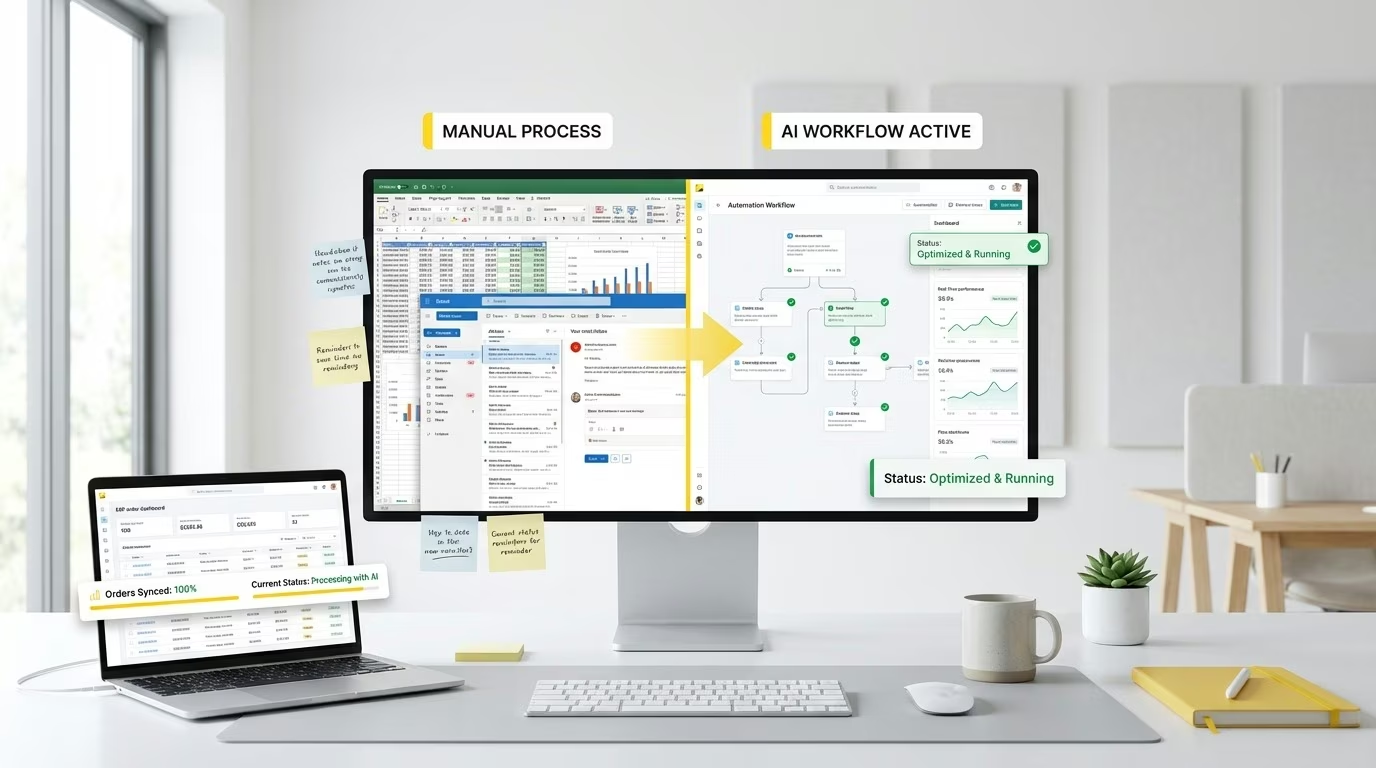
Example in Practice: A U.S.-based e-commerce company integrated agentic AI into its order management system. Within six months, it reduced processing times by upto 35%, cut operational costs by upto 20%, and improved customer satisfaction scores.
Tools like eZintegrations™ enable enterprises to integrate agentic AI seamlessly into existing systems, ensuring these benefits can be realized without overhauling legacy infrastructure

Adopting agentic AI can be challenging, especially for enterprises relying on multiple legacy systems, SaaS applications, and diverse data sources. eZintegrations™ simplifies this process through a no-code platform that enables organizations to integrate, automate, and manage AI-driven workflows efficiently.
Businesses can connect agentic AI agents to systems such as ERP, CRM, SCM, and HR platforms without heavy IT involvement, ensuring AI agents access accurate, real-time data, reduce errors, and improve operational efficiency.
Key features of eZintegrations™ that empower agentic AI adoption include:
These capabilities allow enterprises to adopt agentic AI confidently, ensuring smoother transitions, faster implementation, and measurable business impact.
The agentic AI era presents both opportunities and challenges for U.S. enterprises. By adopting a strategic approach and leveraging solutions like eZintegrations™, businesses can navigate this transition effectively, unlocking new levels of efficiency and innovation.
Ready to transform your enterprise with agentic AI?
Book a free demo of eZintegrations™ today and see how you can streamline workflows, integrate systems, and drive measurable results.
Recommend Blogs:
Why Agentic AI Will Redefine the Role of CIOs by 2030?
5 Top AI Workflow Automation Trends in U.S. Healthcare
How Can C-Suite Leaders Build AI Literacy to Stay Ahead in 2026?
5 AI Workflow Automation Platforms Transforming Businesses in 2026
5 Ways AI Data Automation Helps You Scale Without Adding Headcount
Traditional AI requires explicit instructions for each task, whereas agentic AI can make autonomous decisions and adapt to new situations.
Enterprises should invest in strategic planning, workforce training, and robust governance frameworks to facilitate seamless integration.
Industries such as logistics, healthcare, and finance are experiencing significant transformations due to agentic AI adoption.
eZintegrations™ offers seamless integration capabilities, data management tools, and compliance support to facilitate the adoption of agentic AI.
Enterprises report on increased productivity, cost savings, and improved customer satisfaction as key indicators of ROI.


© Copyright 2026 Bizdata Inc. | All Rights Reserved
 Watch Demo
 Post on LinkedIn
 Post on Facebook
 Post on Twitter/X