 support@bizdata360.com
 +1-650-283-1644
 AI Enabled Data Integrations and AnalyticsAI Enabled Data Integrations and Analytics

In the fast-moving world of finance, manual processes are simply too slow, too risky, and too costly. According to recent research, 88% of organizations now use AI in at least one business function, up from 78% a year earlier.
For finance teams this matters because the stakes are higher than ever: regulatory pressure, real-time stakeholder expectations and a growing volume of transactions all demand smarter workflows. If your finance function is still grounded in spreadsheets, email-chains, and siloed approvals, you’re facing delays, errors, and compliance gaps.
This guide is for finance leaders in the USA who want to harness AI workflow automation for finance to reduce costs, improve accuracy, and turn operations into a strategic advantage.
AI workflow automation for finance refers to using artificial intelligence, machine learning, intelligent document processing and workflow orchestration tools to transform how financial processes are run. Instead of humans manually routing documents, extracting data, checking compliance, and making decisions, the system uses AI to:
For example, instead of a staff member manually reviewing 500 vendor invoices each week, an AI workflow tool can extract line-item data, match it to purchase orders, route it for approval, and update the ledger all with minimal human involvement. That shift frees the finance team to focus on analysis, exceptions, and strategic decisions.
Recent research shows finance departments are increasingly using AI: a global McKinsey survey found 44% of CFOs said their organization used generative AI for more than five use cases in 2026.
The “why” has become urgent for finance teams. Here are the main pressure points and how AI workflow automation addresses them.
Finance teams today cope with higher transaction volumes, multiple data sources, real-time demands, and stricter regulatory regimes. Traditional manual workflows simply cannot keep pace.
Despite the automation of rhetoric, a significant part of finance is still manual. For instance, in a 2026 survey, nearly 49% of finance departments still operated with zero automation at all.
Manual entry leads to rateables errors, delayed approvals, and audit deficiencies. AI workflows reduce human error, standardize approvals, and provide audit trials.
Finance teams increasingly need to deliver insights, forecasts, and guidance rather than just transactions. Automation frees capacity so finance professionals can shift into strategy, analysis and value-added roles.
Companies that automate workflows effectively are seeing better outcomes. A survey found that organizations redesigning workflows with AI are more likely to generate growth and innovation, not just efficiency.
Let’s break down what happens from process selection to scaling.
Focus on where you’ll get the most ROI. For example:
Document the process steps: inputs, decision points, approvals, downstream systems. Identify bottlenecks and manual hand-offs.
Key features to look for:
This is where a platform like eZintegrations™ becomes relevant. It offers no-code workflow building, supports integrations across systems, and allows you to bring your own APIs.
Define trigger points (e.g., invoice received), extraction rules, approval logic, system updates, and exception-handling paths. Include human-in-the-loop if required.
Run a pilot with one workflow. Track metrics like processing time reduction, error rate, cost savings, and user satisfaction.
Once success is proven, scale across other workflows. Establish a centre of excellence, standardized governance, and continuous improvement. Monitoring is critical.
Here are tangible advantages you’ll see when done right:
For instance, research into workflow automation shows that 94% of companies perform repetitive tasks and automation improved productivity for 66% of them.
Here’s how your finance team in the USA can benefit from eZintegrations™ when applying AI workflow automation.
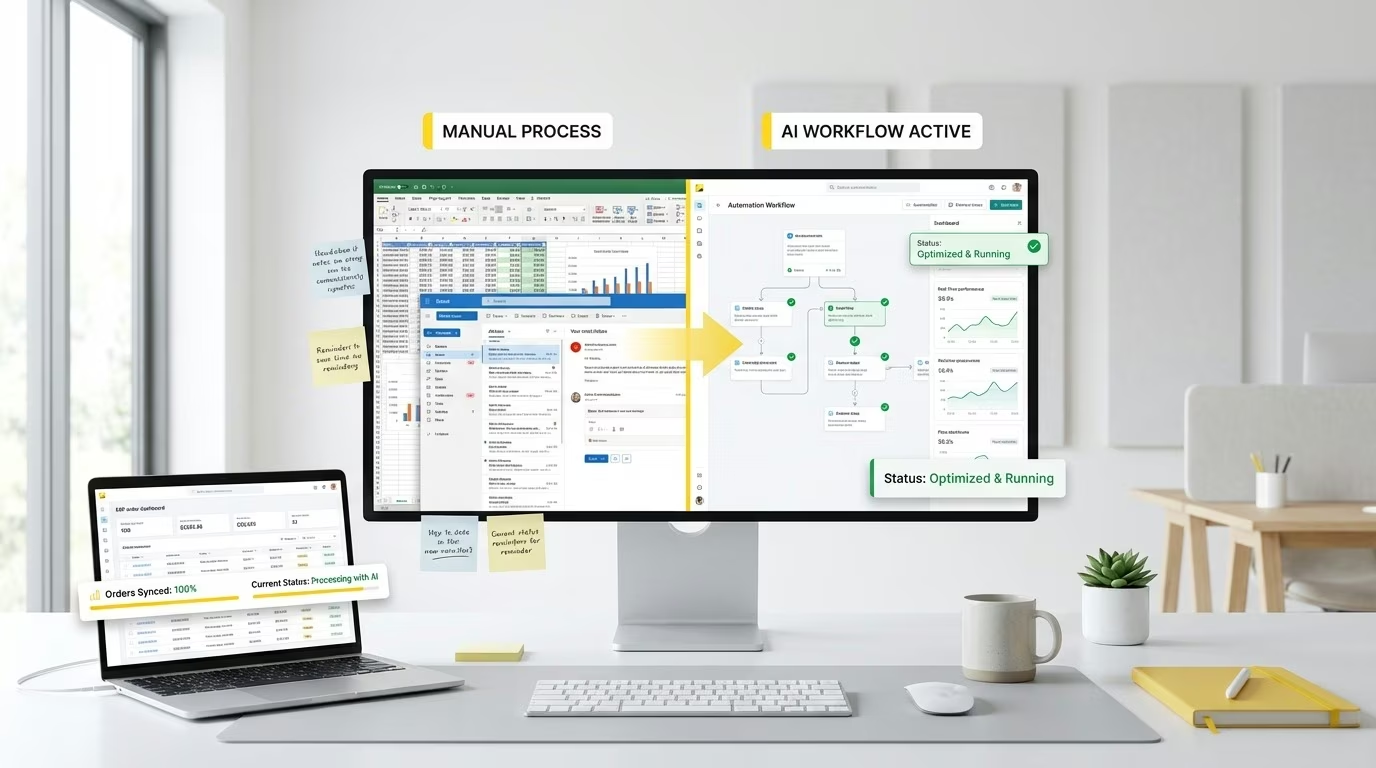
By using eZintegrations™, finance functions, manual document routing and siloed approvals into a model where documents are automatically processed, approvals triggered, downstream systems updated and data fed into finance analytics. That creates more “headspace” for your finance professionals to generate insights and deliver value.
Here is a 5-step roadmap your organization can follow to implement AI workflow automation in finance this year.
One tip: involve your finance team early. Automation is not just about technology but about change management. Get buy-in from the folks who currently do the manual work. Make sure they see how automation will free them up for higher-value tasks, not just replace them.
Here are some specific workflows where finance teams are seeing value in 2026.
Manual invoice handling delays vendor payments, causes duplicate payments, and strains relationships. With automation you can:
Supplier onboarding often involves documents, approvals, tax compliance, and system entries. Automation helps by:
Regulations in the finance sector are constantly evolving. Automation supports by:
Month-end, quarter-end close involves data gathering, reconciliation, and report preparation. With AI workflows you can:
Implementing AI workflow automation is not without its obstacles. Here are common challenges and how to address them.
Finance teams often deal with systems that don’t talk to each other (ERP, CRM, and legacy databases). Solution: Use a platform like eZintegrations™ that supports SaaS, SQL/NoSQL, REST, SOAP, GraphQL and comes with a broad API marketplace.
Legacy OCR often fails on complex invoices or contracts. Solution: Choose a solution with true AI document understanding (not just OCR) that can extract key data points, handle exceptions, and continuously learn.
Staff worry about job displacement or resist new workflows. Solution: Position automation as an enabler for freeing staff for more strategic roles. Train users, involve them early, and show early wins.
Automated decisions must still be auditable and compliant. Solution: Build workflows with clear exception paths and audit trails. Ensure controls are built in from day one.
Many finance teams get stuck in pilots. Research shows only a small percentage of pilots deliver P&L impact. Solution: Define KPIs from the start, build a center of excellence, track results and scale once you’ve demonstrated value.
To know if AI workflow automation for finance is working, track these metrics:
Once you have baseline data, compare automated workflows to go live and then on a rolling basis.
Here are some trends shaping AI workflow automation for finance right now:
AI systems are becoming more autonomous and capable of reasoning across steps in a workflow.
Finance workflows are less isolated. They span procurement, supply chain, vendor management, ERP, and data-lake. Platforms that integrate across systems to win.
With AI adoption growing, regulatory expectations around explainability, auditability, and data governance are increasing.
Earlier automation efforts focused on cost. Now finance teams seek insights, faster decisions, and strategic outcomes.
Final Thoughts: Smarter Workflows, Stronger Finance Teams
In 2026, the time has come for finance teams to move from manual, error-prone workflows into intelligent, automated workflows. By adopting AI workflow automation for finance, organizations can free up capacity, reduce risk, accelerate decision-making and shift finance from a cost center into a strategic partner.
With the right roadmap identify the process, select the platform, pilot, measure and scale you can unlock real impact. A solution like eZintegrations™ offers connectivity, no-code workflow building and AI document intelligence that accelerate this transformation.
Are you ready to take your finance operations to the next level? Book a free demo of eZintegrations™ today and see how it can transform your finance workflows for the better.
Recommend Blogs:
Q1. What is the difference between workflow automation and AI workflow automation for finance?
Workflow automation often refers to rule-based routing of tasks (e.g., invoice approval based on threshold). AI workflow automation adds intelligence: processing unstructured documents, predicting exceptions, adapting decisions based on data, and orchestrating across systems.
Q2. How quickly can a finance team see results from AI workflow automation?
Results vary by workflow and maturity. A well-defined pilot (e.g., invoice capture) can show reduced processing time and errors within a few months. Scaling broadly across finance might take 6-12 months.
Q3. Does AI workflow automation eliminate finance jobs?
Most organisations find automation frees finance professionals to focus on higher-value tasks such as analysis, forecasting and decision support. The goal is shifting from routine tasks to insight-driven roles, not simply head-count reduction.
Q4. What sort of workflows should finance teams prioritise?
Start with high-volume, high-error, manual workflows such as invoice capture, vendor onboarding, accounts payable/receivable, close-reporting processes, compliance checks. Those tend to show the fastest ROI.
Q5. How do I choose the right platform for AI workflow automation?
Important criteria: AI document-understanding capability (not just OCR), workflow orchestration, ability to connect to your systems (ERP/CRM/API), analytics and monitoring, governance and audit capabilities, and a track record in finance workflows. For example, eZintegrations™ offers many of these features.


© Copyright 2026 Bizdata Inc. | All Rights Reserved
 Watch Demo
 Post on LinkedIn
 Post on Facebook
 Post on Twitter/X