 support@bizdata360.com
 +1-650-283-1644
 AI Enabled Data Integrations and AnalyticsAI Enabled Data Integrations and Analytics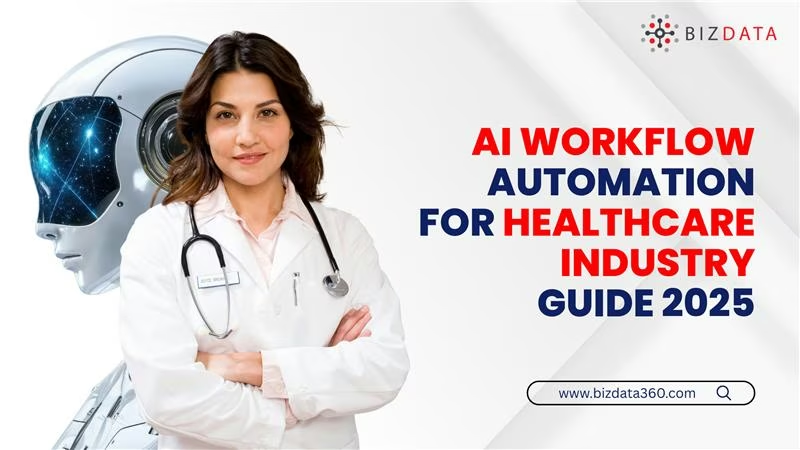

In 2026, healthcare providers face mounting pressure: rising patient loads, workforce shortages, and escalating administrative tasks that eat into patient care time. According to a 2026 report by Blue Prism, 86% of healthcare organizations are already using AI across their operations (source). Meanwhile, a NVIDIA survey of over 600 industry professionals found that 63% of healthcare leaders are actively using AI, with another 31% in pilot or assessment stages (source).
Despite these advances, many U.S. hospitals struggle to operationalize AI within clinical and administrative workflows. Legacy systems, fragmented data, compliance risks, and limited integration capabilities slow progress, but AI workflow automation for healthcare is changing that.
When applied effectively, it helps healthcare organizations:
This 2026 guide explains what AI workflow automation means, why it matters now, and how to implement it using platforms like eZintegrations™.
AI workflow automation in healthcare refers to intelligent systems that orchestrate multi-step clinical and administrative tasks using machine learning, natural language processing (NLP), and predictive algorithms.
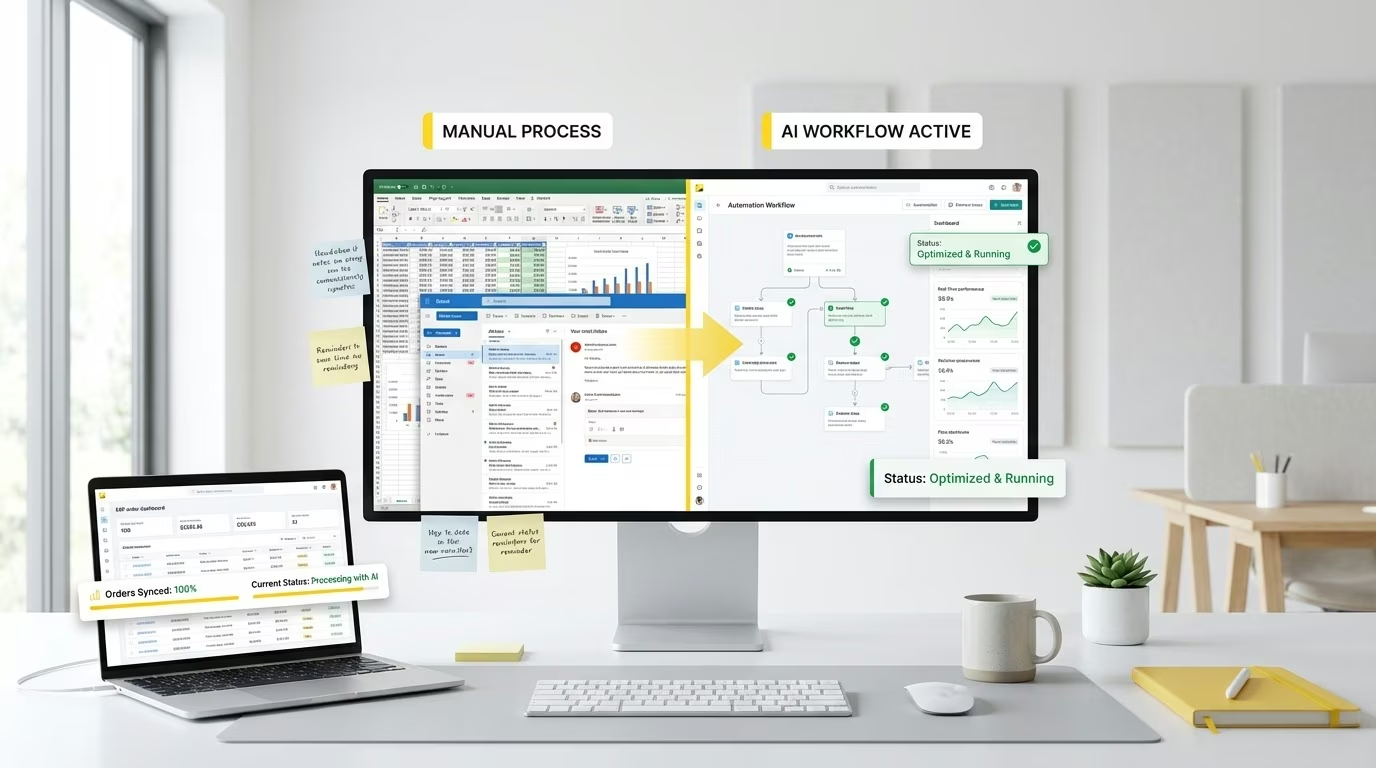
Unlike traditional automation that executes fixed rules, AI-powered workflows can:
Healthcare is among the fastest-growing industries adopting AI solutions. As reported by Boston Consulting Group, AI will transform clinical workflows by 2026 across diagnostics, administrative, and patient engagement functions (source).
Administrative inefficiencies cost U.S. healthcare billions annually. Clinicians spend nearly 50% of their time on documentation and desk work instead of patient interaction (source). AI-driven automation can reclaim this time, reduce burnout, and improve retention.
Most healthcare data (up to 80%) remain unstructured in clinical notes, reports, and images (source).
AI can turn this into structured insights, enabling accurate predictions and faster decisions.
Organizations embracing automation can optimize workflows, meet patient expectations for digital-first care, and stay compliant with evolving regulations.
AI-assisted transcription and summarization can save physicians hours daily.
AI can read, validate, and process claim forms automatically. Case Study: Omega Healthcare uses AI and UiPath to automate document handling, saving 15,000 staff hours monthly and achieving 99.5% accuracy (source).
AI bots can triage patient inquiries, schedule appointments, and prioritize critical cases, improving patient satisfaction.
AI workflow agents track referrals, send follow-ups, and ensure timely patient handoffs across care teams.
Autonomous pharmacy systems manage inventory, verify prescriptions, and prevent errors (source).
eZintegrations™ is a no-code AI data integration and workflow automation platform designed to simplify healthcare automation.
Here’s how it accelerates transformation:
Drag and drop pre-built components to design workflows that connect data across EHRs, claims systems, and third-party APIs without coding.
Connects easily with HL7, FHIR, PACS, LIS, and CRM systems, enabling end-to-end interoperability.
Supports HIPAA-compliant data handling, audit trails, and explainable AI ensuring full visibility and trust.
Built-in dashboards track performance, accuracy, and drift. Feedback loops continuously improve automation accuracy.
Start with one integration and scale organization. The platform supports hybrid cloud deployments and multi-system orchestration.
Automatically extracts and processes data from unstructured healthcare documents such as medical reports, insurance claims, lab results, and discharge summaries. This eliminates manual review delays, enhances accuracy, and speeds up patient data availability across workflows.
AI can sometimes make overconfident predictions. Maintain human oversight and review mechanisms to reduce risks (source).
Integrate siloed systems early. Use middleware like eZintegrations™ to unify data across environments.
Adopt role-based access, encryption, and regular audits. Prioritize HIPAA and FDA compliance for AI-based tools.
Encourage transparency, provide training, and include user feedback loops to drive adoption and trust.

In evaluating the success of AI Workflow Automation for Healthcare, organizations can track measurable improvements across five critical categories. Efficiency increases as automation reduces manual intervention and saves valuable time across workflows.
Accuracy strengthens with fewer data entry errors and enhanced data validation between integrated systems. ROI becomes visible through reduced operational costs, faster claims turnaround, and higher revenue efficiency.
Compliance improves with stronger audit performance and consistent adherence to HIPAA and other healthcare data governance standards. Finally, adoption grows as user satisfaction rises and automation rates increase across clinical, administrative, and financial processes demonstrating how platforms like eZintegrations™ deliver tangible, enterprise-wide value.
AI workflow automation is no longer futuristic; it’s foundational for healthcare resilience and performance. From cutting administrative loads to improving patient outcomes, intelligent automation empowers healthcare organizations to scale efficiently.
eZintegrations™ Helps hospitals and healthcare providers unify systems, automate end-to-end workflows, and deploy AI securely without code.
Ready to see it in action?
Book your free demo and see how your healthcare organization can automate smarter, faster, and safer.
Recommend Blogs:
AI Data Integration for Healthcare Industry Guide
Why Agentic AI Will Redefine the Role of CIOs by 2030?
Healthcare Data Integration: AI Guide & Best Practices 2026
5 Top AI Workflow Automation Trends in U.S. Healthcare
5 Ways AI Data Automation Helps You Scale Without Adding Headcount


© Copyright 2026 Bizdata Inc. | All Rights Reserved
 Watch Demo
 Post on LinkedIn
 Post on Facebook
 Post on Twitter/X