 support@bizdata360.com
 +1-650-283-1644
 AI Enabled Data Integrations and AnalyticsAI Enabled Data Integrations and Analytics

In the modern business climate, leaders are under constant pressure to do more with less. A recent study found that 94% of companies still perform repetitive, time-consuming tasks, but automation has improved job roles for 90% of knowledge workers and boosted productivity for 66% of organizations.
That means if you want to automate business workflows, you’re tackling not just efficiency but also morale, scalability, and competitiveness. This post is for US-based mid-to-large enterprises, IT & operations leaders, and workflow owners who are exploring how AI can shift them out of workflow drudgery and into strategic velocity.
We will walk through what workflow automation means, why AI is a game-changer, how to apply it step-by-step, share real-world tips, and show how our solution eZintegrations™ helps bridge the gap.
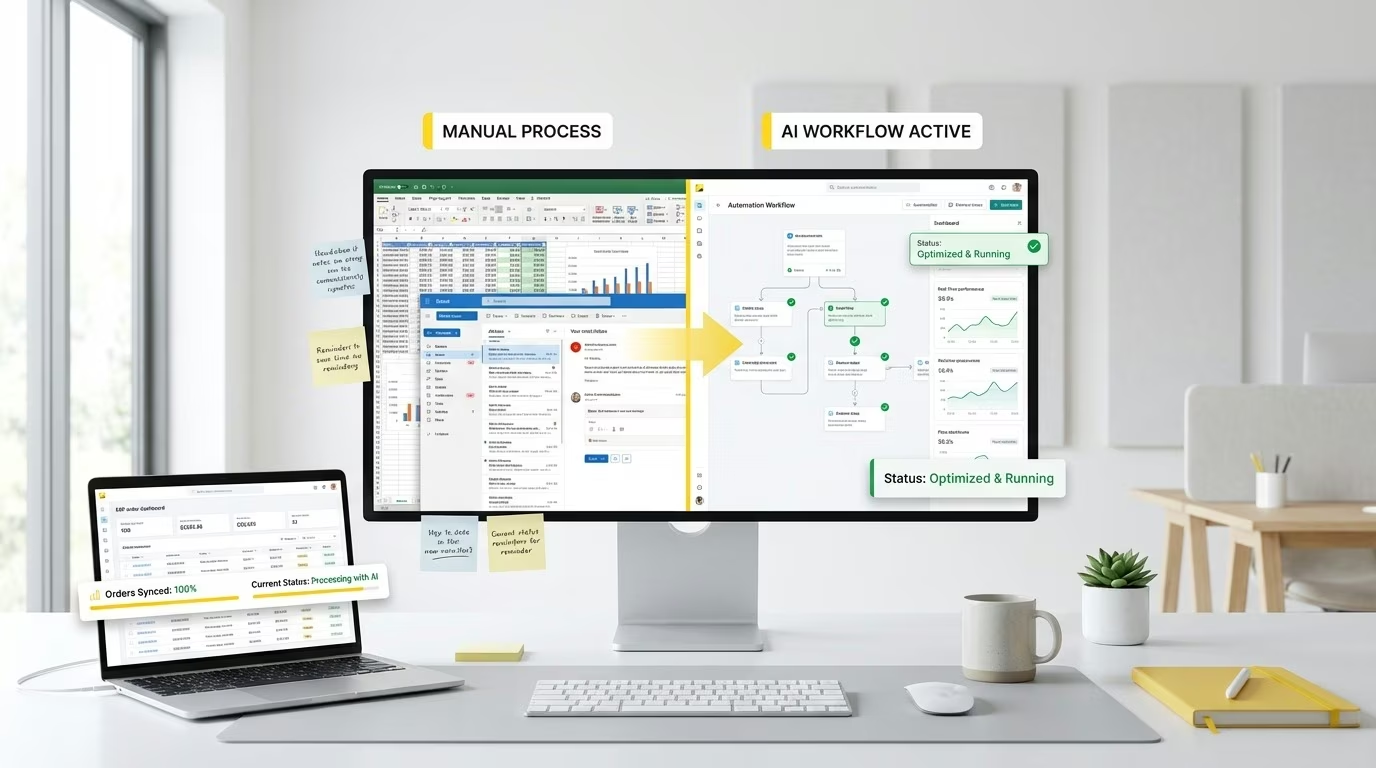
When we say, “automate business workflows,” we’re talking about taking tasks that people do manually data entry, approvals, moving information across systems, monitoring processes and converting them into automated flows that work without or with minimal human input. That could mean:
For many organizations, these workflows span multiple systems, departments, and decision points. Without automation, they’re slow, error-prone and drain staff time. Studies show automation can reduce errors and processing time, freeing teams for more strategic work.
Traditional automation often relies on rigid rules and scripting. AI brings adaptability. For example, a natural-language document can be parsed, key fields extracted, and a decision routed all without human handoffs. Research found that intelligent automation was recognized by 38% of businesses to free up the workforce for higher-value tasks.
The market for workflow automation is accelerating. One forecast estimates the market will reach US$78.26 billion by 2035, growing at a 21% CAGR from 2026. That expansion reflects how enterprises are turning workflow automation into a competitive level, not just an IT project.
Many organizations suffer from disconnected systems (CRM, ERP, SCM, databases, and custom apps). AI-enabled platforms can integrate across those silos, making workflows truly end-to-end rather than step-by-step. Our solution, eZintegrations™, is built with that mindset: it supports SaaS apps, SQL/NoSQL, APIs (REST/SOAP/GraphQL/gRPC) and more, so workflows don’t stop at system boundaries.
Automating workflows means fewer manual hand-offs, fewer errors, faster throughput, and more accurate data. According to research, many organizations implementing workflow automation expect 10-50% time savings on manual processing.
When repetitive tasks vanish, staff can shift into more value-adding roles: analysis, strategy, and customer relationships. That improves employee satisfaction and amplifies impact.
Here is a practical roadmap you can follow when implementing AI-driven workflow automation.
Pick the workflows that:
For example: invoice-to-pay, contract review, onboarding, claims processing. By choosing the right starting point, you generate quick wins and build momentum.
Document how things work today: trigger, inputs, tasks, decisions, systems involved, hand-offs, exceptions. Highlight bottlenecks such as manual approvals, data re-entry, delays, and error-points.
Design what the workflow should look like when automated. For example: a contract arrives → extracted by AI document-understanding → key fields feed CRM → compliance rules triggered → auto-approve or escalate → system update. Our product eZintegrations™ ai document-understanding module handles the extraction and then flows into integration bridges built in one-month free trial.
Look for:
eZintegrations™ meets all these criteria: no-code drag-and-drop, supports any system, free first-month bridge, and the Bizdata API marketplace with 1000+ APIs.
Run a pilot on one workflow. Set clear metrics: reduction in manual hours, error rate, throughput time, cost savings, number of hand-offs. Use baseline data for comparison. Then automate, monitor, and tweak.
Once the pilot succeeds, scale to other workflows. But underpin this with governance: process owners, change management, training, data-governance, monitoring. Without governance, many automations initiatives stall. Research confirms that many initiatives fail due to governance or change of resistance.
Use analytics to spot new bottlenecks, exceptions, and variations. With AI, you can build workflows that evolve, self-correct, and improve over time. As one study states, 35% of respondents saw intelligent workflows that were self-learned and self-correct.
Let’s say a US-based mid-sized insurance firm wants to automate claims processing. Previous claim form arrives, manual review, manual data entry into CRM, routing to adjuster, approval, and payment.
Using eZintegrations™:
As a result, the firm reduces manual processing, cuts delays, improves accuracy, and frees staff to focus on high-value tasks (like fraud detection or customer outreach).
If workflows aren’t well documented, automation can introduce chaos.
Tip: Map current state thoroughly and assign clear process owners before automation begins.
If systems don’t talk to each other, workflow automation stalls.
Tip: Choose a platform (such as eZintegrations™) that supports broad system integration (SaaS apps, databases, APIs) and offers pre-built bridges.
Teams comfortable with manual processes may push back.
Tip: Communicate benefits, show early wins, and involve business users in workflow design.
Automation without governance can lead to errors, compliance issues, and “black box” workflows.
Tip: Build control frameworks, audit trails and monitoring dashboards, and involve both IT and business in oversight.
If you customize too much initially, the workflow becomes rigid and harder to maintain.
Tip: Start simple, standardize workflows, then adapt only when needed. Build flexibility and reusability.
When evaluating platforms, ask:
At eZintegrations™, you get a no-code drag-and-drop builder, a 1000+ API marketplace in the Bizdata ecosystem, and a one-month free integration bridge to quickly prove value.
Automating business workflows via AI is no longer optional; it’s a strategic imperative. By replacing manual hand-offs, integrating disparate systems, and leveraging intelligent automation, your organization unlocks higher productivity, lower cost, better data accuracy, and stronger agility.
The transition to AI-enabled workflows may seem daunting, but with a structured approach and the right platform, it becomes reachable and impactful.
If you want to see how eZintegrations™ can help automate your workflows connect systems, integrate APIs, extract data intelligently book a free demo today and start your automation journey with confidence.
Recommend Blogs:
Q1: How long does it typically take to automate a business workflow with AI?
It varies by complexity. A simple workflow might be automated in a few weeks; end-to-end enterprise workflows can take 3-6 months. With platforms like eZintegrations™, boards can start seeing value in weeks through a free-one month plan.
Q2: What level of AI maturity do we need to leverage automation?
You don’t need to be at “full AI maturity” to begin. Start with AI-enabled document extraction or decision logic, then scale to more advanced capabilities. The key is to pick use cases where the ROI is clear, and you already have data/state to automate.
Q3: How do we measure ROI?
Track metrics such as manual hours saved, error-rate reduction, process cycle time shortened, cost per transaction lowered, employee satisfaction improved, and customer experience enhanced. Compare before and after automation.
Q4: Will automating workflows replace staff?
Automation is not about replacing humans; it’s about shifting them to higher-value roles. By automating repetitive tasks, teams focus on strategic, creative, or customer-facing activities. Many organizations report improvements in job quality post-automation.
Q5: What are the risks if we skip governance when automating?
Without governance you risk opaque workflows, unchecked exceptions, compliance issues, stalled ROI, and user distrust of automation. Establishing ownership, audit trails, monitoring, and change control is essential.


© Copyright 2026 Bizdata Inc. | All Rights Reserved
 Watch Demo
 Post on LinkedIn
 Post on Facebook
 Post on Twitter/X