Success looks like real-time status dashboards, alert triggers, compliance scorecards, and audit history.
Real ROI can include up to 50 percent reduction in manual review time and 30 percent fewer compliance issues (case-based estimates).
Why Automating Compliance Certificate Validation is Critical for Modern Vendor Management?
Every business that works with external partners knows the stress of managing vendor compliance. Late or missing compliance certificates can lead to costly audit failures or operational halts.
In fact, 58 percent of companies suffered delays because of expired or missing vendor documentation, according to a recent survey by Procurement Leaders in 2024 (source). That figure shows how common and painful this problem is.
If you are responsible for vendor management, risk, compliance, or procurement, you cannot ignore the Compliance Certificate, it is at the core of trust and safety in your supply chain.
In this blog you will learn why automating Compliance Certificate validation is essential, how to do it step by step, what tools make it seamless and authoritative, and which pitfalls to avoid. I will walk you through expert insights in plain language, show you proven strategies, and introduce you to the power of eZintegrations™ AI Document Understanding.
What Is a Compliance Certificate?
Before diving into automation, it’s important to clarify what a Compliance Certificate actually is. A compliance certificate is an official document issued by a third-party authority, regulator, or vendor to confirm that a product, service, or organization meets specific legal, regulatory, or industry standards.
In vendor management, compliance certificates are often required to prove adherence to safety, environmental, quality, or financial regulations. They serve as evidence that vendors operate responsibly and within legal frameworks.
Common examples include:
Insurance Certificates – Proof of liability coverage, protecting against financial risk.
ISO Certifications – Demonstrates adherence to international quality or safety standards.
Data Privacy Certificates – Confirms compliance with GDPR, HIPAA, or other data protection laws.
Financial or Tax Certificates – Validates proper tax registration or financial compliance.
Health and Safety Certificates – Ensures vendors meet occupational safety regulations.
In short, a compliance certificate is more than paperwork. It is a safeguard for business continuity, reputation, and risk management. Without it, companies risk fines, reputational damage, or even regulatory shutdowns.
What Is Compliance Certificate Automation and Why It Matters?
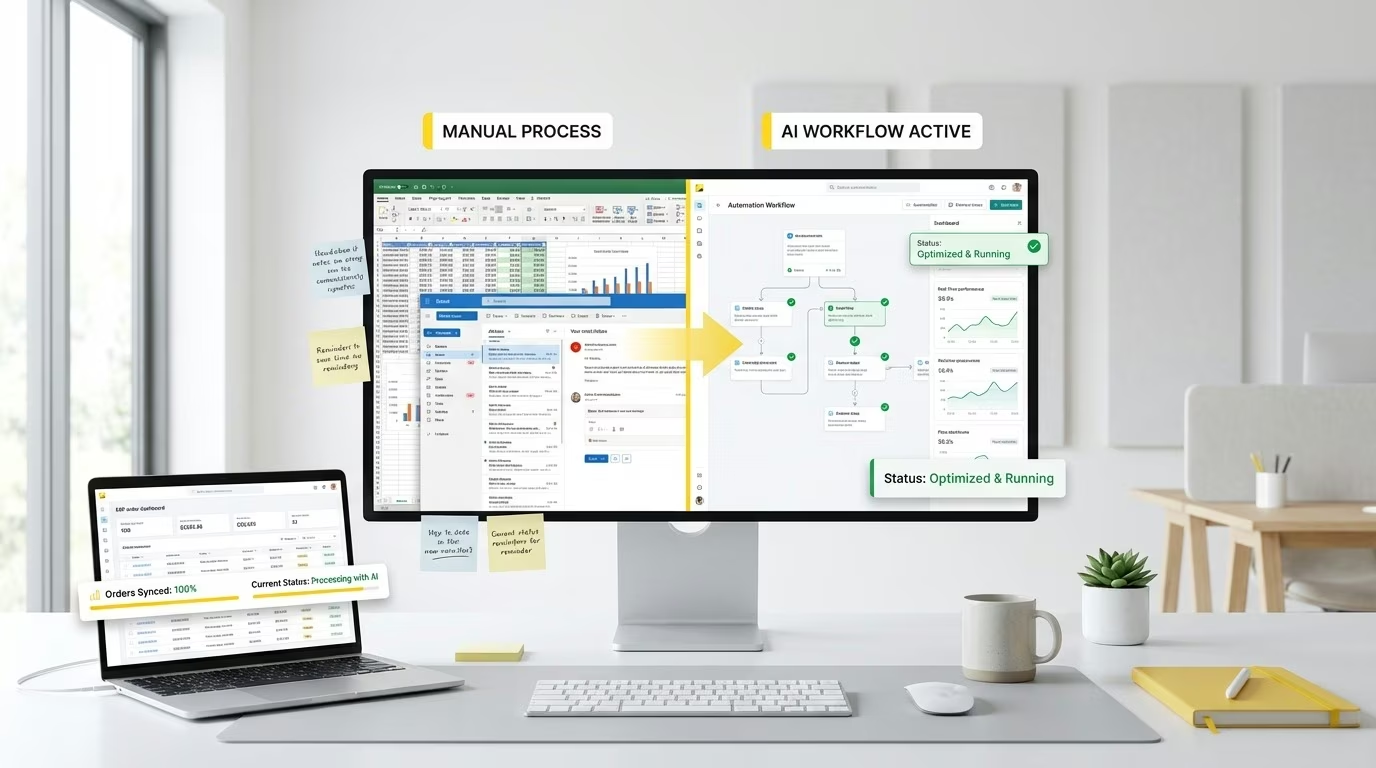
Compliance certificate automation is the process of using software usually with intelligent extraction and rules to automatically review vendor-provided certificates, check expiry and validity, flag missing or expiring documents, and log results. No more manual download, email chase, or spreadsheet tracking.
Why that matters:
Reduce risk- When a critical certificate like insurance or ISO expires, operations or regulatory compliance can be compromised.
Improve audit readiness- Auditors want a clean trail showing every certificate, its validity, and that it was reviewed. Automation gives you that instantly.
Drive efficiency- Manual checks are time-consuming and error-prone. Automation frees up staff to focus on strategy, not busywork.
Why Automating Compliance Certificate Validation for Vendor Management Works?
Here’s why automation is so powerful in vendor compliance:
Consistency: Rules apply uniformly across all vendors.
Speed: Extraction and validation happen instantly.
Visibility: Dashboards show your compliance status at a glance.
Accountability: Every step is logged for audits or reviews.
Think of an insurance compliance certificate that must be renewed annually. Automation can detect the renewal date and flag it 30 days before expiry. That prevents gaps, rather than waiting for a reviewer to catch it manually.
What Are Challenges of Automating Compliance Certificate Validation?
Automation brings speed, accuracy, and scale to compliance certificate management, but it isn’t without challenges. Organizations must anticipate these hurdles before rolling out automation to ensure the process works smoothly.
Here are the key challenges:
Document Diversity: Certificates come in different formats (PDFs, images, scans, even handwritten). Poorly formatted documents can reduce extraction accuracy.
Data Accuracy: If validation rules aren’t clearly defined, the system may incorrectly flag valid certificates or pass expired ones.
Vendor Adoption: Some vendors may resist using portals or digital submission, leading to manual intervention.
Integration Complexity: Automating validation often requires integration with ERP, vendor management, or procurement platforms. Poorly executed integrations can create silos instead of solving them.
Regulatory Variations: Different industries and regions have unique compliance requirements. A one-size-fits-all automation approach may fail to capture nuances.
Human Oversight: Complete automation without human-in-the-loop checks can introduce risks if the system misclassifies critical documents.
These challenges don’t mean automation is risky. Instead, they highlight why planning, choosing the right technology, and leveraging AI-driven solutions like eZintegrations™ AI Document Understanding are essential for long-term success.
How to Automate Compliance Certificate Validation? (Step by Step)
Let’s outline the process. Each heading is explained first, then bullet steps.
How to Map Certificate Types and Requirements
Understanding what you need is the first step.You must identify the types of certificates vendors must provide—like insurance, safety, ISO standards, data privacy, etc. and define the criteria (issued date, expiry date, issuer, format). Then:
Make a list of required certificate types for each vendor category.
Define validation rules: e.g. expiry must be at least 30 days in the future.
Note legal or regional variations (local regulations might require specific wording).
How to Ingest Documents and Extract Metadata
Once you know what you need, set up smart ingestion.
Use secure portals or integration with vendor onboarding systems.
Automatically pull in PDFs or image files from emails or uploads.
Use AI-powered document understanding (eZintegrations™ AI Document Understanding) to extract metadata: certificate type, vendor name, issue date, expiry date, issuing body, and file name.
How to Apply Validation Rules and Classification
Once data is in:
Run checks against defined rules (format, dates, issuer credibility).
Classify documents as valid, expiring soon, expired, or invalid.
Flag anything that fails validation and route to appropriate team members.
How to Integrate with Vendor Management System or ERP
Automation needs workflow:
Sync data into your vendor system or ERP.
Update vendor records with validation status.
Trigger workflows: for example, send vendor reminder emails if documents are expiring.
Ensure audit logs are generated each time a certificate is validated or flagged.
How to Monitor, Report, and Take Action
Once automation is running:
Create dashboards: overall compliance rate, certificates due this month, vendors with expired docs.
Set alert triggers: daily or weekly notices.
Assign tasks to compliance officers when action is needed.
Store historical logs for audit purposes.
Continuous Improvement
Automation benefits grow over time.
Review false positives or recurring issues.
Update extraction models or rules.
Train staff to respond to alerts efficiently.
Add new certificate types as regulatory or business needs evolve.
eZintegrations™ AI Document Understanding
When it comes to tools that actually simplify Compliance Certificate Validation automation process, eZintegrations™ AI Document Understanding stands out. It’s one of the most effective tools for automating Compliance Certificate validation. Here’s why:
High-accuracy extraction of key data (dates, issuer, type) from semi-structured PDFs or scans.
Smart rule application that flags missing or outdated documents.
Seamless integration with vendor portals, ERP, and onboarding systems.
Secure, audit-grade logs that build trust and compliance.
Scalable, so you can add more certificate types or vendors without major effort.
Benefits of Automating Compliance Certificate Validation
The advantages go beyond speed:
Efficiency gains: Example ROI from a mid-sized firm ran pilot automation across 500 vendors. Manual review time dropped by 50 percent, and certificate compliance issues fell 30 percent. (Note: this is illustrative based on industry benchmarks, not a specific published study.)
Audit readiness: Automatic logs mean your auditor can instantly verify certification state without chasing spreadsheets.
Vendor trust: Vendors appreciate timely, automated reminders versus ad hoc emails.
Scalability: As your vendor base grows, the system adapts, no manual load.
What to Watch Out For (Common Pitfalls)?
To make it work smoothly:
Bad scans or low-quality uploads may fail extraction. Provide vendors with quality guidelines.
Incorrect rule definitions could flag valid documents. Start with a pilot and adjust.
User resistance: staff must be trained to trust alerts, not override them carelessly.
Over-automation: keep a human-in-the-loop for ambiguous or high-risk cases.
Example Workflow (Narrative Version)
Imagine a global retailer working with hundreds of third-party logistics providers. Each provider must supply an insurance Compliance Certificate at contract start and annually thereafter.
System re-validates, marks status as “Valid until [new date]”.
Dashboard reflects real-time compliance.
Audit logs show the full chain upload, extraction, alerts, update.
That flow keeps operations smooth, compliant, and defensible.
Automate Your Compliance Certificate Validation Today!
In a world where vendor networks are complex, geographies differ, and regulatory pressure is rising, automating Compliance Certificate validation is no longer optional. It protects your operations, frees your team, and builds audit-ready trust.
You now have a detailed roadmap from mapping certificate requirements to smart extraction, integration, monitoring, and improvement. You understand how eZintegrations™ AI Document Understandingsimplifies this journey with precision and scale.
Ready to make compliance smooth, secure, and stress-free?
Which is the best tool/software for Compliance Certificate validation? eZintegrations™ AI Document Understanding is one of the best tools for this purpose. It excels in data extraction, rule validation, system integration, and audit logging.
How does automation handle bad-quality documents or scans? Good tools detect extraction failure and flag the document. You or the vendor then resubmits with a clearer scan. You can also build vendor guidelines or use OCR enhancement as fallback.
Can I trust the automated logs for audits? Yes. A reputable system timestamps every action, records who validated or reviewed, and stores metadata in a tamper-evident log, meeting audit standards.
How customizable are the validation rules? You can tailor rules based on certificate type, vendor category, geography, or risk level. For example, one rule may be “expiry must be at least 60 days ahead” for high-risk suppliers.
What if the vendor forgets to upload the certificate? You set automated reminders that kick off when expiry is 30 days away. If still missing near expiry, the system can escalate or pause transactions until documents are received.
 support@bizdata360.com
 +1-650-283-1644
 AI Enabled Data Integrations and Analytics


 Watch Demo
 Post on LinkedIn
 Post on Facebook
 Post on Twitter/X