 support@bizdata360.com
 +1-650-283-1644
 AI Enabled Data Integrations and AnalyticsAI Enabled Data Integrations and Analytics

If you’re a Chief Data Officer (CDO) or preparing to become one, you’re probably under pressure from every angle to turn sprawling data assets into measurable value, to align with business strategy, to manage risk and compliance, and to do so all while building trust across your organization.
The hard truth is that too many companies have a “data strategy” only in name loose visions, fragmented efforts, and low stakeholder buy-in. According to one survey, 83 % of companies reported having a CDO or CDAO role, yet 62 % of those respondents said the CDO’s remit was still poorly defined. (Harvard Business Review)
In this post, we’ll dive into the seven critical questions every CDO should ask before building or refining a data strategy. These aren’t checkbox queries they’re the foundation for a strategy that works. We’ll walk through what each question means (what), why it matters (why) and how to approach it (how). And yes, we’ll also show how your solution, eZintegrations™, can plug into the narrative and help you succeed.
If you’re operating in the U.S. market, leading a data office, or preparing your organization to do so, this blog post is for you.
This question asks you to identify your organization’s top business goals (revenue growth, cost reduction, product innovation, customer retention, etc.) and define how a data strategy will enable them.
If data initiatives aren’t explicitly tied to business objectives, they become isolated, costly, and unlikely to produce meaningful ROI. As one article put it: “A data strategy isn’t going to generate a single incremental dollar for your business, it’s an enabler.”
Define the triggers that make the data strategy urgent: competitive pressure, regulatory change, cost pressures, data sprawl, merger/acquisition, AI/ML initiatives.
Without urgency, a data strategy risks getting pushed aside. According to research, many CDOs struggle because the role lacks clarity and urgency.
This is a reality check: where does your organization stand with data infrastructure, data quality, governance frameworks, analytics, maturity, and data culture?
If the foundational capabilities are weak, launching ambitious use cases will likely fail or stall. A survey found only 24 % of firms considered themselves truly data-driven, and only 21 % say they’ve developed a data culture. MIT Sloan Management Review
Map the stakeholders (C-suite, business units, IT, data science, compliance, marketing, operations) and define how you will engage them and secure buy-in.
Data strategy success depends on cross-functional collaboration. Governance frameworks and infrastructure alone don’t guarantee adoption. The article from DataIQ noted: “There needs to be step-by-step explanation … and success needs to be demonstrated.” DataIQ
Define the policies, standards, roles and tools needed for data governance, regulatory compliance (e.g., CCPA, GDPR if applicable, HIPAA), and ethical data use (especially if you’re using AI/ML).
Poor governance undermines trust, exposes risk, and blocks scaling of analytics. Many organizations focus on technology but neglect governance and ethics.
Select the initial high-impact use cases for your data strategy, define success metrics (KPIs) and define how you will measure and monitor them.
Use case prioritization prevents “data paralysis” and ensures your strategy produces visible results. As noted in HBR research: the CDO role is often ill-defined, and success must be demonstrable.
Consider the roadmap beyond pilot use cases: how will you scale across domains, how will you sustain processes, how will you adapt as business and data environments change?
Many strategies stall during scaling because initial programmes succeed but fail to become part of business-as-usual. Research shows that human/culture issues remain the major barrier.
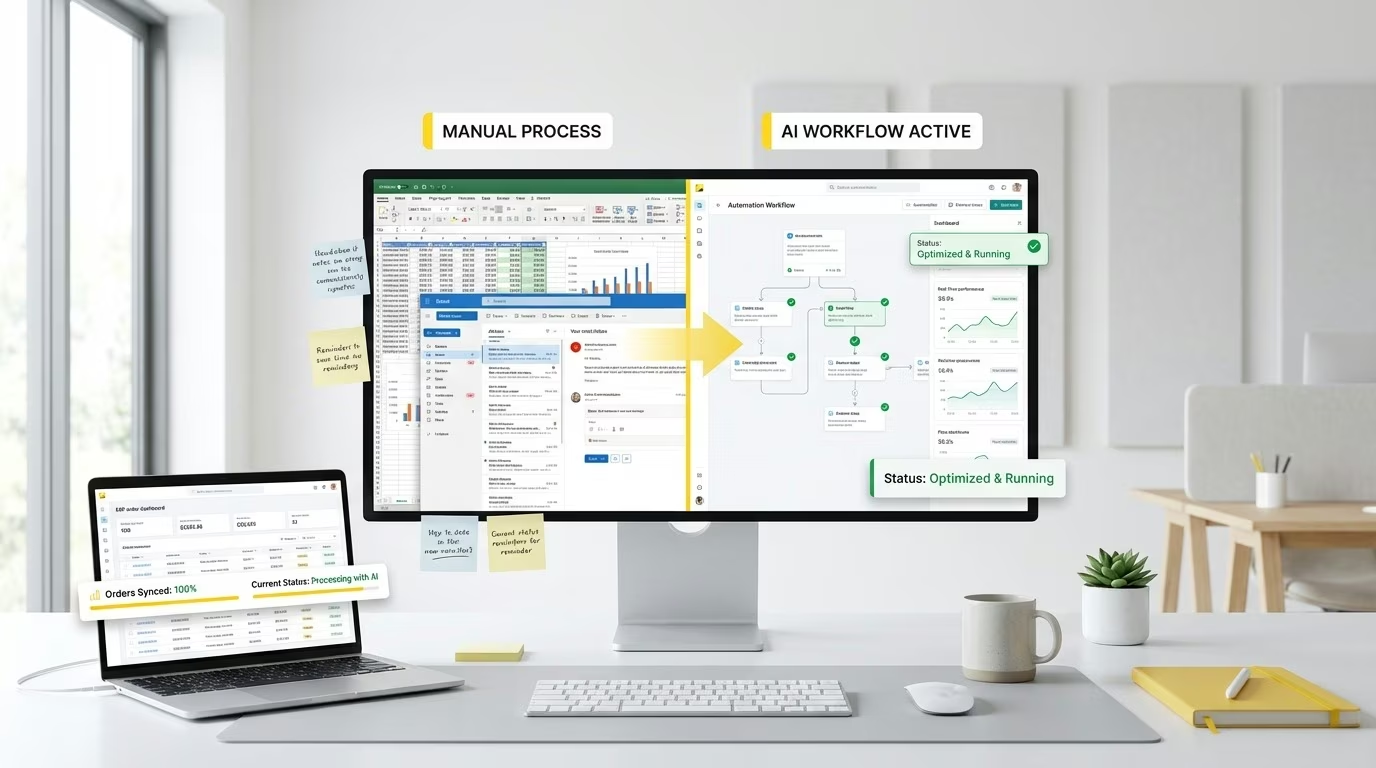
At this point you might ask: “Okay, that’s the strategic side but how do I make it operational?” That’s where eZintegrations™ comes in.
Here’s how we help:
If you build your strategy using the seven questions above, and eZintegrations™ gives you the platform to execute.
Building a successful data strategy is a critical lever for modern organizations. As a CDO, you need to ask the right questions up front to ensure your strategy aligns with business goals, is grounded, has stakeholder buy-in, is governed, measurable and scalable.
Use the seven questions above as your workshop agenda. Map your answers, build your roadmap, prioritize your use cases, and set yourself up to deliver measurable value. And when you are ready to operationalize the strategy, eZintegrations™ is here to help you integrate, govern and scale your data ecosystem.
Ready to move from strategy to action? Book a free demo of eZintegrations™ today and let’s explore how you can turn your data strategy into a business impact.
Recommend Blogs:
Q1: What is a data strategy?
A data strategy is a roadmap that defines how an organization uses data to achieve its business goals.
Q2: How long should a data-strategy initiative take to show results?
Most organizations see measurable results within 6–12 months of implementation.
Q3: What are common pitfalls in building a data strategy?
Lack of alignment, weak governance, poor stakeholder buy-in, and unrealistic scaling plans.
Q4: How do we measure the success of a data strategy?
By tracking defined KPIs like revenue uplift, cost savings, and faster time insights.
Q5: When should we involve external partners or platforms like eZintegrations™?
When internal capacity is limited, you need faster integration and governance execution.


© Copyright 2026 Bizdata Inc. | All Rights Reserved
 Watch Demo
 Post on LinkedIn
 Post on Facebook
 Post on Twitter/X