 support@bizdata360.com
 +1-650-283-1644
 AI Enabled Data Integrations and AnalyticsAI Enabled Data Integrations and Analytics

AI projects are only as good as the data pipelines that fuel them. Yet many enterprises underestimate how fragile their pipelines are. A recent IDC study found that 81% of IT leaders cite data silos as a major barrier to digital transformation, underscoring the critical role of data integration in AI success.
When pipelines are slow, poorly governed, or disconnected, even the most advanced AI models fail to deliver. This matters most for CIOs, data leaders, and business decision-makers who are investing heavily in AI. In 2026, global AI infrastructure spending is projected to reach $47.4 billion, marking a 97% year-over-year increase. (Source)
No enterprise can afford to let data bottlenecks kill their AI ROI. This blog explores the 10 most common data pipeline mistakes that block AI success, why they happen, and how solutions like eZintegrations™ can prevent them.
This blog explores the 10 most common data pipeline mistakes that block AI success, why they happen, and how solutions like eZintegrations™ can prevent them.
When poor-quality data enters your pipeline, AI models learn from noise instead of insights. Issues like duplicate records, missing values, and outdated information often go unnoticed until it’s too late. According to Gartner, 40% of enterprise data is either inaccurate, incomplete, or irrelevant (Gartner).
Why this matters: AI models trained on low-quality data deliver inaccurate predictions, eroding business trust.
How eZintegrations™ helps: The platform validates, cleanses, and enriches data in real time across multiple sources, ensuring only high-quality data powers your AI workflows.
Too many organizations build pipelines as one-off projects instead of dynamic systems. This creates brittle workflows that break with every new data source or API update.
Why this matters: Static pipelines require constant rework, wasting IT resources and slowing AI adoption.
How eZintegrations™ helps: With its drag-and-drop no-code design, eZintegrations™ makes pipelines flexible and adaptive, letting users reconfigure workflows instantly when sources change.
Many enterprises still rely on heavy, legacy ETL tools that require specialized coding. These tools are rigid and slow, leaving data teams overwhelmed.
Why this matters: Legacy-heavy approaches delay projects, increase costs, and make scaling AI pipelines harder.
How eZintegrations™ helps: By offering over 1,000 prebuilt APIs and a modern API marketplace, eZintegrations™ eliminates custom coding for most integrations.
AI thrives on timely data. Static batch processing pipelines often cause delays, meaning models make decisions on outdated inputs.
Why this matters: Delayed data prevents AI from responding to fast-changing business conditions.
How eZintegrations™ helps: The platform supports real-time data synchronization, ensuring AI models always work with current information.
Uncontrolled pipelines expose sensitive data and create compliance risks. In highly regulated industries, this can result in fines and loss of trust.
Why this matters: Weak governance not only blocks AI adoption but also puts enterprises at legal and financial risk.
How eZintegrations™ helps: With enterprise-grade security, role-based access, and full audit trails, eZintegrations™ makes governance and compliance seamless.
Disconnected pipelines often trap valuable data inside departmental systems, making it unusable for enterprise-wide AI.
Why this matters: Data silos block the holistic insights AI needs to generate value.
How eZintegrations™ helps: By integrating SaaS apps, databases, APIs, and on-premises systems into unified pipelines, eZintegrations™ eliminates silos across the enterprise.
Pipelines designed for small datasets often collapse under enterprise-scale AI workloads. Scaling manually takes too much time and costs too much.
Why this matters: Without scalable pipelines, enterprises struggle to handle increasing data volumes in AI projects.
How eZintegrations™ helps: The cloud-native design of eZintegrations™ scales seamlessly with enterprise needs, from pilot AI projects to global deployments.
Manual monitoring and intervention slow down data flows and increase the risk of human error.
Why this matters: Lack of automation adds friction to AI projects and delays insights.
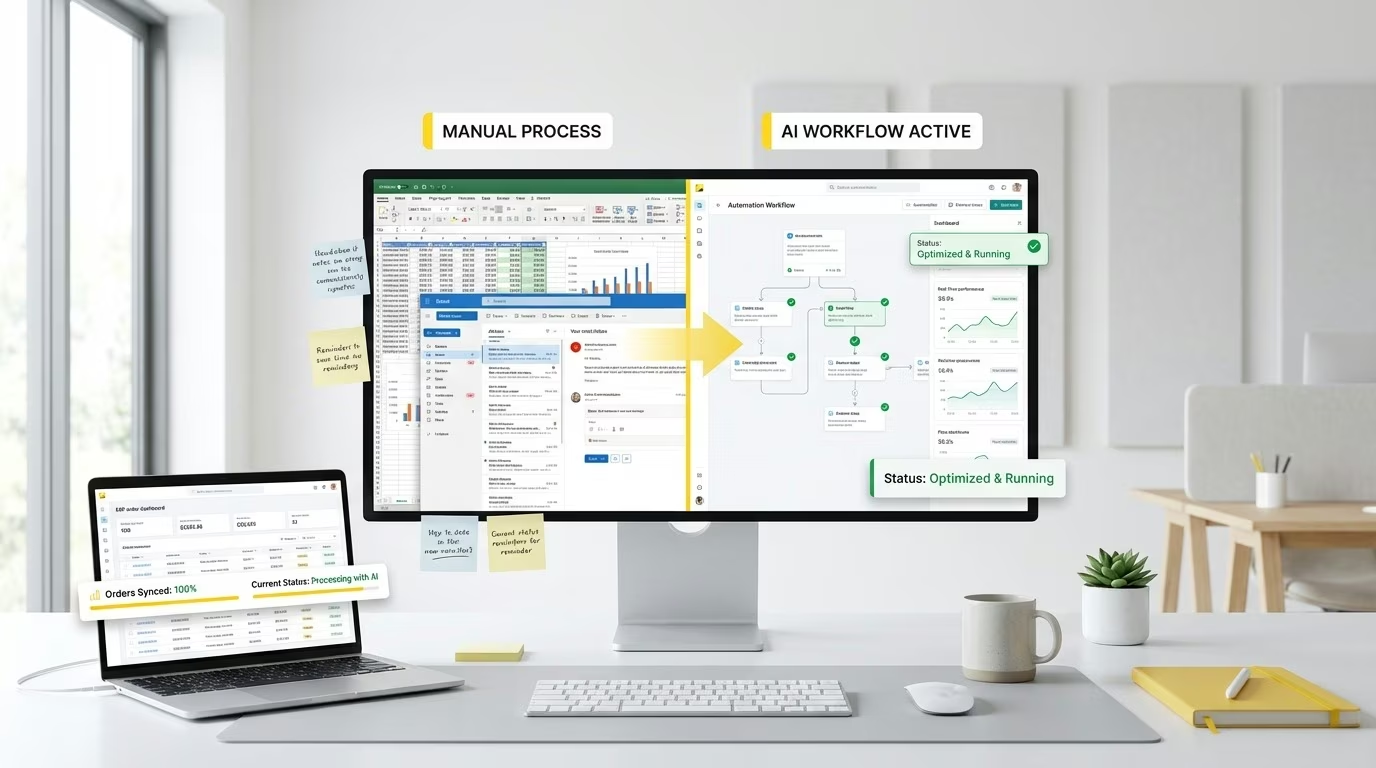
How eZintegrations™ helps: Its AI workflow automation removes manual bottlenecks, letting enterprises focus on insights rather than data wrangling.
AI value often hides in unstructured formats like PDFs, scans, and documents. Many pipelines aren’t built to handle these sources.
Why this matters: Ignoring unstructured data reduces the completeness of AI insights.
How eZintegrations™ helps: With its AI Document Understanding powered by Goldfinch AI, eZintegrations™ extracts and structures data from unstructured sources automatically.
Pipelines degrade over time as data sources evolve. Without monitoring, errors compound and AI results weaken.
Why this matters: AI projects fail silently when pipeline health isn’t tracked.
How eZintegrations™ helps: Built-in monitoring and alerts ensure pipeline performance is continuously optimized, keeping AI initiatives on track.
AI projects fail more often because of data pipeline mistakes than because of model design. In 2026, avoiding the ten pitfalls outlined above is critical for any enterprise aiming to capture real ROI from AI.
eZintegrations™ solves these challenges by delivering a no-code, cloud-native AI data integration and workflow automation platform. From real-time synchronization to unstructured data handling, it empowers enterprises to build robust, future-ready pipelines.
If you want to remove pipeline bottlenecks and accelerate your AI success, book a free demo of eZintegrations™ today!
Q1: Why are data pipelines critical for AI success in 2026?
Data pipelines ensure clean, timely, and connected data reaches AI systems. Without them, AI cannot deliver reliable insights.
Q2: What are the biggest risks of poor pipeline design?
The biggest risks include inaccurate predictions, compliance issues, higher costs, and stalled AI projects.
Q3: Can no-code solutions replace traditional ETL tools?
Yes, modern no-code platforms like eZintegrations™ offer faster, more scalable alternatives without sacrificing control.
Q4: How does eZintegrations™ handle unstructured data?
It uses AI-powered document understanding to extract data from PDFs, images, and other unstructured sources.
Q5: Is real-time data processing essential for AI?
Yes. Real-time pipelines keep AI models aligned with fast-changing business realities.


© Copyright 2026 Bizdata Inc. | All Rights Reserved
 Watch Demo
 Post on LinkedIn
 Post on Facebook
 Post on Twitter/X