 support@bizdata360.com
 +1-650-283-1644
 AI Enabled Data Integrations and AnalyticsAI Enabled Data Integrations and Analytics

By 2026, many U.S. companies have poured billions into AI initiatives, yet a surprising number still struggle to get value from them. According to a recent report, 82% of organizations globally lack the readiness to support production-scale AI.
If you are a CDO, CIO, Head of Data, or business leader exploring how to scale AI at your organization, this blog is for you. We’ll unpack why “Data Readiness” remains the biggest hurdle for U.S. teams 0and how your company can overcome it.
Data readiness refers to how prepared your data infrastructure and practices are to support AI initiatives. This includes:
Why does this matter for AI? Because AI is only as good as the data it’s fed. Without quality, comprehensive, and well-governed data even the most advanced AI models will falter.
Although many companies claim AI is their priority, data quality remains a persistent obstacle. Studies shows that about 67% of organizations do not trust the completeness or accuracy of their data even when data-driven decision-making is a top goal.
Too often, data is stored with inconsistent definitions or formats. Duplicate records, missing fields, and outdated entries are common. Those undermine AI model outcomes, breed bias, and reduce trust in AI-driven insights.
Growing data volumes makes this problem worse. According to one survey, U.S. companies expect data demands to triple by 2026 making data hygiene and quality maintenance much harder.
Many organizations still keep data segregated across departments or systems. Sales, operations, customer support, finance each with their own data silos. Without streamlined integration, building a unified dataset for AI becomes nearly impossible.
Siloed data also creates confusion over data ownership, governance, and access rights. Lack of clarity or documentation about where data lives, who owns it, and how it’s updated hurts AI readiness.
Even when data quality and governance are addressed, technical limitations often hold teams back. According to a 2024 index, only 21% of companies reported having the GPU or infrastructure readiness required for AI workloads.
Only about 32–37% of U.S. organizations say their data foundation is ready to support AI at scale.
Many organizations lack scalable data pipelines, real-time ingestion, unified data stores, or the performance required for large-scale AI processing.
Survey after survey shows that even when data exists, most organizations don’t trust it. One global benchmark found that only 1 in 5 organizations were satisfied with the accuracy and completeness of their data products.
That trust gap slows AI adoption in two ways: business teams hesitate to rely on AI outputs, and data/engineering teams often spend more time fixing data reliability issues than building AI use cases.
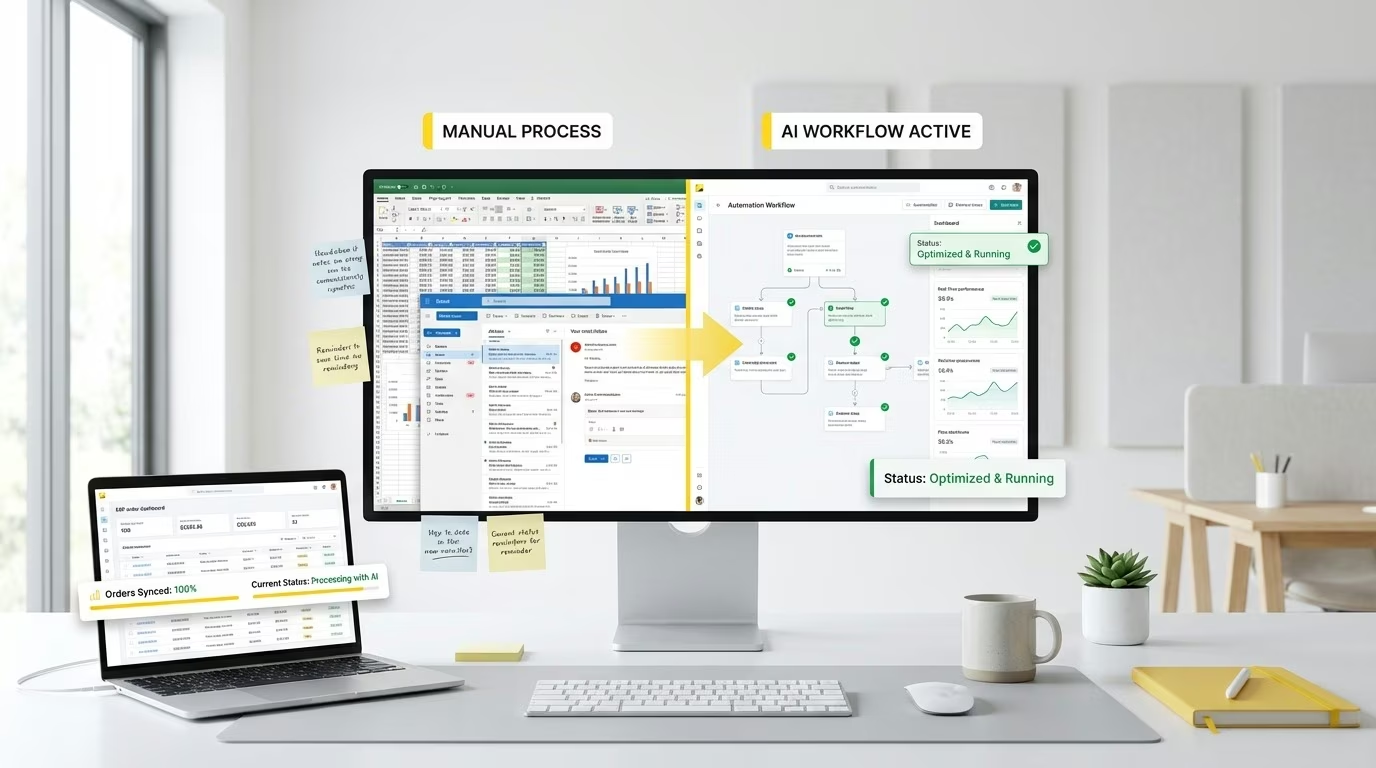
In many companies, data cleansing, integration, lineage tracking and governance still happen manually or semi-manually. This leads to delays, inconsistencies, and errors exactly the opposite of what AI needs.
Less than 10% of organizations report automating more than half of their privacy or security policy enforcement for data used by AI.
All these points to a hard truth: while AI hype is high, most companies are still building the runway.
When data isn’t ready, AI projects can trigger a cascade of pain:
Many businesses find themselves stuck in pilot purgatory unable to scale AI beyond proof-of-concept.
Forward-thinking companies are adopting a few key practices:
This is where eZintegrations™ comes in. Our platform is designed specifically to tackle data readiness enabling U.S. organizations to prepare their data environment for AI in a robust, scalable and governance-friendly way.
With eZintegrations™ you get:
Together, these capabilities help organizations move from data chaos to AI-ready environments, unlocking real ROI from AI investments.
In 2026, the promise of AI remains immense, but the reality is stark: too many AI projects in the U.S. stall or fail because data isn’t ready. Without proper data quality, unified architecture, governance, and automation, even the most advanced AI tools will underperform or be abandoned.
For businesses serious about unlocking AI’s potential, data readiness must be the foundation. A platform like eZintegrations™ can accelerate that transformation: integrating data, cleaning it, governing it, and making it AI-ready, so you can focus on delivering business value, not wrestling with data chaos.
Ready to close the gap between ambition and outcomes? Book a free demo of eZintegrations™ today and start building your AI-ready data foundation.
7 SaaS Workflows U.S. Businesses Should Automate with AI
7 Top Benefits of Salesforce NetSuite Integration
7 Best Agentic AI Tools for Enterprise Automation
How Integration Gaps Are Holding Back Enterprise AI Adoption?
ETL vs ELT Difference: Which Approach Fits into Modern AI Workflows
Estimates vary, but according to a 2024 U.S. index by a major vendor fewer than four in ten (around 32–37%) organizations report high data-readiness to deploy AI at scale.
Manual data cleaning is slow, error-prone, and doesn’t scale. For large or dynamic datasets, especially when updates come in constantly, manual methods quickly become unmanageable. Automation ensures consistency, speed, and ongoing hygiene.
Infrastructure is part of the problem, but often not the main one. Many organizations have sufficient storage or compute yet data remains siloed, poorly governed, unclean or inaccessible. Data readiness covers more than infrastructure.
It means formal policies around data ownership, access rights, metadata, lineage, privacy, compliance. Governance ensures data is reliable, traceable and safe for AI building trust with stakeholders and reducing legal or compliance risks.
It depends on your starting point. For some companies, shifting to a unified data platform with automated pipelines and governance can take a few months. For others with heavily fragmented legacy systems, it may take longer. The key is to start with a clear roadmap and incremental wins.


© Copyright 2026 Bizdata Inc. | All Rights Reserved
 Watch Demo
 Post on LinkedIn
 Post on Facebook
 Post on Twitter/X