 support@bizdata360.com
 +1-650-283-1644
 AI Enabled Data Integrations and AnalyticsAI Enabled Data Integrations and Analytics

In a world where supply chains are under constant pressure from inflation and labor shortages to rapidly shifting customer demands, efficient, reliable data exchange is no longer optional.
A recent survey show nearly 60% of supply-chain leaders in 2024 plan to invest in electronic data interchange (EDI) tools and cloud-based ERP integrations to mitigate delays. Meanwhile, in the United States, about 80% of companies already rely on EDI for procurement and logistics communications. (PW Consulting)
That is why EDI SAP Integration matters so much today. This blog post is for supply-chain managers, IT leaders, procurement heads, and anyone responsible for enterprise-system architecture in a company relying on either EDI, SAP or both.
We will walk you through what EDI SAP Integration is, why you need it now more than ever, and how you can implement it smoothly using a modern solution like eZintegrations™ including its AI Document Understanding module to solve real-world challenges.
EDI (Electronic Data Interchange) is a method to automatically exchange common business documents (purchase orders, invoices, shipping notices) between trading partners in a standardized electronic format. Instead of emailing PDFs or manual data entry, EDI enables direct machine-to-machine communication.
Benefits of traditional EDI include:
For decades, large enterprises and major retailers mandated EDI compliance for suppliers and distributors.
SAP is one of the most widely used enterprise resource planning (ERP) suites globally. According to 2026 industry data, a significant portion of large enterprises rely on SAP for finance, supply-chain, procurement, inventory, and overall operational workflows.
ERP systems like SAP serve as the central nervous system of an organization. They manage master data (products, suppliers, customers), transactional data (orders, shipments, invoices), and business rules. For companies running SAP ERP, having external documents like supplier purchase orders or customer invoices flowing smoothly into SAP is mission critical.
EDI SAP Integration refers to connecting an organization’s EDI system with its SAP ERP environment. The goal is to:
In short, it removes disjointed handoffs paper, Excel, emails, manual entry and replaces them with automated, standardized, and reliable flow of data.
The broader business environment makes EDI SAP Integration more critical than ever:
In this environment, a reliable EDI SAP Integration is no longer optional; it is mandatory for companies wanting agility, compliance, and operational excellence.
Even though SAP provides integration tools, here is why many organizations struggle:
Before you start, it helps to understand that eZintegrations™ works like a no-code bridge between your EDI systems and SAP. It handles heavy lifting, so you don’t get stuck with custom mappings, long development cycles, or format issues. The goal is to move documents in and out of SAP without manual entry or back-and-forth emails.
Begin by adding SAP and your EDI source as connections inside eZintegrations™.
You authenticate once, set basic configuration, and the platform keeps the link active.
This removes the need to build point-to-point connectors from scratch.
Load the document formats you want to handle.
Most teams start with the core set, like purchase orders, ASNs, invoices, and confirmations. The platform accepts EDI files, XML, CSV, JSON, and even PDFs through its AI Document Understanding feature.
Each document is mapped to the right fields in SAP.
You match things like product codes, quantities, PO numbers, pricing, and vendor IDs.
This is all done visually, so you skip custom ABAP code or middleware logic.
Once your mappings are ready, create the workflow that defines how documents move.
For example:
These workflows run on their own and help you avoid manual intervention.
Run a short pilot with selected partners before rolling out widely. Check if values match; documents land in the right SAP modules, and exceptions are handled properly. Most teams complete this stage quickly because the platform handles validation automatically.
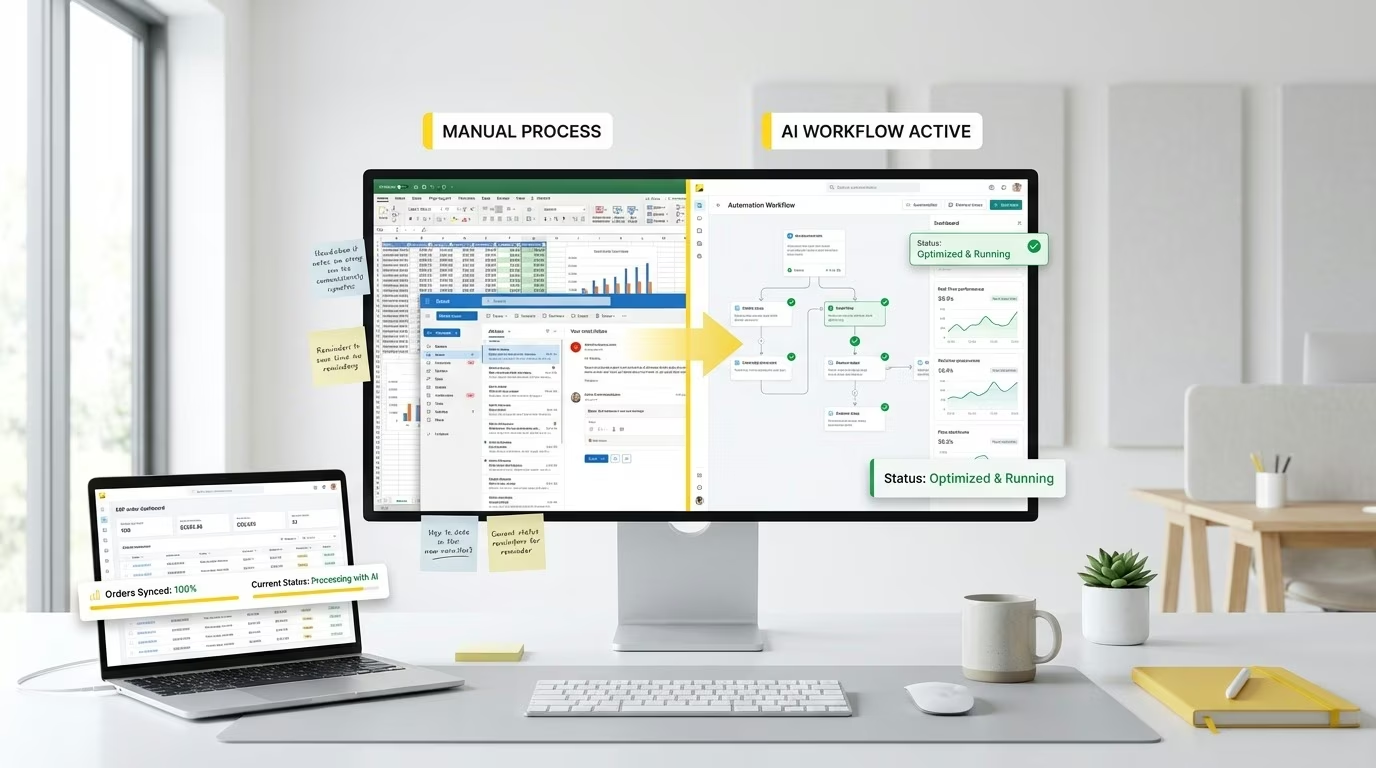
After testing, switch to full production. The dashboard shows document flow, processing time, failures, and partner status in real time. You can add new partners, new document types, or new SAP modules whenever needed without rebuilding anything. Schedule a quick live demo by our expert team.
Most organizations still deal with a mix of EDI files and unstructured documents. Vendors send POs as PDFs; carriers share delivery notes as scanned images, and many partners do not follow the same EDI standards. This creates delays, manual entry, and errors inside SAP. eZintegrations™ solves this gap with its AI Document Understanding capability that reads documents the way a human does.
The feature is built to extract clean and structured data from PDFs, scanned files, handwritten notes, images, and complex templates. It works without OCR or NLP rules, which means you do not need to train models for every supplier or layout. The platform learns patterns automatically and sends organized data straight into your SAP workflows.
Once enabled, it handles several common challenges that slow down EDI and SAP teams.
You get cleaner data, fewer exceptions, and faster cycle times.
The extraction runs before the integration, so your SAP system receives data that is ready for posting.
This helps maintain data quality even when partners do not send standard EDI files.
The number of suppliers sending nonstandard formats continues to grow.
Teams want a single workflow where EDI and non-EDI documents flow into SAP without extra tools or manual steps.
eZintegrations™ provides an integrated layer where AI extraction, enrichment and workflow automation all operate in one place, which means your SAP team spends less time correcting data and more time improving operations.
When planning an EDI SAP Integration project, watch out for these common mistakes:
These mistakes are avoidable with a clear plan, good tool selection, and stakeholder alignment from the start.
If your business uses SAP ERP and interacts with trading partners using EDI, then EDI SAP Integration isn’t a nice-to-have; it’s essential. With growing supply chain complexity, demanding partners, and rising pressure to automate and scale, robust integration is the foundation for operational excellence and competitive edge.
A modern, managed solution like eZintegrations™ offers an efficient path forward. It reduces onboarding friction, handles mixed ecosystems, ensures data integrity, and delivers scalability all while lowering long-term costs and maintenance burdens.
If you’re ready to transform your data workflows, reduce manual overhead, and build a resilient, scalable integration backbone, book a free demo of EDI SAP integration today. Let’s help you bridge your SAP ERP and EDI systems and power your business for the challenges of 2026 and beyond.
Q1: Does EDI SAP Integration work only if both sides use SAP?
Not at all. The point of EDI SAP Integration is to connect your SAP ERP with external EDI systems or partner networks. With a modern integration platform, you can transact with partners who may use different ERPs, legacy systems, or cloud tools.
Q2: What if a trading partner does not support standard EDI formats (ANSI X12 / EDIFACT)?
That’s a common scenario. A flexible integration solution like eZintegrations™ can often handle semi-structured documents, CSVs, XML, or PDFs using AI-based document parsing and mapping. It greatly simplifies onboarding non-standard partners.
Q3: Is EDI SAP Integration only for large enterprises or is it feasible for mid-sized companies too?
It is valuable for companies of any size. In fact, EDI adoption among SMEs has grown strongly worldwide as EDI-as-a-Service reduces traditional cost and expertise barriers.
Q4: Will integrating EDI with SAP slow down our migration if we plan to move from SAP ECC to S/4HANA?
If done carefully, integration can actually smooth the transition. Many modern EDI integration platforms support both ECC and S/4HANA. Proper planning, combined with modular integration, ensures minimal disruption during migration.
Q5: What kind of ROI can we expect from implementing EDI SAP Integration?
While ROI varies by business size, partner network, and transaction volume, typical benefits include: 30–50% reduction in manual processing time, fewer errors, faster invoice-to-cash cycles, and lower operational costs. Plus, improved supply chain resilience and scalability.


© Copyright 2026 Bizdata Inc. | All Rights Reserved
 Watch Demo
 Post on LinkedIn
 Post on Facebook
 Post on Twitter/X