 support@bizdata360.com
 +1-650-283-1644
 AI Enabled Data Integrations and AnalyticsAI Enabled Data Integrations and Analytics

In today’s volatile economic climate, financial statement analysis has become a cornerstone for corporate strategy. With 62% of CFOs investing more in real-time analytics and 71% of finance teams expected to automate routine tasks by 2026 (source: Gartner), traditional approaches are no longer enough. For tech professionals and decision-makers, understanding and leveraging financial statement analysis is critical for survival and growth.
Manual reporting processes often introduce risks, delays, and inconsistencies. If you’re tired of wrestling with outdated spreadsheets or reconciling mismatched data across ERP, CRM, and third-party sources, you’re not alone. This blog is your complete 2026 guide to modern, AI-powered financial statement analysis. It explores best practices, top tools, and how platforms like eZintegrations™ and Goldfinch AI are transforming corporate financial intelligence.
Financial statement analysis is the process of evaluating a company’s financial health by interpreting its income statement, balance sheet, and cash flow statement. It reveals insights into profitability, liquidity, solvency, and operational efficiency.
This practice isn’t just for accountants; it’s vital for investors, financial analysts, compliance officers, and business strategists. In an AI-first era, the need for accurate, timely, and contextual insights has never been more urgent.
Organizations that invest in effective financial statement analysis gain a significant competitive edge. A structured analysis allows businesses to:
Understanding real-world applications helps clarify the true value of this process. Here are a few practical examples:
Also Check out: Document Workflow Automation: Software, Best Practices Guide
Intelligent Document Processing (IDP): Ultimate Guide 2026
Enterprise Document Automation with AI-Driven Workflows
In 2026, financial agility is a core differentiator. With economic uncertainty and stricter ESG disclosures, companies must go beyond static reports. Continuous analysis powered by AI ensures businesses stay ahead of disruptions.
Despite its importance, financial statement analysis comes with its share of roadblocks. Many tech professionals encounter these issues:

To streamline and enhance your analysis process, consider adopting the following practices:
The right tools can significantly elevate your analysis. Some of the top categories include:
To ensure accuracy and consistency, follow these recognized standards:
Valuation is a key outcome of financial statement analysis. It helps stakeholders determine the worth of an enterprise by analyzing metrics like:
Accurate valuation requires trusted data pipelines, which is where eZintegrations™ and AI come into play.
For continued learning, many organizations publish video tutorials and webinars. Check platforms like:
AI is fundamentally reshaping financial analysis by enabling:
The synergy of AI with finance allows for contextual insights, not just numbers. This is especially important when tackling questions like, “Which of the following creates problems with financial statement analysis?” Answers often include fragmented systems, delayed reporting, and inaccurate inputs for all issues that can be addressed with AI.
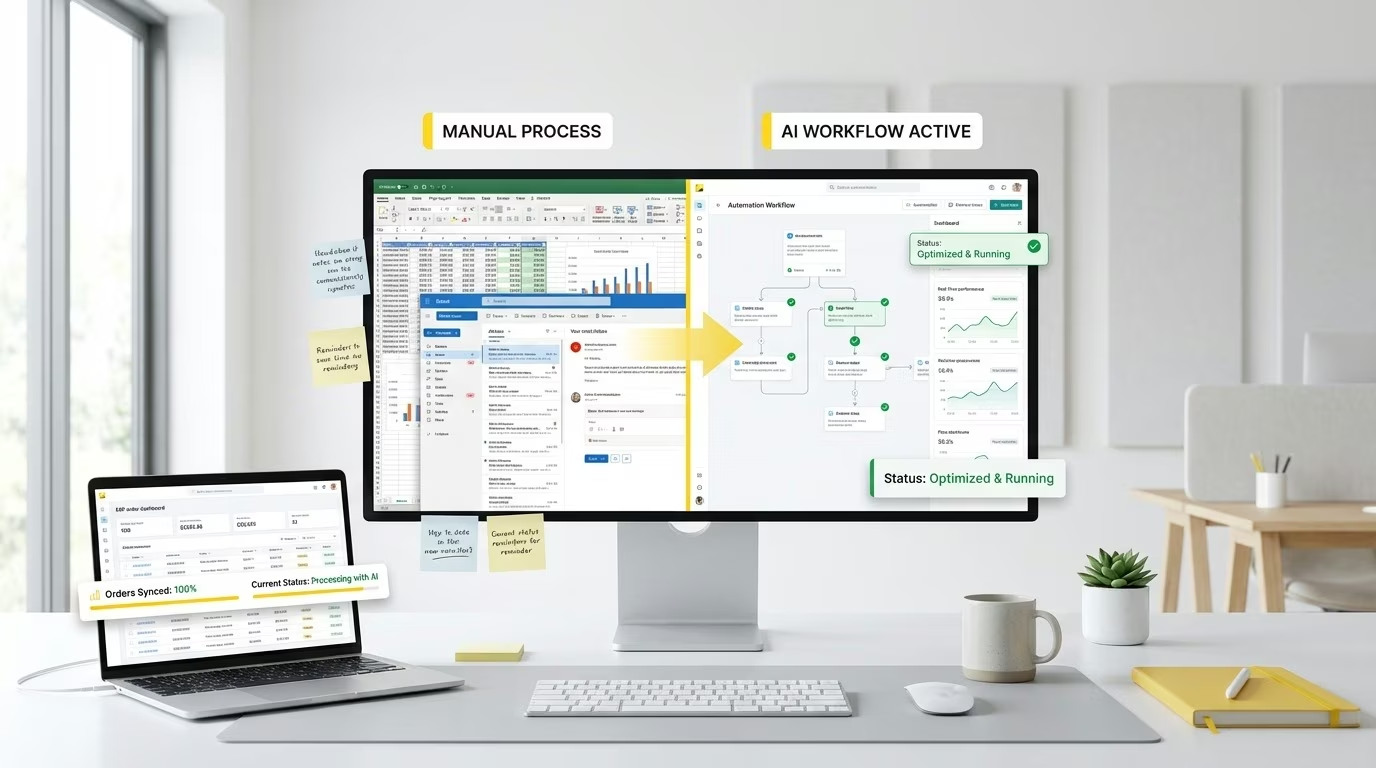
eZintegrations™ is a no-code, visual data pipeline platform that connects disparate systems like ERP, CRM, and financial databases. It helps by:
Goldfinch AI enhances this by extracting data from unstructured formats like invoices, receipts, or scanned contracts using OCR and NLP. It enables:
Together, they eliminate silos, reduce latency, and enable corporate financial statement analysis in real-time.
Financial statement analysis in 2026 is no longer about historical record-keeping. It is about building future-ready insights that enable smarter, faster, and more strategic decisions. Platforms like eZintegrations™ and Goldfinch AI offer transformative capabilities that streamline your reporting, minimize risk, and deliver real-time intelligence.
Book a free demo of eZintegrations™ today and see how AI-driven financial analysis can elevate your enterprise’s performance.
Q1. What is the main purpose of financial statement analysis?
A: To assess a company’s financial health, performance, and potential risks or opportunities through structured interpretation of financial reports.
Q2. What are the best tools for financial statement analysis in 2026?
A: Leading tools include eZintegrations™, Goldfinch AI, Power BI, and ERP-native reporting systems like SAP and NetSuite.
Q3. How does AI help with financial statement analysis?
A: AI automates data extraction, improves accuracy, enables real-time alerts, and supports predictive forecasting using large language models.
Q4. What causes problems in financial statement analysis?
A: Common issues include siloed data, manual errors, lack of standardization, and outdated tools.
Q5. How can I start modernizing our financial analysis process?
A: Begin by automating data pipelines with tools like eZintegrations™ and adding AI capabilities for faster, deeper insights.


© Copyright 2026 Bizdata Inc. | All Rights Reserved
 Watch Demo
 Post on LinkedIn
 Post on Facebook
 Post on Twitter/X