 support@bizdata360.com
 +1-650-283-1644
 AI Enabled Data Integrations and AnalyticsAI Enabled Data Integrations and Analytics

The Pharmaceutical Supply Chain is mission-critical. They connect raw material sourcing, manufacturing, testing, logistics, and delivery of life-saving medicines. Yet many quality teams still rely on humans to manually verify Certificates of Analysis (COA) and Certificates of Conformance (COC), slowing operations, eroding compliance confidence, and introducing avoidable risks.
Manual verification today eats up to 30 percent of quality assurance time and is prone to errors that can trigger regulatory action or recalls. According to Deloitte research, error rates in manual documentation processes can reach 3 to 5 percent, leading to millions in inefficiencies and compliance costs if left unchecked.
This blog is for quality leaders, supply chain managers, and compliance professionals in the pharmaceutical industry who want a practical roadmap to remove manual COA and COC verification from their processes.
If you are struggling with slow batch releases, compliance headaches, or teams buried in paperwork, read for a clear, experience-based guide backed by trusted insights.
TL DR — Key Takeaways
Before we explore details, here’s what you need to know:
Certificates of Analysis (COA) are formal documents that confirm the quality, identity, and purity of a material batch. They include test results, reference methods, specifications, and authentication by a lab or manufacturer.
Certificates of Conformance (COC) show that a product or component meets the required standards or specifications. Both are essential for quality assurance, regulatory compliance, and supply chain transparency.
In pharmaceutical environments, COA and COC verification ensure the materials used in drug manufacturing meet regulatory and internal quality standards before they enter production or are shipped to customers.
This verification is not just the best practice. Regulators such as the FDA require documented proof of quality and independent verification beyond supplier claims to meet Good Manufacturing Practices (GMP). (GMP Trends)
Despite technological advances, many organizations still:
This creates bottlenecks, human error, and poor traceability that can disrupt batch releases, regulatory audits, and supplier onboarding.
Manual document review might have worked in simpler times, but today’s pharmaceutical environment demands speed and precision. Here are the core reasons manual verification fails modern needs:
Unstructured COA formats and diverse supplier templates make manual review error-prone. Even small typographical mistakes in lab result entry can mislead teams or trigger false compliance flags.
Teams often spend hours per certificate manually matching test results to specifications stored in your ERP, LIMS, or QMS. This extends batch release cycles, delaying production and delivery.
Paper files or siloed digital folders lack robust audit trails. GMP and electronic record standards call for verifiable, timestamped documentation. Manual checks often fall short.
Manual verification rarely aligns with modern data integrity standards like the FDA’s 21 CFR Part 11. That can invite warning letters, regulatory holds, or failed inspections if auditors cannot trace decisions back to reliable records.
Shifting from manual to automated COA and COC verification requires rethinking document workflows and data integration across your supply chain. Below is a practical framework.
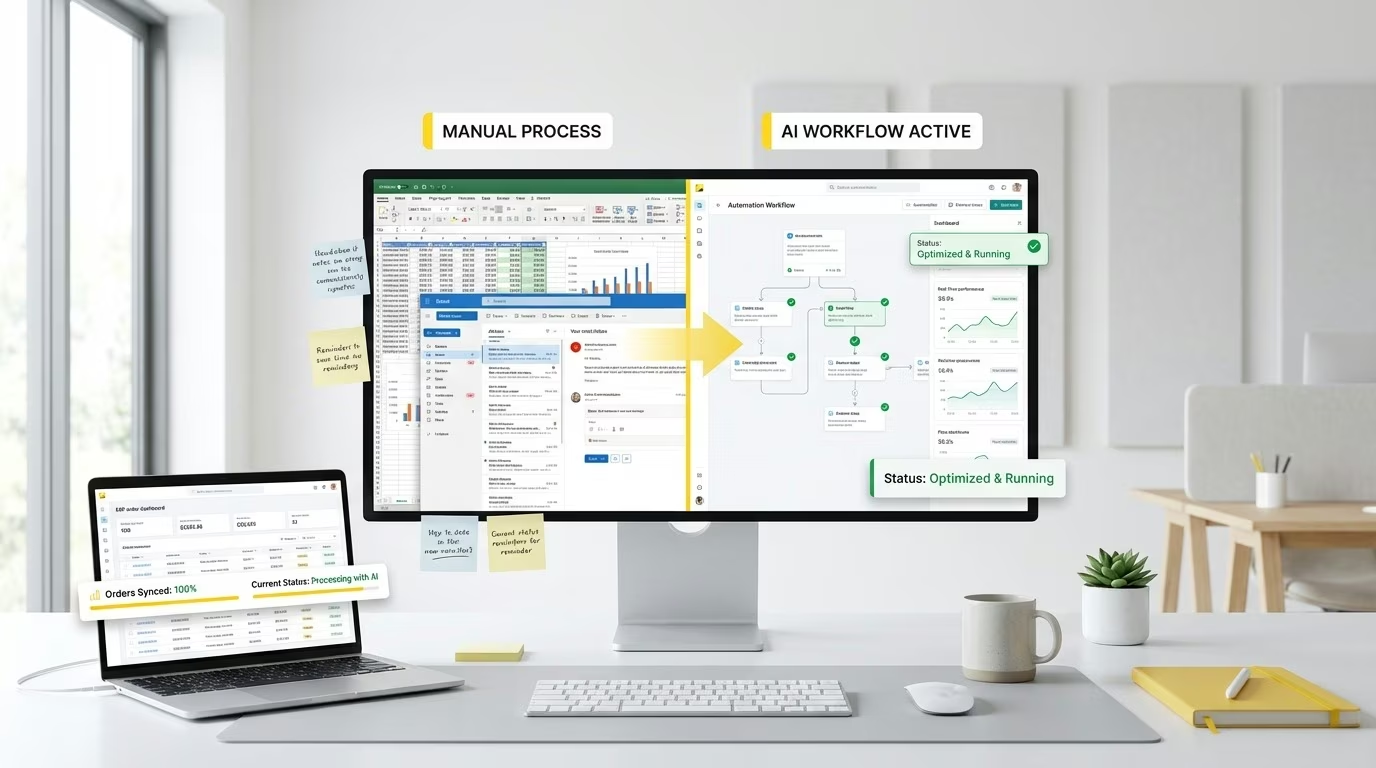
Instead of manual data entry, AI systems extract structured data from unstructured COA and COC documents arriving as PDFs, scans, or emails. The system identifies key fields like product ID, lot number, test results, and compliance criteria with precision.
Automated workflows compare extracted data against your internal quality specs stored in systems like ERP and LIMS. Rules can automatically approve compliant documents or flag out-of-spec results for investigation.
AI-powered verification logs every decision, timestamp, and user action, making audits faster and audit readiness continuous rather than episodic.
Automated ingestion and verification only work if your systems talk to each other. Integration platforms like eZintegrations™ connect document workflows with your QMS, ERP, and compliance repositories so verification becomes part of your regular data flow.
eZintegrations™ AI Document Understanding is designed to automate exactly these frictions. It brings together intelligent document extraction, validation logic, and workflow automation in a platform that fits into existing pharmaceutical IT landscapes.
Here’s how it helps:
Instead of having quality teams manually read and type hundreds of certificates, eZintegrations™ uses AI models to extract structured, verified data instantly. This drives accuracy and saves valuable time.
The solution doesn’t create another silo. It connects with your ERP, LIMS, QMS, and email systems, so COA data flows into the systems where teams already work. That reduces duplication and speeds up verification.
You set the quality parameters and business rules. eZintegrations™ matches extracted COA data against those specs and flags mismatches automatically so teams can focus on exceptions rather than routine checks.
Every processed document includes traceable metadata, validation logic, and review status. When auditors ask for evidence, teams can provide clean records in minutes.
If you want to see how this works in your environment, visit eZintegrations™ AI Document Understanding or book a quick demo and walk through your use case.
Switching from manual to automated verification delivers measurable advantages:
Manual COA and COC verification no longer makes sense in a world where AI can transform accuracy and speed. If your team is still buried in spreadsheets, PDFs, and manual comparisons, you are leaving time and compliance confidence on the table.
Modernize your workflows with eZintegrations™ AI Document Understanding and turn document verification into an engine of efficiency and trust.
Book a quick demo today and see how automation transforms your pharmaceutical quality processes.
Recommend Blogs:
AI-Powered Pharmaceutical Document Management
Easy EHR & EMR Integration – Connecting Healthcare …
Healthcare Industry – AI-Enabled Data Integrations and …
How to Automate Electronic Batch Records (EBR) Using AI?
How to Automate Pharmaceutical Batch Record Review to Ensure Quality?
How Accurate Is AI Document Verification?
AI and machine learning models today can achieve very high accuracy in extracting and interpreting structured data from unstructured documents. Accuracy increases over time as models learn from corrections and feedback.
Can Automation Handle Diverse COA Formats?
Yes. Modern AI document understanding handles varied templates and formats, learning patterns, so it doesn’t rely on fixed templates.
Will Automation Replace Quality Teams?
No. Automation eliminates routine work, but quality professionals remain critical for evaluating exceptions and making decisions.
Is Automation Compliant with GMP and Regulatory Standards?
Yes. When implemented with proper controls, automated verification supports electronic records and audit trails that align with GMP expectations and standards like 21 CFR Part 11.
What Systems Can eZintegrations™ Connect To?
It integrates with common enterprise systems, including ERP, LIMS, QMS, and cloud document repositories.


© Copyright 2026 Bizdata Inc. | All Rights Reserved
 Watch Demo
 Post on LinkedIn
 Post on Facebook
 Post on Twitter/X