 support@bizdata360.com
 +1-650-283-1644
 AI Enabled Data Integrations and AnalyticsAI Enabled Data Integrations and Analytics

Running a Magento store is hard. Between processing high order volumes, managing inventory, and coordinating across sales, support, and operations, it’s easy to miss critical updates.
That’s why Magento Slack Integration can change the game. When you link Magento with Slack, your team gets real-time alerts for orders, stock changes, and system issues replacing manual checks and dramatically shortening response times. Slacks are wildly popular these days. In 2026 it had roughly 47.2 million daily active users and served over 750,000 organizations worldwide.
In fact, according to recent data, among online stores using the Slack App globally, about 6.6 percent are built on Magento.
If you run a Magento store and want your team to act faster, stay aligned, and reduce manual overhead, this guide is for you.
In this post, we’ll walk you through everything from “what” a Magento Slack Integration is, to “why” it matters today and “how” you can implement it effectively.
Whether you’re a small retailer managing a few dozen orders a day or a large brand handling thousands, you’ll uncover practical workflows to save time and avoid costly oversights. We’ll also highlight how eZintegrations™ can simplify this integration and take your automation further.
Magento Slack Integration refers to the connection between your Magento store and Slack, the team communication tool. Once set up, key Magento events trigger notifications directly in Slack channels or DMs for example, when:
These alerts can be configured based on your business rules such as store view, product category, or customer group.
Depending on the integration tool, you may also get richer workflows: custom messaging, channel routing, two-way syncs, or even triggering external processes like CRM updates, inventory restocks, or analytics dashboards.
When someone places an order at 3 AM, you don’t want your team to check Magento the next morning and scramble. With Slack notifications, you get the alert instantly, enabling faster fulfillment.
Real-time alerts also help you catch issues early like failed payments, low inventory, or system errors before they impact customer satisfaction or business continuity.
Slack is where your sales, support, fulfillment, and operations teams already talk. By sending Magento events directly there, everyone stays aligned with what’s happening.
For example:
This reduces context switching, speeds up workflows, and ensures nobody misses critical updates.
Without integration, someone needs to log in to Magento, check pending orders, monitor stock levels, and copy-paste details into Slack or email. That’s tedious and error prone.
Automated Slack alerts eliminate this manual process. As a result, your team can focus on high-value work instead of repetitive admin tasks.
When Magento pushes alerts to Slack, you create a central hub for operations. Teams across departments see the same data simultaneously.
This unified visibility helps leadership, operations, and teams make faster, more informed decisions.
As your store grows, manual oversight becomes unsustainable. An integrated, automated system scales with your volume.
No-code automation tools make it easier for non-developers to maintain and update workflows, which is especially helpful for mid-sized teams or fast-growing stores.
If you want a faster, easier, and more scalable way to connect Magento with Slack, eZintegrations™ gives you a no-code path to get everything running smoothly. The platform handles APIs, data mapping, and automation behind the scenes so your team can focus on the workflows, not the technical setup.
Start by adding Magento as a source system inside eZintegrations™. You can authenticate using your Magento API keys. Once connected, eZintegrations™ automatically reads available data objects like orders, products, inventory, and customers.
Next, choose Slack as your target. You can connect to your workspace in a few clicks and select which channel, or user should receive notifications. eZintegrations™ supports sending messages to multiple channels at once.
Before building the workflow, decide which Magento triggers matter the most. Common examples include:
You can pick one trigger or combine several depending on your business needs.
Inside the workflow builder, select the Magento trigger and map it to the Slack message you want to send. You can customize the message with fields like order ID, customer name, product SKUs, order value, or inventory levels.
eZintegrations™ lets you add logic blocks too, such as sending a different alert for high-value orders or routing inventory alerts to a specific team channel.
Run a quick test to confirm that messages are reaching the right Slack channels with the right data. After that, save and activate the workflow. Once you live, your team will start receiving Magento updates in real time. Book a quick demo to get it done by our expert team.
Most teams struggle with API complexity, custom coding, and maintenance. eZintegrations™ removes all that overhead. You can:
This gives you a cleaner, more reliable Magento Slack Integration that grows with your business and supports your teams across sales, fulfillment, support, and operations.
Let’s imagine a mid-sized online retailer using Magento to manage 5,000–10,000 orders per month. They started with some popular tool to post new orders to Slack. That was fine at first, but soon they faced issues: too many alerts, no way to tie orders to their CRM, no inventory of restock workflows, and no visibility into long-term trends.
Here’s how eZintegrations™ helped:
Result: The retailer reduced manual work by 70%, improved order fulfillment speed, maintained tighter control over inventory, and gained better insight into their sales trends.
This is just one example of how eZintegrations™ transforms Magento Slack Integration from a simple alerting tool into a fully automated, intelligent workflow backbone for e-commerce operations.
Don’t send every event to Slack by default. Choose events that matter like new orders, payment failures, low stock, or order cancellations. Customizable alerts help reduce noise and surface only actionable items.
Map notifications to relevant Slack channels:
This keeps communication focused and reduces confusion.
Critical alerts (like site errors or payment failures) deserve high visibility, perhaps @channel or push notifications. Routine updates (like each order) might be aggregated or batched. Also, consider auto-deleting sensitive info after a defined time.
As your store evolves more products, higher volume, more integrations the workflows built in day one may no longer scale. Periodically audit what’s working, what’s noise, and optimize accordingly.
When sending store data to Slack, make sure API keys are stored securely, use encryption, control access to Slack channels, and comply with relevant data protection and retention policies especially when handling sensitive customer data.
Too many notifications
Result: Alert fatigue and missed critical updates.
Solution: define clear rules for what triggers Slack alerts and batch non-critical ones.
Unstructured or confusing messages
Result: Team members don’t know what action to take.
Solution: Use clear, consistent message templates that include order ID, status, action required, and fallback channels for follow-up.
Ignoring long-term workflows
Result: over-reliance on manual tasks, missed opportunities for automation.
Solution: review workflows quarterly and extend them to CRM, ERP, or analytics systems using eZintegrations™ or similar platforms.
Slack data overload and security risks
Result: sensitive data scattered, hard to manage, and potentially exposed.
Solution: limit data shared over Slack, implement access controls, and purge or archive old messages as needed.
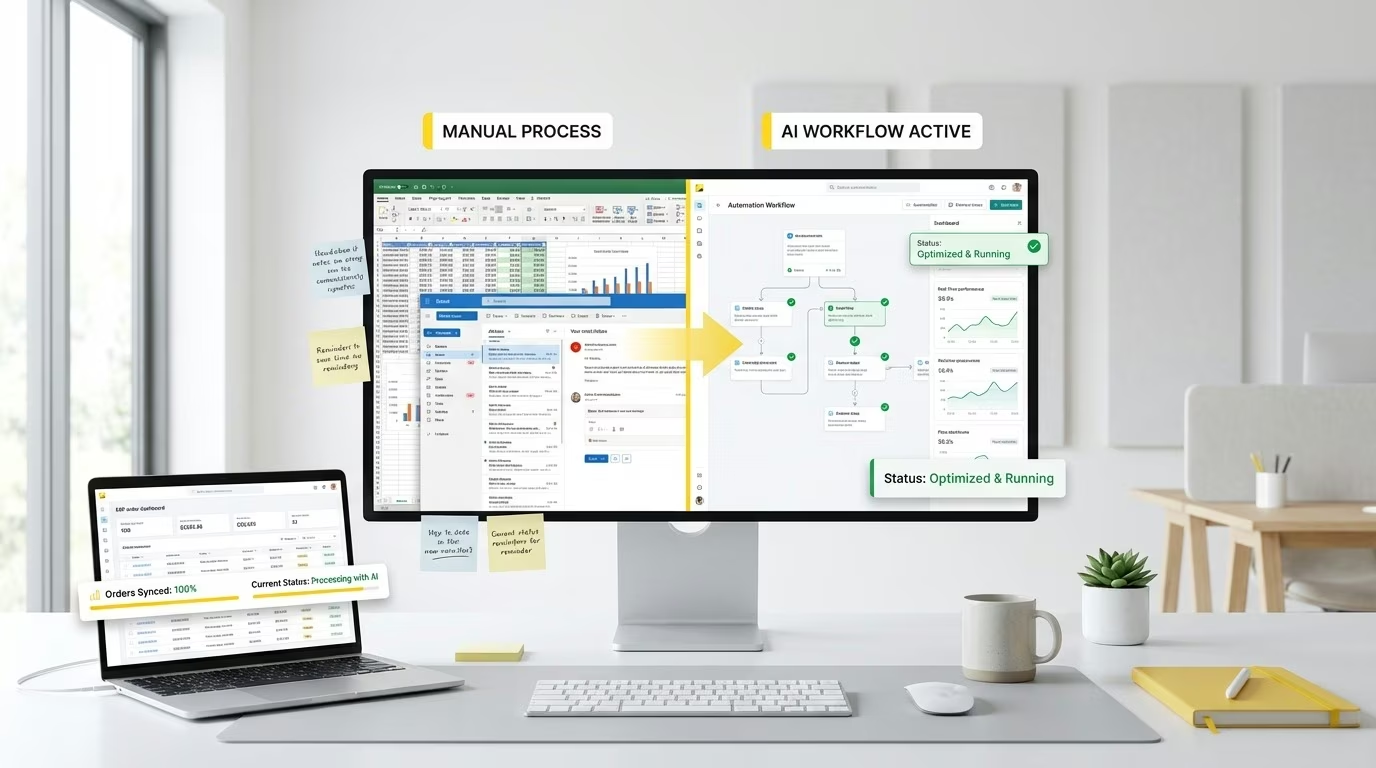
If you run a Magento store in 2026 and your team still relies on manual checks, scattered spreadsheets, or emails to track orders, inventory, and customer issues, you are working harder than you need to. Magento Slack Integration transforms the way your team works from reactive manual workflows to proactive, automated, and efficient operations.
With a no-code platform like eZintegrations™, you can go beyond simple alerts. You can build full workflows connecting Magento to CRM systems, inventory management, analytics, and more with minimal setup.
Ready to move your store into the fast lane? Book a free demo of eZintegrations™ today and see how quickly you can build smarter, AI-powered workflows that save time, reduce errors, and keep your team aligned.
eZintegrations™ is one of best tool/platform for Magento Slack Integration.


© Copyright 2026 Bizdata Inc. | All Rights Reserved
 Watch Demo
 Post on LinkedIn
 Post on Facebook
 Post on Twitter/X