 support@bizdata360.com
 +1-650-283-1644
 AI Enabled Data Integrations and AnalyticsAI Enabled Data Integrations and Analytics


If your sales team closes a deal and your accounting team only learns about its days later, you’re living in the era of disjointed workflows and that’s costing your business time, money and growth. In fact, organizations that integrate CRM and accounting systems experience up to a 30% increase in productivity and a 25% reduction in administrative costs. (Source)
In this blog post, we dive into the full guide of QuickBooks Salesforce Integration, why you need it, and how to make it happen smoothly in 2026. You’ll walk away with an understanding of how to align your sales and finance teams, reduce errors, improve cash flow and scale your operations using the right tool, and yes, how our platform eZintegrations™ fits in.
This guide is for marketing leaders, finance officers, IT chiefs, and operations managers in US-based mid-sized B2B companies who want their systems to work together, rather than against each other.
QuickBooks is a popular accounting software used by small and mid-sized businesses to manage their finances with ease. It helps companies track income and expenses, create invoices, run payroll, manage bills, and generate financial reports from one place. Finance teams rely on it for accurate bookkeeping and real-time visibility into cash flow, which keeps the business organized and audit ready.
QuickBooks Salesforce Integration is the process of connecting your CRM (Salesforce) with your accounting system (QuickBooks) so data such as customer records, invoices, payments, sales orders flows seamlessly between the two platforms rather than getting manually re-entered.
Here are typical data points that businesses sync when integrating:
In 2026, companies expect data in real-time, cross-department collaboration, and fewer silos. According to recent guides, the top integration for business systems is QuickBooks with Salesforce, especially as AI, cloud and automation mature.
When your systems don’t talk, you end up with inconsistent data, slower billing cycles, a frustrated sales team, and finance in the dark. Integration removes those bottlenecks.
Here are the business benefits:
Manual data re-entry wastes time and introduces mistakes. As one article puts it, employees spend 13% of their time on redundant tasks. Integration automates tasks like creating invoices and updating payment status.
With sales and finance teams working from the same dataset, you get insights faster and make better decisions. For example, knowing a customer’s unpaid invoice before offering them a new discount.
When your sales data feeds into invoices automatically, you reduce time-to-invoice and time-to-payment. That accelerates cash flow and improves your working capital.
As you grow, manual tasks replicate badly. Integration supports scale. It also reduces reconciliation errors and ensures a single source of truth. For example, one 2026 update reports “reduces 15+ hours monthly on manual reconciliations”.
When your CRM and accounting system both feed accurate data, you unlock advanced analytics and AI potential whether it’s forecasting, customer lifetime value modeling or predictive churn analysis.
Implementation has multiple stages: planning, selection, mapping, deployment, and monitoring.
Before you choose any tool, ask:
Here are common methods:
Given your enterprise needs, a no-code AI workflow automation platform like eZintegrations™ can dramatically simplify this step by offering drag-and-drop mapping, pre-built connectors and native support for API/service integrations (REST, SOAP, GraphQL, gRPC).
Mapping means aligning fields between Salesforce and QuickBooks. Example: Salesforce “Opportunity” → QuickBooks “Invoice”.
Trust-worthy integration requires:
Never go live immediately. Run a sandbox integration with a subset of data. Test for accuracy, latency, and exception handling.
Once live:
As you grow, you may want to sync additional systems (inventory, ERP, BI). Because eZintegrations™ supports multiple system bridges and API marketplace, you avoid being locked into just Salesforce ↔ QuickBooks.
Here are the core ways eZintegrations™ helps:
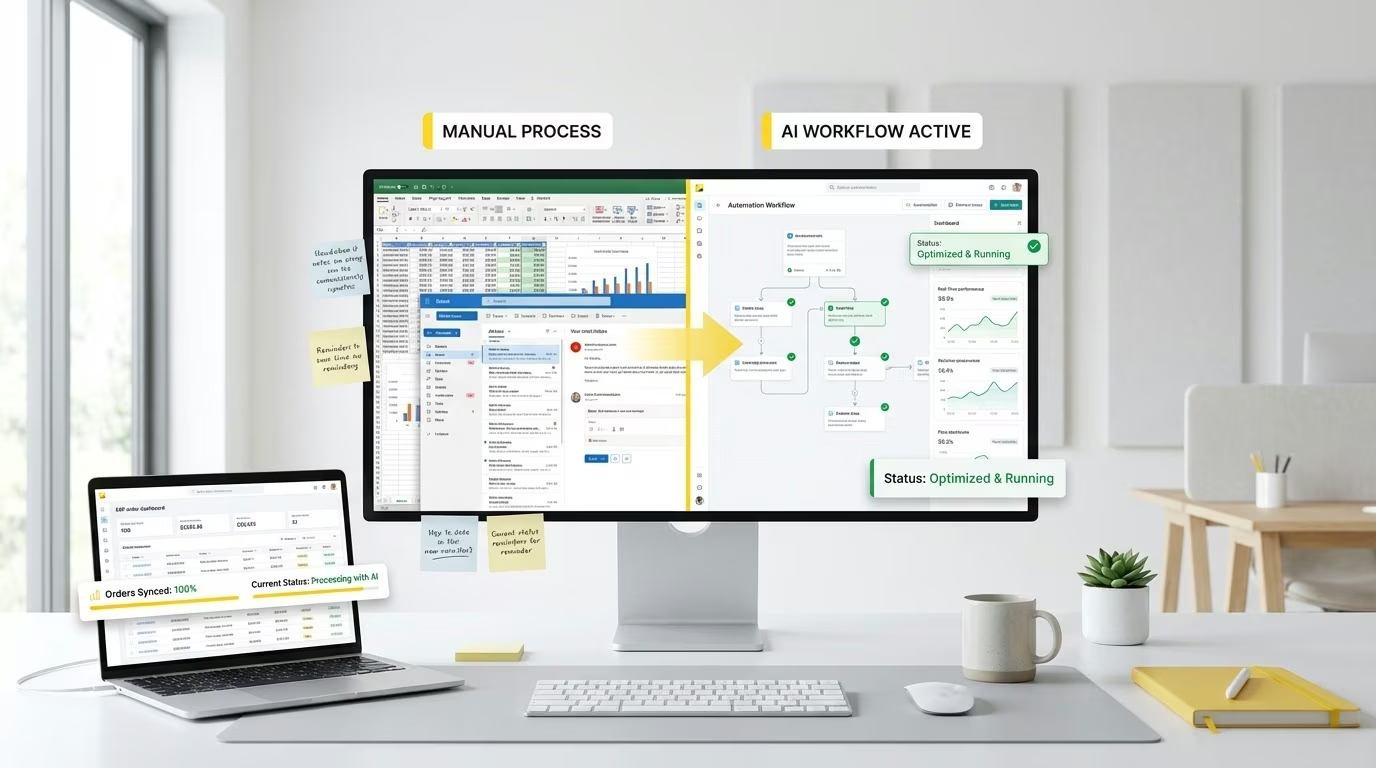
A mid-sized US B2B company uses Salesforce for tracking leads and opportunities, and QuickBooks Online for invoicing. Before integration: sales reps ended deals, accounting got the data via CSV after a day delay, payment follow up lagged, and disputes around duplicate invoices happened monthly.
With eZintegrations™ in place:
When selecting your tool, evaluate on:
Because you get more than just a connector: you get a full AI-enabled workflow automation engine that allows you to:
How are companies using this integration today:
Sales team closes an order in Salesforce → invoice automatically generated in QuickBooks → payment status flows back to Salesforce → sales rep follows up for renewals.
Customer record in Salesforce synced with accounting data from QuickBooks, including payment history. Enables sales or service teams to reference financials without switching systems.
Finance sees the sales pipeline in Salesforce and can forecast revenue based on closed deals. Sales see outstanding invoices and credit limits in real time.
As deal volume grows, manual entries explode. Integration allows you to scale without proportional headcount growth.
Here are a few steps you should take to ensure success:
How do you know your integration is working? Here are some relevant KPIs:
Mitigation – get your data clean before integration, set robust mapping and master data rules.
Mitigation – involve users early, train them, shows clear value to each department.
Mitigation – choose a platform that supports multiple systems and future workflows (e.g., eZintegrations™).
Mitigation – ensure your integration tool supports secure authentication, audit logs, and compliance with your regulations.
If your sales and finance systems are operating in isolation, you’re missing out on efficiency, accuracy and growth. The integration of QuickBooks and Salesforce is no longer optional it is essential in 2026. With a well-planned integration, you’ll streamline operations, reduce manual effort, unlock insights, and scale faster.
When you partner with a platform like eZintegrations™, you’re not just connecting two systems, you’re building an intelligent workflow engine that evolves as your business does.
Ready to see how it works? Book a free demo of eZintegrations™ today and discover how your company can join the dozens of US-based B2B businesses that are closing the loop between sales and finance with intelligence, clarity and speed.
Yes. Many integrations tools support QuickBooks Online out-of-the-box and also offer connectors for QuickBooks Desktop (though Desktop often requires gateway/configuration).
That depends on data volume and complexity. A basic connector can be deployed in days; a full enterprise-scale, custom workflow integration may take several weeks to a few months.
Integration doesn’t fix bad data; it propagates it. That is why data cleaning, mapping, and governance upfront are critical. Without that, you risk amplifying mistakes.
Not necessarily. Pre-built connectors and no-code platforms enable business analysts to set up many workflows. If you have complex requirements (custom fields, bidirectional real-time sync, multiple systems), you may still need developer support.
Standard connectors often focus on one or two data flows (e.g., invoices). eZintegrations™ supports full AI workflow automation, connects multiple systems, offers drag-and-drop mapping, supports API monetization and broad enterprise use cases not just a simple link between two platforms.


© Copyright 2026 Bizdata Inc. | All Rights Reserved
 Watch Demo
 Post on LinkedIn
 Post on Facebook
 Post on Twitter/X