This blog offers actionable best practices and explores tools, trends, and challenges in detail.
SaaS applications are the backbone of modern enterprises. By 2026, the average mid-size business is expected to use over 130 SaaS apps across departments (BetterCloud, 2024). However, the explosion of these tools often leads to siloed data, inconsistent reporting, and security risks. SaaS data integration addresses this by connecting disparate applications and enabling seamless data flow across systems. For tech professionals, the stakes are high: fragmented data means missed opportunities, compliance headaches, and slow decision-making. Integrating SaaS data effectively is not just an IT task—it’s a competitive advantage.
In this guide, we’ll cover the full landscape of SaaS data integration in 2026: what it is, why it matters, common challenges, and best practices.
What is SaaS Data?
Before diving into integration, it’s essential to understand the nature of SaaS data. SaaS data refers to information generated, stored, or processed by software-as-a-service applications like Salesforce, HubSpot, NetSuite, and Slack.
These applications manage various data types:
Customer data (CRM, support platforms)
Financial data (accounting and ERP tools)
Operational data (project management, logistics)
Marketing data (campaign performance, lead tracking)
User behavior data (web analytics, app events)
This data is typically stored in vendor-specific cloud environments and accessed via APIs or export tools. Its distributed and dynamic nature makes SaaS data integration a strategic necessity.
What is SaaS Data Integration?
SaaS data integration is the process of synchronizing data between multiple SaaS applications and other systems such as on-premise databases, data lakes, or analytics platforms.
It enables organizations to:
Eliminate data silos
Create a 360-degree view of customers
Automate workflows between systems
Drive unified reporting and analytics
Integration can be achieved through APIs, event-based connectors, iPaaS solutions, or custom-built middleware. In 2026, modern platforms are increasingly powered by AI and low-code interfaces, making integration faster and more scalable.
Benefits of SaaS Data Integration
Effective SaaS data integration provides measurable gains across teams, from marketing and sales to finance and IT.
Here’s how integrated SaaS data transforms organizations:
Improved decision-making: Unified data allows for accurate, real-time insights.
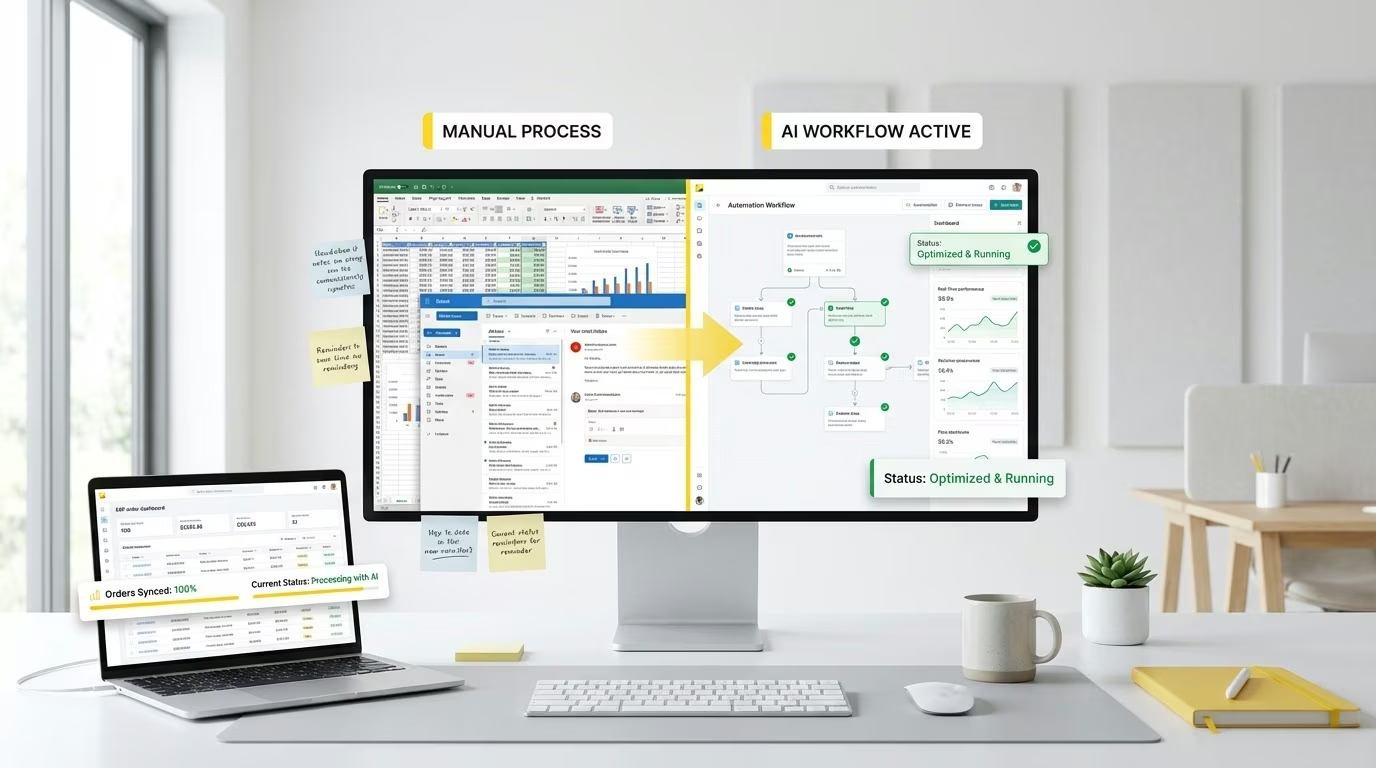
Operational efficiency: Automate data syncing and eliminate manual entry.
Enhanced data governance: Central control over data security and compliance.
Personalized customer experiences: Merge customer data from multiple touchpoints.
Cost savings: Reduce duplicate tools and avoid data silos.
Challenges of SaaS Data Integration
Despite its advantages, integrating SaaS data isn’t without hurdles. As enterprises scale, the number of data sources and compliance requirements multiplies.
Some key challenges include:
Data inconsistency: Varying formats, schemas, and standards across tools.
API limitations: Many SaaS APIs have rate limits or lack support for historical data.
Security risks: Poorly integrated systems increase vulnerability to data breaches.
SaaS data governance: Difficulty enforcing policies across decentralized environments.
Legacy system incompatibility: Bridging cloud SaaS and on-premise systems is often complex.
Example of SaaS Data Integration
Let’s take an eCommerce company using Shopify, HubSpot, and NetSuite. Without integration:
Marketing runs campaigns in HubSpot without access to order history from Shopify.
Finance manually exports data from Shopify to reconcile with NetSuite.
Operations can’t track customer lifetime value easily.
With a SaaS data integration platform:
Customer data flows seamlessly from Shopify to HubSpot and NetSuite.
Marketing personalizes outreach based on past purchases.
Finance and operations access real-time sales and inventory insights.
This eliminates duplication, improves customer experience, and boosts agility.
SaaS Data Integration Best Practices
To succeed with SaaS data integration in 2026, tech professionals should follow a clear set of strategic and technical best practices. These ensure scalability, performance, and security.
Here are the best practices to follow:
Start with a data strategy: Identify key business objectives and align data flows accordingly.
Map data relationships: Understand how data travels across apps and where transformations are needed.
Choose the right platform: Evaluate SaaS data integration tools based on scalability, ease of use, and connector availability.
Automate where possible: Use event-based triggers and AI for intelligent syncing.
Secure your integrations: Encrypt data in transit, use authentication, and follow SaaS data protection standards.
Monitor and audit regularly: Use observability tools to detect issues and ensure compliance.
AI SaaS Data Integration
AI is reshaping SaaS data integration with intelligent mapping, anomaly detection, and contextual enrichment.
How AI improves integration:
Automated data mapping: Machine learning suggests field-level matches across systems.
Smart error resolution: AI recommends solutions for failed workflows.
Natural language configuration: Users can set up integrations with conversational prompts.
Predictive analytics: Prepares unified data for AI/ML models and forecasting.
Goldfinch AI, for example, enhances unstructured data understanding by extracting insights from PDFs, scanned documents, or invoices. This capability transforms previously untapped data into integration-ready formats, reducing manual effort and accelerating time to value.
SaaS Data Integration Future Trends in 2026
The future of SaaS data integration is deeply intertwined with AI, data decentralization, and automation.
Emerging trends to watch:
Data mesh architectures: Decentralized, domain-oriented data ownership models.
Composable data infrastructure: Plug-and-play integration layers tailored to business use cases.
AI-driven observability: Proactive monitoring of data flows and pipeline health.
Privacy-first integration: Tools built with built-in compliance and consent management.
Unified API marketplaces: Reusable, vendor-agnostic APIs for faster deployment.
Platforms like eZintegrations™ are adapting to these shifts with no-code visual builders, pre-built connectors, and customizable integration bridges, making future-ready integration more accessible.
How eZintegrations™ and Goldfinch AI Help with SaaS Data Integration
For tech professionals dealing with complex, multi-app environments, eZintegrations™ and Goldfinch AI offer complementary advantages. eZintegrations™:
No-code SaaS data integration platform with visual drag-and-drop workflows
Supports databases, APIs, SFTP, ERP, CRM, and cloud data lakes
Built-in API marketplace with 1000+ ready-to-use connectors
Real-time sync and issue tracking for proactive integration management
Converts scanned files, PDFs, and unstructured inputs into clean, structured data
Ideal for industries like legal, logistics, and healthcare
Together, they help organizations:
Eliminate data silos
Enhance SaaS data governance
Integrate legacy and modern systems
Automate repetitive data extraction tasks
Use Cases for SaaS Data Integration
The value of SaaS data integration goes far beyond simple data syncing. In 2026, integration enables advanced use cases that drive strategic growth and operational agility.
Here are some powerful use cases that illustrate the depth of modern SaaS data integration:
Customer Data Platforms (CDPs): Unify CRM, marketing automation, customer support, and website analytics into a central customer profile for hyper-personalization.
End-to-End Supply Chain Visibility: Connect ERP, logistics, warehouse management, and procurement tools to track goods from suppliers to customers in real-time.
Finance Automation & Reporting: Integrate accounting software, invoicing platforms, and banking APIs to automate reconciliation, forecasting, and compliance reporting.
Employee Onboarding Automation: Combine HRIS, IT service management, and payroll systems to streamline onboarding and ensure data consistency across departments.
Regulatory Compliance and Audit Readiness: Connect document management systems with compliance software to maintain traceability and automate audit trails.
IoT & SaaS Integration for Smart Operations: Merge real-time IoT sensor data with SaaS-based analytics or BI dashboards to optimize manufacturing, energy usage, or equipment maintenance.
AI-Ready Data Lakes: Feed structured and unstructured data from SaaS sources into centralized data lakes for machine learning model training and inference.
Healthcare Data Aggregation: Integrate EHR, insurance, lab systems, and patient portals to provide clinicians with complete, real-time patient insights.
Each of these use cases leverages the strengths of SaaS data integration platforms to deliver business value, reduce manual effort, and increase agility in decision-making.
Conclusion: Your Next Step Toward Smarter Integration
SaaS data integration in 2026 is not a nice-to-have; it’s mission-critical. As tech stacks evolve, organizations need smart, secure, and scalable ways to connect their data sources.
With tools like eZintegrations™ and Goldfinch AI, tech professionals can streamline operations, power better insights, and stay ahead of competitors. Ready to simplify your SaaS data integration strategy? Book a free demo call today.
Frequently Asked Questions (FAQ)
1. What is SaaS data integration?
It’s the process of connecting SaaS applications to each other or other systems, enabling seamless data flow and unified insights. 2. Why is SaaS data integration important in 2026?
With over 130 apps used on average by businesses, integration prevents data silos and ensures real-time decision-making. 3. What tools can help with SaaS data integration?
eZintegrations™, Zapier, MuleSoft, and Boomi are some tools, with eZintegrations™ offering a no-code interface and 1000+ pre-built connectors. 4. What is the role of AI in SaaS data integration?
AI automates field mapping, resolves data mismatches, and prepares data for analytics. Goldfinch AI adds document understanding and extraction capabilities. 5. How secure is SaaS data integration?
Security depends on encryption, API authentication, data governance, and monitoring tools. Platforms like eZintegrations™ offer built-in logging and real-time alerts for added security. 6. Which data integration platforms provide pre-built connectors for popular SaaS applications? eZintegrations provide pre-built connectors for popular SaaS applications.
 support@bizdata360.com
 +1-650-283-1644
 AI Enabled Data Integrations and Analytics


 Watch Demo
 Post on LinkedIn
 Post on Facebook
 Post on Twitter/X