 support@bizdata360.com
 +1-650-283-1644
 AI Enabled Data Integrations and AnalyticsAI Enabled Data Integrations and Analytics

If your IT service management system (ServiceNow) and your core enterprise resource planning system (SAP) still operate in silos, you’re leaving real business value on the table. You may still experience redundant data entry, slow reaction to business-impacting incidents, and incomplete visibility into how IT issues ripple into business operations.
The average enterprise runs nearly 900 applications, yet only 29% are integrated. In this context, a robust ServiceNow SAP integration is no longer an optional nice-to-have; it’s a strategic necessity.
This guide is written for IT leaders, enterprise architects, integration managers, and business analysts in the US who are preparing or executing a ServiceNow-SAP integration in 2026. I’ll show you what to know, how to approach it and why implementing with a tool like eZintegrations™ positions you for smarter, AI-enabled workflows instead of just stitching systems together.
ServiceNow is a leading cloud-based digital workflow platform that helps enterprises automate and manage IT, HR, customer service, and other core business operations from a single system.
It streamlines service requests, incident management, change control, and workflow approvals, enabling teams to work more efficiently with real-time visibility and collaboration. By connecting people, processes, and data, ServiceNow turns manual, fragmented processes into unified digital workflows that improve productivity, compliance, and customer experience.
A ServiceNow SAP integration refers to the technical and process-oriented linkage between ServiceNow (the workflow/IT service management platform) and SAP (the enterprise ERP backbone) such that:
Integration scenarios include:
Almost every enterprise I speak to has one or more of these pain points:
By mastering the ServiceNow SAP integration, you move from reactive firefighting to proactive, connected intelligence from merely handling tickets to optimizing business flows.
Integrating ServiceNow with SAP creates a connected ecosystem that enhances visibility, agility, and intelligence across IT and business operations.
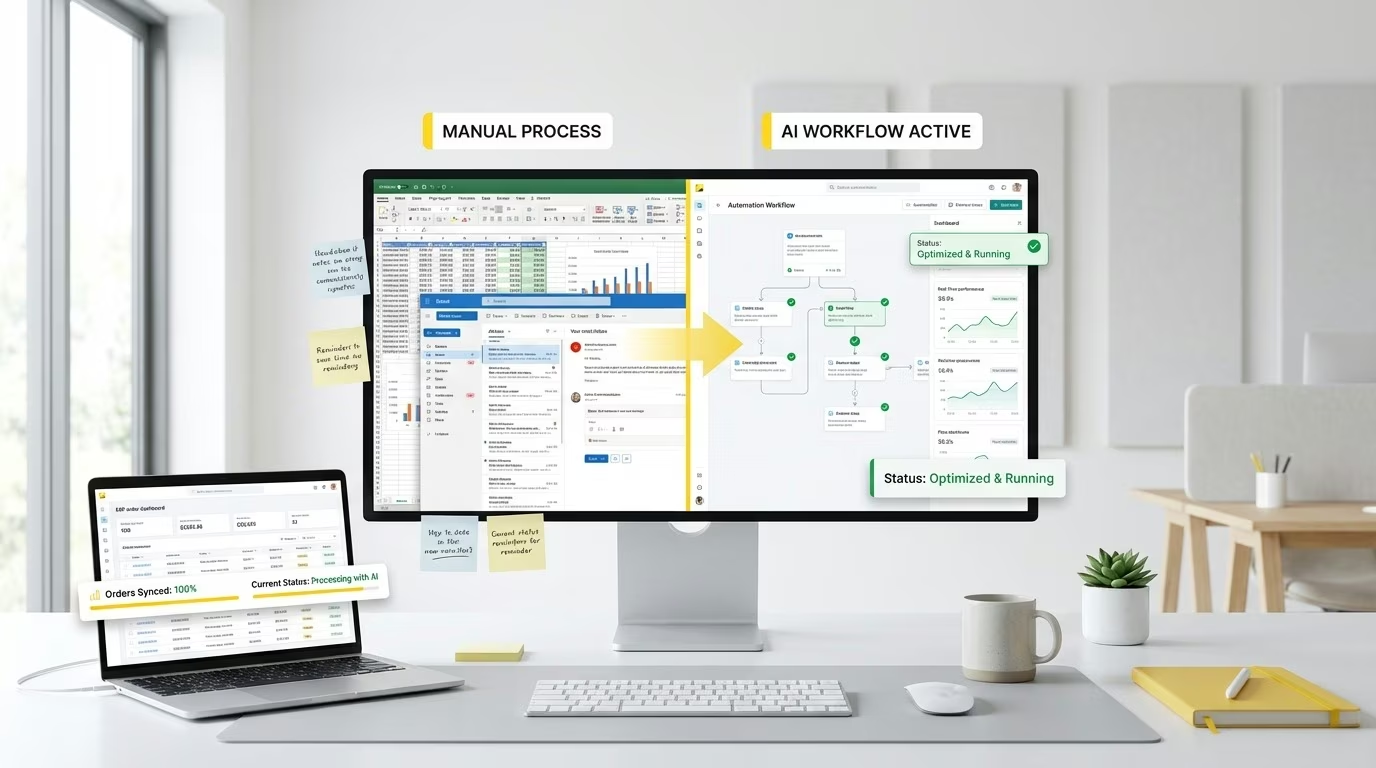
Integrating ServiceNow and SAP with eZintegrations™, a no-code AI data workflow automation platform, helps enterprises connect systems quickly, cut manual work, and build intelligent workflows.
Step 1: Define Scope & Objectives
Identify key processes like incident-to-cost-centre updates or HR onboarding. Set clear goals and measurable KPIs such as error reduction or faster resolution times to track ROI and business impact.
Step 2: Configure in eZintegrations™
Use the drag-and-drop builder and prebuilt connectors from the Bizdata API Marketplace (1000+ APIs) to link SAP and ServiceNow. Set one-way or two-way data flows and connect multiple targets without coding or middleware.
Step 3: Map Data & Security Policies
Map objects like incidents, cost centres, or assets. Define triggers, validate data flows, and apply governance and audit controls to protect sensitive information.
Step 4: Pilot & Validate
Run a pilot for one high-value use case like asset onboarding. Monitor data accuracy and latency using dashboards, refine workflows, and validate results with both IT and business teams.
Step 5: Scale with AI Workflows
After validation, roll out new scenarios, embed AI for anomaly detection or predictive workflows, and monitor ROI. eZintegrations™ turns integration into continuous AI-driven workflow intelligence.
Here’s how our platform (eZintegrations™) can enable this integration with speed and intelligence.
A large US enterprise was connecting SAP S/4HANA and ServiceNow manually. They faced: manual data transfers, frequent errors in cost-centre data, delayed incident resolution, and lack of unified visibility.
Rather than struggle with custom code and long timelines, the enterprise used eZintegrations™ to treat their integration as a strategic intelligence workflow. They positioned ServiceNow–SAP as a combined intelligence engine, not just two systems connected.
Even with a solid strategy, you’ll face issues. Here are major and mitigation strategies.
Many SAP landscapes are heavily customized. Standard connectors may not work out of the box.
Mitigation:
Bad data on either platform undermines integration.
Mitigation:
Integration touches IT, business operations, finance, and more. Without buy-in, projects stall.
Mitigation:
High data volumes (millions of records) can stress systems. For example, one solution supports 20 + million records daily between ServiceNow and SAP HANA. Perspectium
Mitigation:
To emphasize how eZintegrations™ shifts the paradigm:
In short: you move from “integration project” to “intelligence workflow project”.
Here are actionable tips tailored to US enterprises integrating ServiceNow and SAP in 2026.
If you’re managing enterprise, IT and business operations in the US and haven’t yet tackled the integration between ServiceNow and SAP, you’re at risk of falling behind. A robust ServiceNow SAP integration is no longer optional, it’s foundational to operational excellence, business agility and future-proofing your architecture.
By following a structured approach defining scope, choosing the right architecture, mapping workflows, piloting, scaling and by leveraging a platform such as eZintegrations™, you position your organization not just to connect systems, but to deliver intelligence.
If you’d like to explore how eZintegrations™ can accelerate your ServiceNow–SAP integration (and embed AI-data workflows for business value), Book a free demo with us today. Let’s turn integration into insight, and data into strategic intelligence.
SAP integration Suite: Ultimate Guide 2026
How to Automate Complex Business Workflow Without Writing Code?
How U.S. Enterprises Are Preparing for the Agentic AI Era?
SAP and Salesforce Integration Simplified by eZintegrations
How to Integrate Data Between Legacy Systems and SaaS Apps?
Q1. What typical data objects are exchanged in a ServiceNow-SAP integration?
Common data objects include cost centres, user/employee records, IT assets, change requests, incidents, procurement workflows, and financial transactions. The exact objects depend on your business processes.
Q2. How long does a ServiceNow–SAP integration project usually take?
It depends on scope and complexity. A pilot might take 6-12 weeks if you use pre-built connectors and a no-code platform. Larger scale rollouts may take 6-12 months. Using eZintegrations™ can shorten the timeline considerably.
Q3. Can highly customized SAP landscapes still integrate with ServiceNow?
Yes. While standard connectors may cover baseline scenarios, you’ll likely need custom API mapping, transformation logic and workflow design. Using a flexible platform like eZintegrations™ helps to handle custom APIs and bespoke workflows.
Q4. How do we measure the success of integration?
Track metrics such as reduction in manual entries, number of automated transactions, mean incident resolution time, reduction in error rate, business process downtime, compliance/audit gaps closed. Establish baseline metrics for pre-integration.
Q5. What are the key risks and how can we mitigate them?
Key risks include data quality issues, performance/volume constraints, stakeholder misalignment, and scope creep. Mitigation involves data audits upfront, pilot rollout, governance model, modular architecture, and transparent stakeholder communication.
Q6. Which is the best platform for Servicenow SAP Integration?
eZintegrations™ is one the best platform for Servicenow SAP Integration.


© Copyright 2026 Bizdata Inc. | All Rights Reserved
 Watch Demo
 Post on LinkedIn
 Post on Facebook
 Post on Twitter/X