 support@bizdata360.com
 +1-650-283-1644
 AI Enabled Data Integrations and AnalyticsAI Enabled Data Integrations and Analytics

Data is growing at an explosive rate. According to Statista, over 328 million terabytes of data are created every day worldwide. But amidst this digital explosion, organizations face growing pressure to protect sensitive information, comply with regulations like GDPR and HIPAA, and minimize risk. Yet, most businesses struggle with a critical gap they don’t know what data they have or how sensitive it is.
That’s where data classification becomes essential. Whether you’re a security architect, compliance officer, or data engineer, understanding what data you store, where it resides, and how it should be handled is a foundational step. This guide breaks down what data classification is, the types and levels involved, how to implement it effectively, and how AI tools are changing the game.
Data classification is the process of organizing data into categories based on its type, sensitivity, and business value. It is much more than just labeling information; it’s the foundation of a secure and efficient data ecosystem. At its core, data classification organizes data into predefined categories based on sensitivity, content, or purpose. This categorization helps organizations apply the right policies, security controls, and compliance measures.
In practice, classification considers three dimensions: the context (who uses the data), content (what’s inside), and risk (impact of exposure). It’s often the first step in any robust data governance or cybersecurity strategy.
Not all data is equal, and classifying it based on sensitivity ensures it gets the right level of protection. The four primary types of classification widely used across industries include:
Implementing a classification strategy isn’t just about security; it has wide-reaching benefits for business efficiency, compliance, and decision-making. Here’s how it helps:
Seeing real-world examples brings clarity to why classification matters. Each industry handles sensitive data differently, and applying the right classification ensures data is protected, compliant, and efficiently used across workflows. Below are common industry-specific scenarios that show how strategic classification drives better outcomes:
These examples illustrate how classification is foundational not just for security and compliance, but also for operational efficiency and business agility.
Data classification isn’t just a compliance checkbox; it plays a critical role in shaping a secure, efficient, and scalable data strategy. As data volumes grow and threats become more sophisticated, understanding what data you have and how it should be handled is vital. Without proper classification, organizations face significant risks and operational inefficiencies:
A well-implemented classification system not only reduces risk but also empowers secure innovation, allowing teams to work confidently while maintaining regulatory compliance and customer trust.
Proper classification takes planning and the right tools. It’s not a one-off task, but a continuous process embedded into data operations. Here’s how to start:
To ensure long-term success, organizations must adopt field-tested best practices when implementing data classification at a scale. These foundational steps not only reduce manual errors but also improve compliance, security posture, and operational efficiency:
These best practices form the backbone of a scalable, secure, and intelligent data classification strategy.
Also Check out: What are Data Silos? Problems & Solutions Guide 2026
Structured vs Unstructured Data: Comprehensive Guide 2026
The market offers a variety of tools for different environments and needs. Whether you’re classifying structured or unstructured data, these solutions lead the way:
Even the best strategies face real-world hurdles. Recognizing these challenges helps your organization build more resilient and effective classification systems:

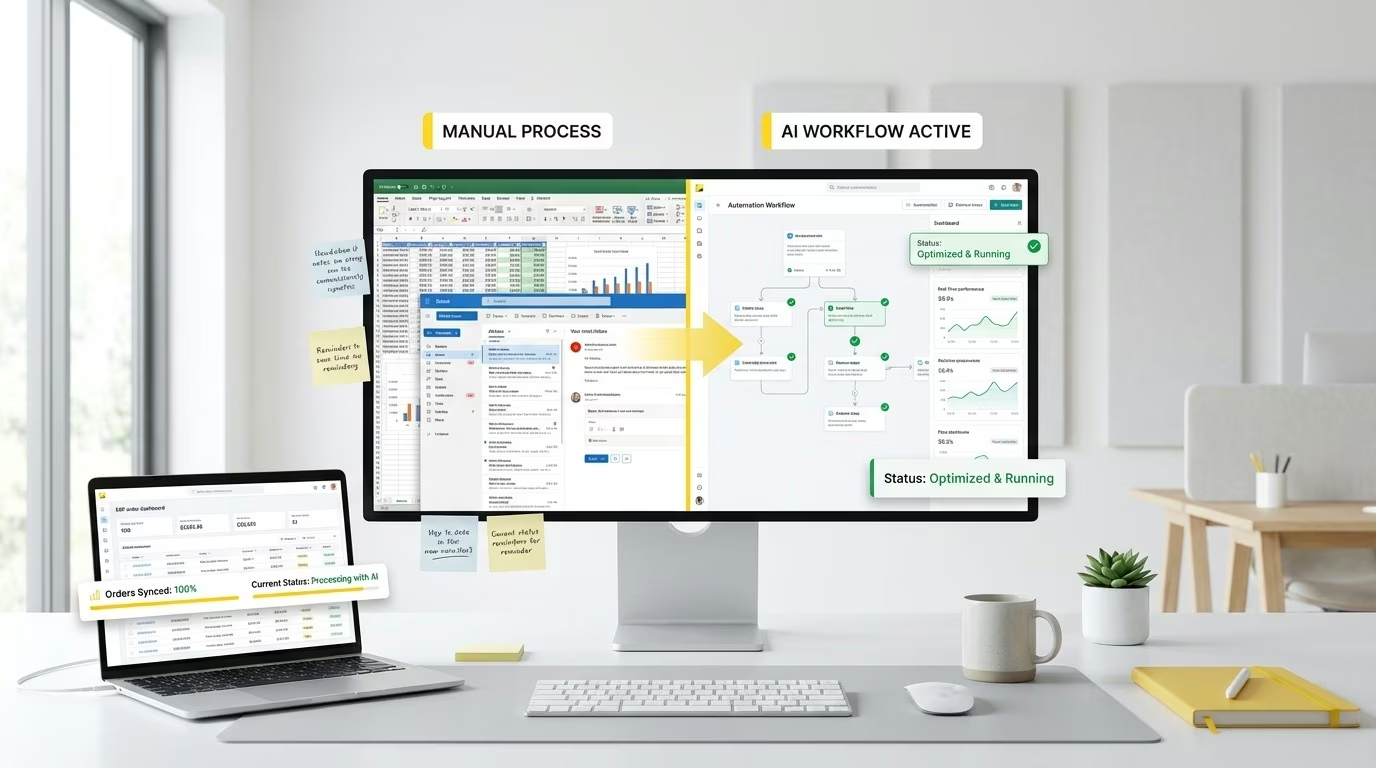
AI is transforming how organizations approach data classification. Traditional methods often rely on manual tagging or rule-based systems that are slow, error-prone, and difficult to scale. AI solves these bottlenecks by automatically analyzing data patterns, structure, and semantics. This enables faster and more accurate classification across large data volumes.
Modern platforms like eZintegrations™ apply machine learning to intelligently tag, categorize, and manage structured and semi-structured data across diverse systems, including cloud apps, databases, and APIs.
Meanwhile, Goldfinch AI enhances unstructured data classification by using advanced OCR and NLP techniques to extract information from scanned forms, PDFs, and images. It then applies smart classification logic based on context and content. This combined approach supports enterprise-scale automation, improves compliance, reduces risk, and unlocks meaningful data insights.
As data evolves, so should its classification. Data reclassification ensures that labels stay aligned with the data’s value, risk, or usage over time.Reclassification can occur manually or be triggered automatically based on changes in metadata, workflows, or document lifecycle stages.
Before classification comes discovery. You can’t secure what you don’t know exists. Data discovery identifies, indexes, and catalogs data across systems.Once discovered, data can be accurately classified based on content, sensitivity, and business value.
In analytics and machine learning, classification refers to labeling data based on patterns. It’s used for predictions and automation. Unlike security-based classification, data mining classification helps with fraud detection, churn prediction, sentiment analysis, and more.
Big data environments demand new approaches. With massive volumes and unstructured formats, traditional classification doesn’t scale.
eZintegrations™ and Goldfinch AI leverage distributed computing and AI models to enable real-time classification across hybrid and cloud environments.
Data classification will continue to evolve alongside advancements in AI, data privacy, and enterprise infrastructure. As organizations deal with growing data complexity, the future points to smarter, more scalable, and context-driven solutions that ensure both compliance and innovation:
These innovations will empower organizations to treat data classification not just as a compliance task but as a strategic enabler of data-driven decision-making.
Modern challenges demand modern tools. Both eZintegrations™ and Goldfinch AI address the scale and complexity of data classification today:
Together, they help organizations eliminate data silos, streamline governance and achieve compliance on a scale.
Modern data classification isn’t limited to structured databases; it also must handle unstructured document formats like PDFs, scanned files, and images. This is where eZintegrations™’ AI Document Understanding plays a crucial role. It automates the extraction and classification of document content using advanced OCR and NLP, turning unstructured text and images into structured data ready for tagging.
Whether it’s invoices, contracts, healthcare records, or compliance documents, the platform identifies key fields, parses embedded images and applies metadata classification rules at scale. This reduces manual effort, improves classification accuracy, and ensures consistent handling of sensitive information across the enterprise.
Data classification is no longer optional. It’s a necessity for secure, efficient, and compliant data operations in 2026. With AI-driven tools like eZintegrations™ and Goldfinch AI, organizations can move beyond manual methods and scale classification across their entire ecosystem.
Book your free demo today and see how eZintegrations™ can transform your data classification strategy.
Q1: What is data classification used for?
A: It’s used to protect sensitive data, ensure compliance, and organize data for efficient access.
Q2: What is the best data classification tool?
A: Tools like eZintegrations™ and Microsoft Purview are top picks, depending on your infrastructure.
Q3: How is data classification related to GDPR and HIPAA?
A: These regulations require you to identify and secure sensitive data, making classification essential.
Q4: Can AI do automated data classification?
A: Yes. AI-powered tools like eZintegrations™ can classify data based on patterns, metadata, and content
Q5: Is classification required for unstructured data?
A: Yes. Tools like Goldfinch AI can classify documents, images, and emails.


© Copyright 2026 Bizdata Inc. | All Rights Reserved
 Watch Demo
 Post on LinkedIn
 Post on Facebook
 Post on Twitter/X