 support@bizdata360.com
 +1-650-283-1644
 AI Enabled Data Integrations and AnalyticsAI Enabled Data Integrations and Analytics

In today’s interconnected digital landscape, software integration is no longer optional; it’s essential. Businesses rely on an average of 130 software applications across departments, according to Statista. Yet, 67% of organizations say siloed data remains a top obstacle to digital transformation (MuleSoft, 2024). That’s where software integration comes into play.
Software integration refers to the process of connecting different software systems, enabling them to function as a cohesive digital ecosystem. Whether it’s CRM and accounting systems, ERPs and third-party logistics tools, or cloud-based and on-premises apps, integration is key to unlocking operational efficiency and data-driven decision-making.
This guide is tailored for tech professionals seeking clarity on how integration works, how to approach it, and how AI platforms like eZintegrations™ and Goldfinch AI are reshaping software integration strategies.
Software integration is the process of connecting two or more software systems to enable them to work together seamlessly. This enables businesses to synchronize data, automate workflows, and streamline operations across departments.
As businesses adopt more digital tools (e.g., CRM, ERP, eCommerce, analytics, marketing automation), the need for seamless communication between these systems becomes critical. Without integration, data silos form, leading to inefficiencies, duplication, and inconsistent reporting. Software integration bridges these gaps by creating interoperable systems that support a connected enterprise.
Different use cases demand different integration approaches. Understanding these types helps in choosing the best fit for your organization.
Before jumping into implementation, it’s important to recognize the advantages of an integrated system.
Businesses today run on fragmented systems: CRMs, ERPs, HRMS, marketing tools, analytics dashboards, and more. Without integration, teams are stuck manually importing/exporting data, leading to delays and inefficiencies.
Software integration follows structured methodologies for smooth implementation.
Seeing real-world scenarios helps you visualize integration impact.
Despite the benefits, software integration comes with its own set of hurdles.

Not all software needs integration to prioritize those that contribute to critical workflows or customer experiences.
Also Check out: What is Data Integration? AI & Real-time Solutions, Guide 2026
SaaS Data Integration in 2026: Best Practices, Tools, and Trends
Achieving seamless software integration isn’t just about connecting systems; it’s about aligning technology with business goals to improve performance, data consistency, and operational efficiency. To ensure a smooth integration process, organizations must adopt a thoughtful, strategic approach. Below are key best practices that drive success in integration projects:
Numerous platforms offer robust solutions for various integration needs.
Implementing software integrations requires careful planning and a phased execution approach.
Steps to follow:
While often used interchangeably, software integration and system integration serve different purposes in IT infrastructure.
Software integration specifically involves linking multiple software applications so they can function cohesively and share information in real time. For instance, integrating a CRM tool like Salesforce with a marketing automation tool like HubSpot allows data to flow between systems automatically. The focus here is on enabling interoperability between software programs, often through APIs or middleware platforms.
System integration, on the other hand, is broader in scope. It involves integrating not only software but also hardware components, networking equipment, and even business processes into a single, cohesive infrastructure. A system integrator may work on combining servers, databases, cloud services, IoT devices, and software applications to form a unified, functional ecosystem. This type of integration often happens in industries with complex infrastructures, such as manufacturing or healthcare.
Though closely related, software integration and data integration have distinct objectives and execution models.
Software integration is concerned with the real-time interaction between different applications. It enables multiple systems to communicate, exchange commands, and trigger processes. For example, integrating a helpdesk ticketing system with an ERP allows service teams to access customer purchase data instantly, improving resolution times.
Data integration, meanwhile, is primarily about consolidating and harmonizing data from multiple sources, regardless of the application, into a single, unified view for reporting, analytics, or storage. This is common in BI and data warehousing use cases, where structured data from ERPs, CRMs, and other sources is extracted, transformed, and loaded (ETL) into a central database.
In essence, software integration enables systems to talk to each other, while data integration ensures that the data they produce and consume is accurate, accessible, and analyzable.
The future of integration is intelligent, cloud-first, and AI-powered.
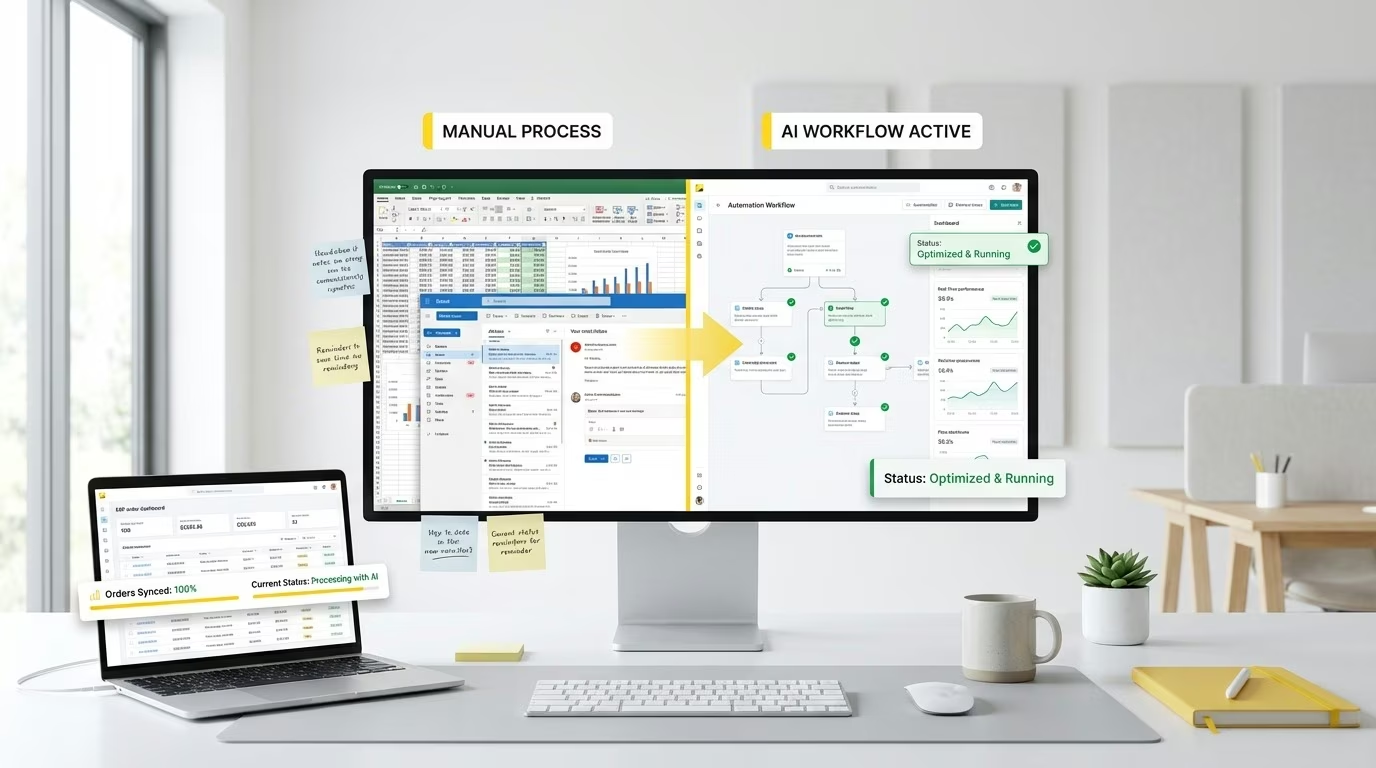
AI is fundamentally transforming how integrations are built, optimized, and maintained. Artificial Intelligence is revolutionizing the integration landscape by making processes more intelligent, adaptive, and self-healing. Unlike traditional integrations that require manual configuration and ongoing oversight, AI-powered integration introduces automation, smart recommendations, and self-optimization, significantly accelerating deployment and reducing errors.
Goldfinch AI excels in AI-powered extraction, while eZintegrations™ uses ML to recommend connectors and automate workflows.
eZintegrations™ offers a visual, drag-and-drop interface to integrate systems like ERPs, CRMs, data lakes, and third-party APIs. Users can:
Goldfinch AI complements eZintegrations™ by:
Together, they simplify enterprise software integration with speed, accuracy, and intelligence.
Software integration is the foundation of digital transformation. From improving efficiency to powering real-time decisions, integration unlocks immense business value. With platforms like eZintegrations™ and Goldfinch AI, you can automate and future-proof your IT ecosystem.
Ready to streamline your software stack? Book a free demo of eZintegrations™ today and experience the next-gen software integration solutions tailored to your enterprise.
Q1. What is software integration in simple terms?
It’s the process of connecting different software applications so they can work together and share data seamlessly.
Q2. What are the best software integration services for enterprises?
Platforms like eZintegrations™, MuleSoft, and Workato offer reliable enterprise integration services.
Q3. Can I integrate my CRM with accounting software?
Yes, CRM and accounting software integration is common and improves billing, invoicing, and customer management.
Q4. How is AI used in software integration?
AI helps automate workflows, extract data from documents, and monitor integration health in real time.
Q5. What’s the difference between custom software integration and off-the-shelf connectors?
Custom integrations offer flexibility for complex needs, while prebuilt connectors are faster to deploy but may lack customization.
Q6. What is continuous integration in software development?
Continuous integration automates code testing and merging to streamline development using tools like eZintegrations™.
Q7. Which integration service is best for syncing business software?
eZintegrations™ offers best seamless syncing of business software with low-code automation.
Q8. Which ETL software is best for data integration?
Goldfinch AI provides robust ETL, and real-time data integration tailored for business intelligence.
Q9. What is application software integration?
It’s the process of connecting different apps to work as a unified system, often powered by eZintegrations™.
Q10. What is integration testing in software testing?
It’s the phase where combined modules are tested together to ensure smooth data flow and interaction.
Q11. How to resolve hardware-software integration challenges in medical devices?
Use secure middleware and AI tools like Goldfinch AI to bridge hardware-software gaps efficiently.
Q12. What is integration testing in software?
Integration testing checks if software components interact correctly after being combined.
Q13. Which e-commerce software has the best developer resources for integration?
Platforms like Shopify and BigCommerce lead, and eZintegrations™ simplifies connecting them with third-party tools.
Q14. Which cloud data integration software is the best?
Goldfinch AI stands out for its scalable and AI-powered cloud data integration.
Q15. What is CRM software integration?
It connects CRM systems with other apps to unify customer data and workflows—easy with eZintegrations™.
Q16. What is integration testing in software engineering?
It ensures that integrated software modules work together as intended within the system architecture.
Q17. Which tool offers the best integration with other software?
eZintegrations™ excels in connecting SaaS apps, databases, and APIs with minimal code.
Q18. Which accounting software offers the best integration with other business tools?
QuickBooks and Xero offer strong integrations, especially when paired with eZintegrations™ for automation.
Q19. What does integration mean in software development?
Integration means linking components or systems, so they function as one, enabled easily with tools like Goldfinch AI.


© Copyright 2026 Bizdata Inc. | All Rights Reserved
 Watch Demo
 Post on LinkedIn
 Post on Facebook
 Post on Twitter/X