 support@bizdata360.com
 +1-650-283-1644
 AI Enabled Data Integrations and AnalyticsAI Enabled Data Integrations and Analytics

Have you ever wondered how much time your team spends extracting data from documents like invoices, purchase orders, or PDFs? According to McKinsey, knowledge workers spend roughly 20 percent of their workweek searching for and extracting information from documents. That’s an enormous loss in productivity and a huge cost for organizations relying on manual document handling.
This is where Business Document Processing steps in. In 2026, this intelligent approach has evolved from a routine administrative task to an essential digital transformation priority. It empowers businesses to scan, understand, categorize, and route documents with precision, leveraging AI and automation platforms.
This guide is designed for tech professionals like CTOs, IT Directors, Solution Architects, and SaaS Integrators looking to understand, implement, and optimize Business Document Processing in their enterprise. Here, you’ll learn how this process works, why it’s vital, the role of platforms like eZintegrations™ and Goldfinch AI, and best practices for making it a seamless part of your digital workflow.
Business Document Processing is the end-to-end approach of capturing, extracting, and processing data from documents used in daily business operations. This includes files such as invoices, sales orders, employee forms, PDFs, and scanned documents. The goal is to reduce or eliminate manual data entry and enable seamless connections across ERP, CRM, and SaaS platforms.
Modern Business Document Processing uses AI, OCR (optical character recognition), and machine learning to:
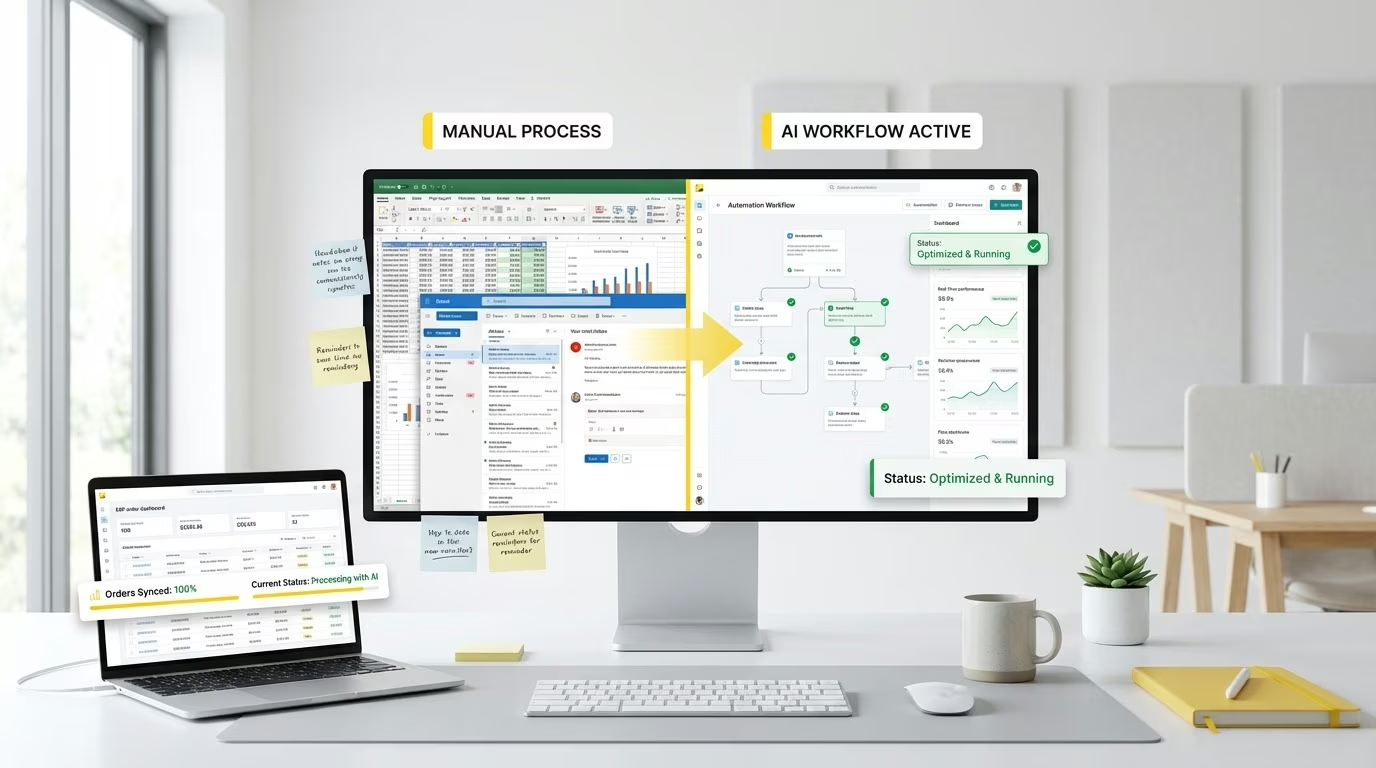
With platforms like eZintegrations™ and Goldfinch AI, businesses can now process documents instantly, making Business Document Management an intelligent, seamless experience across departments.
Business Document Processing applies to many types of documents. Understanding these types allows businesses to select the right approach and tools.
Ideal for documents with predictable layouts:
Designed for extracting data from:
Best suited for:
Each approach allows for tailored data capture and transformation, making Business Document Management more efficient across platforms.
Modern Business Document Processing operates as an automated, multi-step workflow:
Documents arrive via:
With AI Document Understanding, platforms like eZintegrations™ and Goldfinch AI:
Data is cleansed, enriched, and verified:
Documents are routed to:
Documents are stored securely in:
Information is surfaced as actionable data across departments, allowing:
Modern Business Document Processing platforms like eZintegrations™ streamline these steps, making it seamless across SaaS platforms.

Business Document Processing delivers measurable benefits across industries. It eliminates delays, improves data quality, and allows departments to focus on higher-impact work. Here are the benefits:
Modern AI powered platforms like eZintegrations™ and Goldfinch AI enable businesses to capture, understand, and utilize documents in ways that drive productivity and operational excellence.
Also Check out: Document Workflow Automation: Software, Best Practices Guide
Intelligent Document Processing (IDP): Ultimate Guide 2026
How Enterprises Can Automate OCR Data Extraction with AI
Here are a few examples of how Business Document Processing is applied across departments and platforms:
Accounts Payable: Automate data extraction from invoices for seamless connections between ERP platforms like NetSuite and QuickBooks.
Sales Orders and CRM: Use Business Document Templates and AI Document Understanding to link sales orders and customer data between platforms like Salesforce and Marketo.
Employee Records: Extract and categorize employee documents using Business Document Management Software for quick HR access.
Helpdesk and Service Operations: Automate case document review and processing across platforms like Zendesk, Jira, and ServiceNow.
Modern businesses must overcome several hurdles to enable seamless Business Document Processing:
With platforms like eZintegrations™ and Goldfinch AI, businesses can overcome these hurdles by making Business Document Processing seamless, automated, and highly intelligent.
To make Business Document Processing seamless and intelligent, businesses should adopt best practices:
Use platforms like eZintegrations™ and Goldfinch AI to enable seamless connections across platforms
Modern platforms enable seamless connections across SaaS platforms, making Business Document Processing highly intelligent and automated. Here are popular platforms:
Modern Business Document Processing is increasingly powered by artificial intelligence, making it an intelligent endeavor. AI platforms like Goldfinch AI enable:
With AI Business Document Processing, platforms like eZintegrations™ enable seamless connections across SaaS platforms like Salesforce, NetSuite, Marketo, Mailchimp, and more.
Modern businesses must integrate platforms and documents seamlessly across departments. Here is how eZintegrations™ and Goldfinch AI enable seamless connections:
With eZintegrations™ and Goldfinch AI, enterprises can build intelligent, seamless connections across departments, making Business Document Processing error-free, automated, and highly intelligent.
Modern enterprises can no longer afford manual, fragmented, error-prone document processing. Today’s AI-driven platforms like eZintegrations™ and Goldfinch AI enable seamless connections across SaaS platforms like Salesforce, NetSuite, Marketo, and Mailchimp. Together, they help enterprises capture, understand, and utilize Business Documents with precision, making Business Document Processing a seamless, intelligent endeavor.
Book a free demo of eZintegrations™ today and transform your Business Document Processing for a smarter, more connected, and error-free future.
Q1. What is Business Document Processing?
Business Document Processing is an automated method of extracting, understanding, and processing information from documents, such as invoices, forms, and PDFs.
Q2. What are the benefits of Business Document Processing?
Benefits include improved data quality, seamless connections across platforms, AI-driven anomaly detection, and improved operational efficiency.
Q3. What are the first steps in creating a Business Document?
The first steps include understanding the document’s purpose, selecting a Business Document Template, and ensuring seamless connections across platforms.
Q4. What platforms enable Business Document Processing?
Modern platforms like eZintegrations™ and Goldfinch AI enable seamless connections across SaaS platforms like Salesforce, NetSuite, Marketo, Mailchimp, and more.
Q5. Why is AI important in Business Document Processing?
AI provides intelligent Document Understanding, making extraction, classification, and enrichment seamless and error-free across platforms.
Q6. What are the first steps in creating a business document?
The first steps in creating a business document include defining the purpose, gathering necessary information, and choosing the appropriate format or template.


© Copyright 2026 Bizdata Inc. | All Rights Reserved
 Watch Demo
 Post on LinkedIn
 Post on Facebook
 Post on Twitter/X