 support@bizdata360.com
 +1-650-283-1644
 AI Enabled Data Integrations and AnalyticsAI Enabled Data Integrations and Analytics

Healthcare providers across the globe face mounting pressure to improve care quality while managing massive data volumes. During an EHR go-live or migration, one of the biggest bottlenecks is medical chart abstraction: the labor-intensive process of manually extracting key patient data from paper records, PDFs, scanned documents, or legacy systems into a new EHR.
According to a 2024 HIMSS Future of Healthcare AI report, 86% of healthcare leaders say AI is essential for improving administrative workflows and clinical documentation. The combination of rising documentation complexity, shrinking budgets, and increasing clinician burnout makes it clear: manual chart abstraction is unsustainable.
That’s where AI-driven solutions come into play. Automating this process isn’t just a tech upgrade; it’s a strategic necessity to succeed in modern healthcare operations.
Medical chart abstraction is the process of reviewing, identifying, and extracting essential data points from a patient’s health records. This data includes medical history, lab results, medications, allergies, immunizations, and treatment plans.
The goal is to ensure accurate and complete clinical information is transferred to the new EHR system. This step is crucial during:
It’s slow, error-prone, and often lacks consistency. But it doesn’t have to be that way anymore.
Manual abstraction is not only tedious but also risky for healthcare organizations. Common pain points include:
These inefficiencies can have real-world consequences, from billing rejections to patient safety issues. That’s why many organizations are now investing in AI to do heavy lifting.
AI-powered chart abstraction uses advanced technologies like Optical Character Recognition (OCR), Natural Language Processing (NLP), and machine learning to extract and structure data from scanned charts, forms, and PDFs.
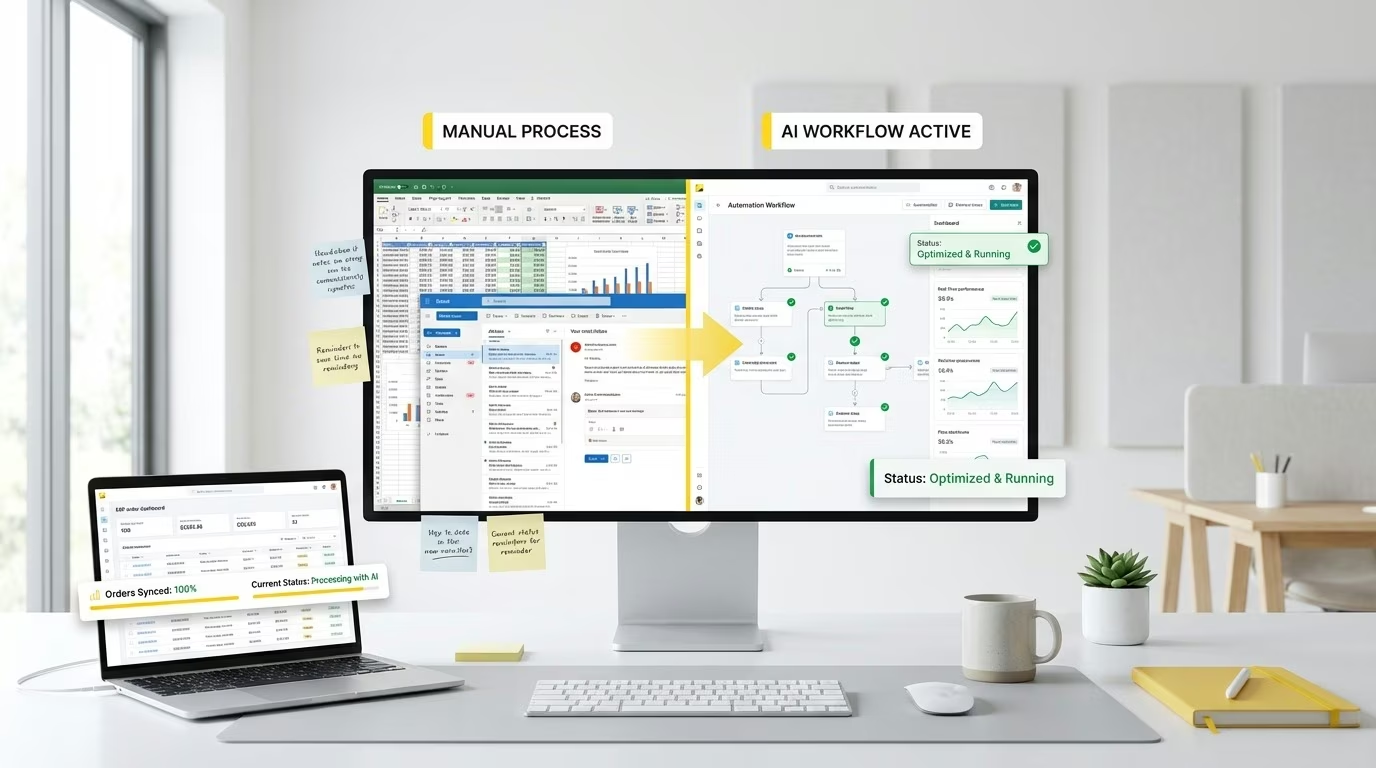
Here’s how it transforms the process:
The result: faster, more accurate chart abstraction with minimal manual intervention.

For a successful implementation of automated chart abstraction, healthcare IT leaders should follow these best practices:
When done right, AI automation transforms not just the chart abstraction process but your entire EHR strategy:
AI Document Understanding by eZintegrations™ is designed to solve various healthcare data issues with precision and scale. It combines optical character recognition (OCR), natural language processing (NLP), and intelligent data mapping to automate clinical data capture from any document source.
What It Does in Healthcare:
Step 1: Connect Sources
Securely link document sources including file storage, EMRs, APIs, or scanned record repositories.
Step 2: AI Extraction
AI analyzes the documents, reads through structured and unstructured data, and pulls out relevant clinical information.
Step 3: Structure & Validate
The system structures extracted data, applies validation rules, and ensures field mapping aligns with your EHR or analytics platforms.
Step 4: Send to Destination
Data flows directly into your EHR system, cloud storage, or preferred system of record with real-time sync and audit trails.

Manual Chart Abstraction: Staff spend hours manually reviewing and typing patient data from paper charts into EHR systems.
Administrative Burden: Nurses and admins are pulled into repetitive tasks that divert them from higher-value clinical work.
Document Complexity: Medical forms, handwritten notes, and legacy scans are difficult to process consistently and accurately.
EHR Delays & Errors: Delayed or incomplete chart data entry leads to go-live slowdowns, compliance risks, and patient care disruptions.
Cost Overruns: Manual abstraction projects often go over budget due to extra staffing, extended timelines, and quality assurance efforts.
eZintegrations™ is a cloud-native, no-code integration platform designed to unify data from diverse systems including EHRs, APIs, and document repositories. Its AI Document Understanding feature automates data extraction from scanned documents, handwritten records, and complex medical files.
With this capability, healthcare organizations can eliminate the manual effort involved in abstracting medical charts by:
It simplifies the entire medical chart abstraction process and aligns with healthcare’s need for precision, speed, and compliance.
During an EHR implementation or system switch, AI Document Understanding automates the extraction of key clinical data such as diagnoses, medications, allergies, and labs from legacy systems, scanned documents, and paper charts. This reduces manual abstraction effort. It also accelerates go-live timelines and ensures accurate and complete patient records are carried into the new EHR system.
When hospitals, clinics, or healthcare systems merge or acquire new facilities, there is often a need to consolidate disparate patient records from different platforms. The AI enables seamless integration of structured and unstructured data from various EHRs and document repositories. This creates a unified and clean longitudinal patient record across the organization.
AI can automatically extract and structure relevant documentation to support coding, billing, and reimbursement. This ensures that claims are substantiated with accurate clinical evidence. It also helps providers remain audit-ready for compliance checks, reducing revenue cycle delays and potential penalties.
For researchers and public health teams, accessing high-quality, structured patient data is critical. The platform enables bulk processing of charts to extract research-relevant data points such as demographics, diagnoses, and outcomes. This accelerates cohort identification, data analysis, and the execution of studies or population health initiatives.
Before patient data can be used for analytics, reporting, or AI modeling, it must be clean, normalized, and structured. eZintegrations™ automates this process by extracting raw clinical data from varied formats. It then transforms the data into a standard model and delivers it to data warehouses or BI platforms with minimal human intervention.
As the industry embraces digital transformation, AI-powered document understanding will play a vital role in modern EHR environments:
Adopting solutions like AI Document Understanding by eZintegrations™ ensures your health system stays ahead of the curve.
Manual medical chart abstraction is no longer sustainable in today’s fast-paced healthcare environment. Whether you’re preparing for an EHR go-live or simply want to streamline clinical data handling, AI-powered automation is the future.
With eZintegrations™ and its AI Document Understanding feature, your organization can:
Start your transformation today Try for free or Book a free demo to see how AI Document Understanding can simplify your medical chart abstraction process.
Recommend Reading:
EHR Integration: Ultimate Guide 2026
EMR Integration: AI, Best Practices, Complete Guide 2026
Top Best Healthcare Interoperability Solutions: Guide for 2026
Q1: What is medical chart abstraction, and why is it important?
Medical chart abstraction is the process of extracting key clinical information from health records into digital systems. It ensures complete and accurate data transfer during EHR transitions or audits.
Q2: How does AI help with chart abstraction?
AI automates the extraction and structuring of data from scanned documents, reducing the need for manual review while improving speed and accuracy.
Q3: Is eZintegrations™ HIPAA compliant?
Yes. eZintegrations™ is designed with enterprise-grade security and meets all major regulatory standards including HIPAA.
Q4: Can this be used with any EHR system?
Yes. eZintegrations™ supports interoperability with leading platforms like Epic, Cerner, Meditech, and custom-built EHRs.
Q5: What kind of documents can the AI Document Understanding process?
It can handle scanned charts, PDFs, lab reports, handwritten notes, and structured forms.


© Copyright 2026 Bizdata Inc. | All Rights Reserved
 Watch Demo
 Post on LinkedIn
 Post on Facebook
 Post on Twitter/X