 support@bizdata360.com
 +1-650-283-1644
 AI Enabled Data Integrations and AnalyticsAI Enabled Data Integrations and Analytics

Before diving into the details, here’s what you need to know:
Test case documents define how software is validated against requirements. These documents describe the inputs, execution conditions, and expected results for a software feature or function. However, in many QA environments, these documents are outdated, inconsistently maintained, and dispersed across teams and tools.
This inconsistency leads to duplicated efforts, testing delays, and misaligned product expectations. Modern QA teams need a better way to manage these documents for faster delivery and fewer bugs.
Most QA teams still rely on spreadsheets, Word documents, or legacy tools to create and manage test cases. Here’s what goes wrong:
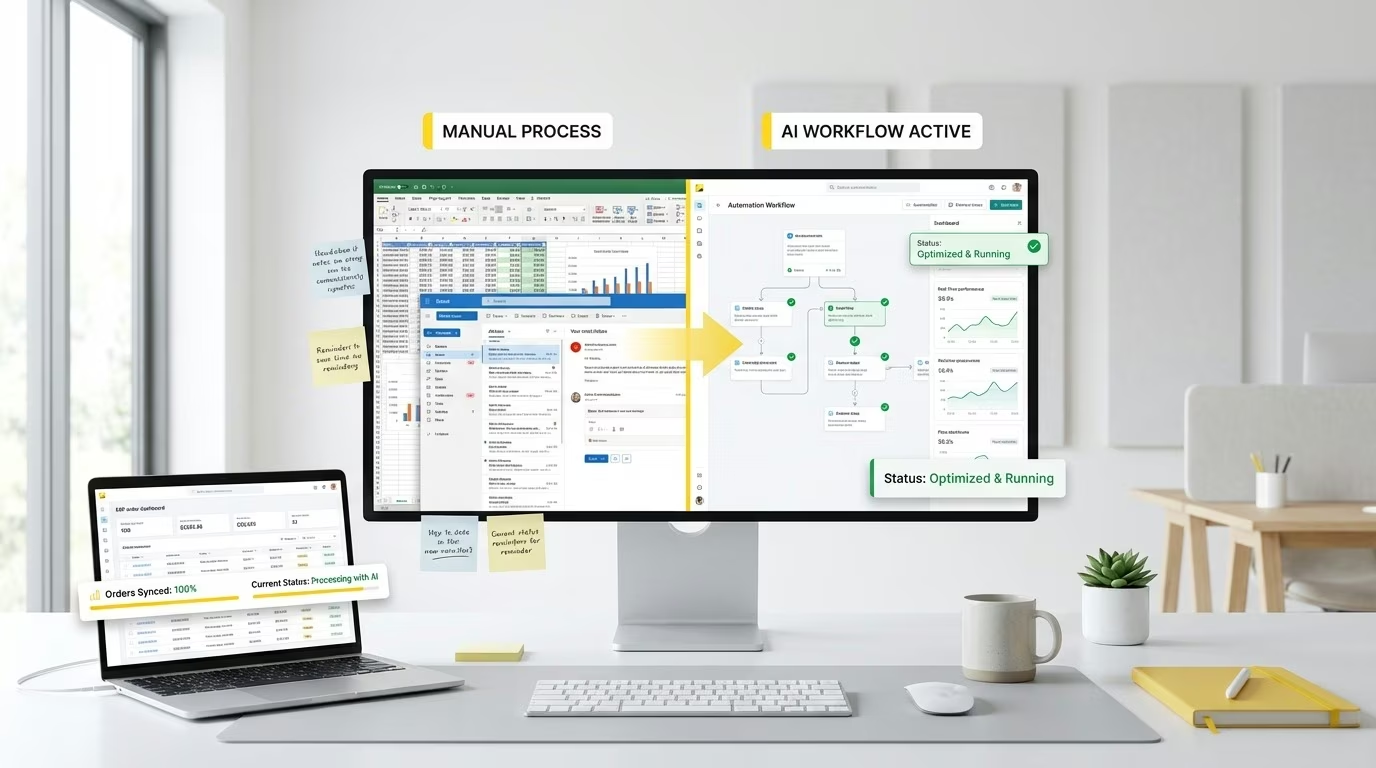
Automating test case document management brings structure and reliability to the QA process. It eliminates guesswork and ensures everyone works from a single source of truth.
By turning unstructured documents into actionable data, automation supports QA acceleration.
eZintegrations™ AI Document Understanding is a cloud-native, no-code platform that transforms unstructured documents like test case data into structured formats usable by QA tools and ERP systems.
It uses a combination of OCR, NLP, and deep learning to:
This AI-driven approach accelerates software validation while reducing human dependency.
DevOps thrives on agility, speed, and continuous delivery. Test documentation that’s outdated or disconnected disrupts these goals. Automation integrates QA seamlessly into DevOps workflows by:
Here are the key benefits your QA and DevOps teams can expect:
With eZintegrations™ AI Document Understanding, these benefits are just a few clicks away.
Some common problems faced by QA teams relying on manual documentation:
Automation addresses each of these issues by creating standardized, accessible, and dynamic documentation.

Test case automation benefits every industry, but here are a few with high impact:
In each case, eZintegrations™ AI Document Understanding automates test documentation to reduce risk and boost speed.
Return on investment (ROI) includes both tangible and intangible benefits:
These gains are achieved by eliminating repetitive documentation work, accelerating release cycles, and enhancing software quality.
Getting started with eZintegrations™ AI Document Understanding is simple:
No coding. No integration. Just plug in, upload, and go live.
Manual test documentation creates unnecessary drag on QA and DevOps. Delays, errors, and disconnected updates kill agility. Automating test case document management not only solves these issues but builds a future-ready QA foundation.
With eZintegrations™ AI Document Understanding, enterprises can standardize, centralize, and scale their test documentation quickly, with minimal IT costs.
Try eZintegrations™ AI Document Understanding for free or Book your free demo now to experience the transformation firsthand.
What is test case document automation?
It refers to using AI-powered tools to extract, structure, and update test case documentation without manual input.
Can AI handle unstructured test cases?
Yes, platforms like eZintegrations™ AI Document Understanding use OCR and NLP to interpret unstructured documents including PDFs, images, and spreadsheets.
Is eZintegrations™ compatible with my current QA tool?
Yes, it integrates seamlessly with most QA, ERP, and CRM platforms through APIs or data sync.
How long does the implementation take?
Most users can start processing documents within hours of setup.
Is it secure for sensitive QA data?
Yes, eZintegrations™ complies with enterprise-grade security standards.


© Copyright 2026 Bizdata Inc. | All Rights Reserved
 Watch Demo
 Post on LinkedIn
 Post on Facebook
 Post on Twitter/X