In 2026, when the average enterprise user spends over 90 minutes per day actively in Slack and more than 750,000 organizations rely on it, integrating Slack with Salesforce becomes a strategic imperative for business teams. (Source: Demandsage) For B2B organizations in the U.S., the pain of delayed data updates, siloed communication, and manual CRM processes translates into lost deals, frustrated teams and poor forecasting. This deep-dive guide to “Salesforce Slack Integration” is written for marketing managers, sales operations leaders, CRM admins and IT teams who want to break those silos, drive real-time collaboration and achieve faster ROI from their CRM investment. We’ll map out what the integration is, why it matters in practical terms, and how you can deploy it effectively with best-practice tips and a spotlight on how eZintegrations™ complements your strategy by enabling no-code AI data workflows between Salesforce, Slack and beyond.
Key Takeaways
Integrating Salesforce with Slack fosters real-time collaboration and reduces context switching between tools.
Major benefits include faster deal updates, improved data quality, and better forecasting across sales, marketing, and service.
Common challenges include data governance, user adoption and workflow design addressing these up front pays off.
eZintegrations™ can sit alongside or extend your Salesforce-Slack setup, enabling AI-powered data automation, cross-system workflows and API monetization.
A structured three-phase implementation (Plan → Deploy → Optimise) helps you avoid the typical pitfalls and start realizing outcomes quickly.
What is Salesforce Slack Integration?
At its core, the “Salesforce Slack Integration” refers to the linkage of Salesforce (CRM, Sales Cloud, Service Cloud, partner-tools) with Slack channels, workflows and notifications. This enables:
Slack channels to show Salesforce records (leads, opportunities, cases) and let users act on them without toggling into CRM. (salesforce.com)
Automated alerts in Slack when Salesforce data changes (e.g., a high-value opportunity moves stage), so the team is immediately aware. (rolustech.com)
Bi-directional syncing (in many implementations) so updates in Slack trigger CRM changes and vice versa reducing manual steps.
Slack is no longer simply a chat tool; it is being positioned as a “work-operating system” where collaboration, data, AI agents and automation converge. (salesforce.com) And Salesforce has embraced that vision by offering native integrations, connectors and workflow capability. The net effect is teams spend less time switching tools and more time acting on insight. Because of this shift, integrating Slack and Salesforce is not just “nice to have” it is a central part of digital-work strategy, particularly for U.S.-based enterprises looking to optimize sales cycles, support responsiveness and marketing-to-revenue alignment.
Why Salesforce Slack Integration is a Game-Changer
Before integration, organizations commonly face:
Sales reps are waiting for CRM updates, leading to stale pipelines and missed opportunities.
Support or marketing teams missing notifications when case statuses change or key leads advance.
Teams switching between Slack, Salesforce and spreadsheets wasting time and increasing error risk.
Data visibility issues: leadership lacks real-time insight into what’s happening on the ground.
Here are the key advantages you can expect:
Faster deal cycles: Internal research has shown sales teams using the Salesforce-Slack combo updated deals twice as fast; in one case a 29% increase in reps updating opportunities daily after Slack workflows were used. (slack.com)
Improved collaboration across functions: When quota attainment, pipeline status and partner updates surface in Slack channels, non-sales groups (legal, finance, product) stay aligned and can react faster. (slack.com)
Better data quality & forecasting: With automated Slack prompts tied to CRM records, you reduce manual entry delays and boost accuracy of forecasting. (rolustech.com)
Reduced context-switching: Users stay inside Slack, see CRM data, act on it. That means less toggling between apps and fewer interruptions.
Scalable workflows: Because Slack supports 2,600+ integrations and low-code workflows, adding custom alerts, approvals or partner-communication channels becomes far easier. (slack.com)
A mid-sized U.S. technology company integrated Salesforce with Slack to surface high-value lead alerts into dedicated Slack channels. The sales managers immediately saw activity, reps responded faster, and pipeline movement accelerated by roughly 25%. (Case based on aggregated industry reports) (rolustech.com)
How eZintegrations™ Augments Your Salesforce Slack Integration?
While native Slack-Salesforce integrations handle many use-cases, enterprises often face more complex demands: multi-system workflows, custom APIs, legacy databases, AI-triggered actions, and the need for rapid configuration. That is where eZintegrations™ steps in.
Key advantages of eZintegrations™ in this context
No-code AI data workflows: Build workflows that trigger when a Slack message occurs, pull CRM data from Salesforce, enrich it via other systems and post back into Slack or trigger other systems.
Multi-system integration: Connect Salesforce + Slack + ERP + Data Lake + partner API in one workflow something native tools may struggle with.
Rapid deployment: Analyzed, configured and put into use by analysts, IT professionals, or developers within hours or days rather than weeks.
Built-in API marketplace (Bizdata API Marketplace): Over 1,000 ready APIs you can plug in, enabling leverage of partner data, monetization or custom extensions.
Tracking and monetization: If your organization has partner or ecosystem workflows, you can expose APIs and manage consumption via eZintegrations™.
Scalable and governed: Enterprise users get enterprise-grade governance, supporting compliance and cross-department workflows.
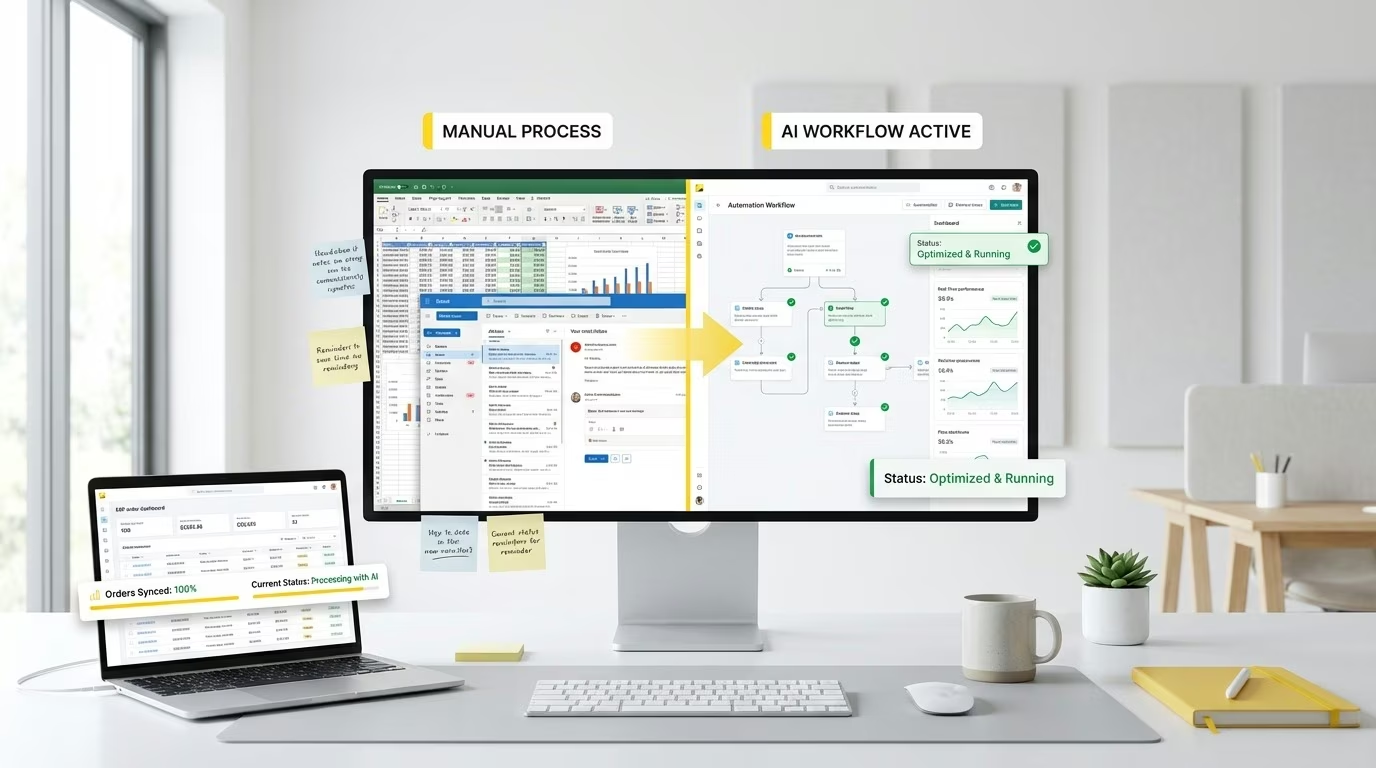
Imagine a support case that gets logged in Salesforce. Via eZintegrations™, a Slack channel immediately gets a summary, the relevant engineer is pinged, a JIRA (or Azure DevOps) ticket is auto created, and a follow-up survey goes to the customer all without leaving Slack or manually switching systems. This amplifies the value of the Slack-Salesforce link by spreading the benefit broader across the enterprise.
Best Practices & Tips for U.S. Enterprises
Make sure that Slack channels don’t become notification dumps. Design channels with context:
Assign owners or moderators.
Use private channels for high-value deals to avoid noise.
Encourage actionable posts: every Slack message triggered by Salesforce should guide “what to do next”.
High automation still requires good data. If Salesforce fields are stale or inconsistent, Slack notifications become meaningless. Set metrics like:
Percentage of opportunities updated via Slack workflow.
Time between stage change and Slack alert.
Channel engagement: how many times are users clicking through to CRM from Slack?
Because Slack becomes a front-door to CRM data, enforce:
Role-based access (which Slack channels see what data).
Data masking for sensitive records.
Audit logs linking Slack activity back to CRM updates.
Rolling out this integration means culture shift. Encourage adoption with:
Quick wins: start with one high-value sales team.
Training sessions: show how Slack becomes the “digital HQ” of deals or support.
Leadership buy-in: sales leaders using Slack channels for pipeline reviews lead by example.
Common Challenges & How to Overcome Them?
Notification overload- If you surface too much CRM to update noise into Slack, users disengage. Fix: Start small. Limit notifications to high-priority triggers (e.g., >$100K deals, service escalations). Use digest summaries rather than every change. Data quality and duplicate updates- Users may update in Slack but not in Salesforce (or vice versa), causing data inconsistency. Fix: Use auditing and automation rules. Set Slack workflows to prompt CRM updates and use Salesforce validations. Monitor data freshness. Cross-system integration complexity- When your workflow spans more than Sales Cloud + Slack (e.g., ERP, marketing automation), native connectors may struggle. Fix: Bring in eZintegrations™ early to orchestrate multi-system workflows, handle API complexity and provide a unified view. User adoption- Users may resist new tools or channels. Fix: Involve end-users early, show measurable benefits (faster response times, less toggling). Use champions. Provide training and documentation.
Integrate Salesforce and Slack Today!
If you are serious about accelerating sales cycles, improving responsiveness and turning data into action, the “Salesforce Slack Integration” is one of the smartest moves a U.S. B2B enterprise can make in 2026. But it takes more than simply flipping a switch: planning, governance, adoption and the right workflow to tooling matter. That’s where eZintegrations™ comes in. With its no-code AI data workflow engine, multi-system support and API marketplace, it’s designed to augment and extend your Slack-Salesforce integration into a full enterprise automation platform. Ready to see how it works in your environment? Book a free demo of eZintegrations™ today and discover how you can connect Salesforce, Slack and your entire ecosystem without heavy lifting or custom code. Your team will thank you, and your pipeline will show it. Recommend Blogs:
What systems in Salesforce can I integrate with Slack? You can integrate Sales Cloud, Service Cloud, Marketing Cloud, Account Engagement, Commerce Cloud, and even custom objects. Slack’s “Sales Cloud for Slack” and “Platform for Slack” support these use-cases.
Does integration require coding? Not necessarily. You can use native connectors and Slack Workflow Builder, which are low code. For more complex multi-system workflows (ERP, NoSQL, custom APIs), a platform like eZintegrations™ enables no-code drag-and-drop configuration.
How quickly will we see benefits (ROI)? Many companies report measurable gains within weeks of pilot: e.g., one internal study saw a 29% increase in opportunity updates daily after Slack workflows. Your mileage depends on channel selection, notification discipline, and user adoption.
How do we ensure data security and governance? Ensure Slack channels respect role-based access, integrate with your identity provider, mask sensitive fields, and audit interactions. Use encryption, compliance logs and limit visible records via permission sets in Salesforce.
Can this integration scale be for enterprise-wide use? Yes. Especially when you pair the native Slack-Salesforce link with a workflow platform like eZintegrations™. That lets you connect to additional systems, manage governance, source data from external APIs, and build enterprise-grade automation.
Which is the best software/tool for Salesforce Slack integration? eZintegrations™ is one of the best software/tools for Salesforce Slack integration
 support@bizdata360.com
 +1-650-283-1644
 AI Enabled Data Integrations and Analytics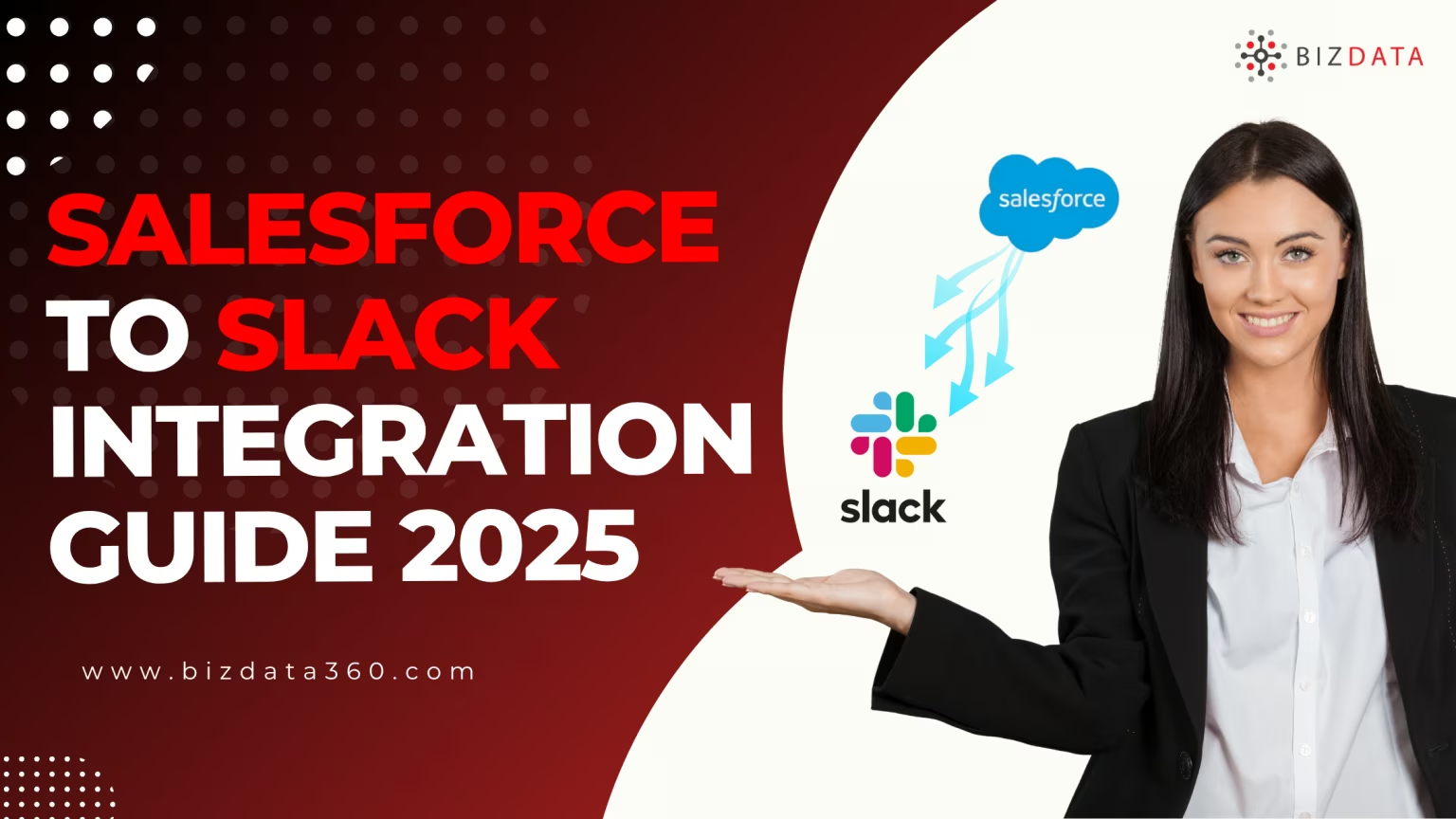


 Watch Demo
 Post on LinkedIn
 Post on Facebook
 Post on Twitter/X