AI Data Integration for E-commerce connects scattered systems like ERP, CRM, logistics, and storefronts into unified workflows.
It tackles deep industry pain points: inventory misalignment, reverse logistics, system disconnection, manual reconciliation.
AI-powered mapping, event-based pipelines, and smart governance make integration more scalable and resilient.
eZintegrations™ offers a no-code, AI workflow automation platform tailored to e-commerce integrations and analytics.
Start with a pilot, measure, and expand that phased approach ensures stability and ROI.
Why AI Data Integration Is Reshaping the E-commerce Industry in 2026?
In 2026, e-commerce companies that dominate are the ones who convert data silos into smart, flowing systems. The idea of AI Data Integration for E-commerce is no longer a futuristic concept; it’s now a core differentiator.
Customer expectations are soaring seamless omnichannel experiences, fast delivery, hyper-personalization. Yet many retailers still grapple with fragmented systems, inventory imbalances, and clumsy returns handling.
The E-commerce Industry faces persistent challenges: logistics delays, poor inventory synchronization, disconnected shopping channels, burdensome reverse logistics, legacy systems, and data complexity. Integrating AI-driven data flows is the only way to make all those moving parts move together.
This guide is for e-commerce leaders, data or operations heads, and digital growth teams who want to turn data into competitive advantage. You’ll learn how AI data integration works, why it’s vital, how to build it, and how eZintegrations™ fits into that architecture.
The E-commerce Landscape: Pressures & Pain Points
Before diving in, let’s surface what’s keeping e-commerce leaders up at night. The “E-commerce Industry” page lists core pain areas and these align perfectly with where AI Data Integration must deliver:
Key Industry Challenges
Logistics and Shipping Delays- Poor integration with shipping systems and carriers makes cross-border and last-mile delivery unpredictable.
Inventory Management- Disconnected systems cause stock imbalances overstocking in some places, stockouts in others.
Omnichannel Inconsistency- Maintaining uniform listings, pricing, and promotions across marketplaces, webstore, and retail is complicated when systems don’t sync.
Legacy Systems- Many firms struggle to modernize because their old systems resist integration.
Data Management Complexity- Massive volumes of product, customer, and transactional data strain systems.
Payment Diversity & Identity Verification- Supporting BNPL, digital wallets, and fraud checks increases integration load.
Manual Entry & Reconciliation- Data entry, spreadsheets, and manual fixes still exist and they introduce errors.
These problems are not just annoyances. They erode margins, waste effort, frustrate customers, and stunt growth.
What AI Data Integration for E-commerce Really Means?
AI Data Integration for E-commerce is the infrastructure that turns fragmented data into trustworthy, usable intelligence across your systems. It goes beyond moving data: it understands, cleans, routes, and governs it so that downstream models and teams can trust it.
Key Components
Connectors that link to storefronts, ERPs, CRMs, logistics platforms, payments, etc.
AI-assisted mapping and transformation that automatically aligns fields even when schemas drift.
Event-based or streaming pipelines for near real-time data updates.
Validation, anomaly detection, and feedback loops to catch errors early.
Governance and audit trails so you know data lineage, who changed what, and when.
With this in place, your AI systems, dashboards, marketing engines, and fulfillment workflows all speak from the same, clean data language.
Why It Matters More in 2026?
The e-commerce industry is under relentless pressure higher customer expectations, more channels, global reach, tighter margins. AI Data Integration tackles this head-on:
Omni-channel consistency- Unified data ensures product metadata, pricing, and stock are identical everywhere.
Systems modernization- You can integrate legacy systems incrementally without ripping them out.
Scalable returns handling- Returns become a structured flow connecting customer, warehouse, inventory, and finance systems.
Data volume handling- AI helps manage, compress, reconcile, and standardize large data streams.
Reduced manual overhead- Automatic reconciliation and mapping frees teams to focus on growth, not fire drills.
Real-time responsiveness- Price changes, stock updates, promotions – all flow fast enough to respond to market dynamics.
In short, AI integration is not a “nice to have”; it’s how you survive and lead in 2026.
How eZintegrations™ Elevates AI Data Integration?
If you were building this yourself, here’s where eZintegrations™ becomes your secret weapon.
Core Features & Offerings
AI Workflow Automation- A unified platform that supports both structured and unstructured data for integration and workflow automation.
API Marketplace- Access a catalog of APIs and connectors so you don’t build everything from scratch.
Real-time Connectivity- Support for WebSocket, webhooks, two-way sync, and event triggers to keep data fresh.
AI Document Understanding– Transform unstructured documents like invoices, purchase orders, and supplier reports into structured data.
Pre-built Industry Connectors- Support for commerce platforms, ERPs, logistics systems, and more, with templates to accelerate delivery.
Governance & Auditing- Built-in logging, versioning, and controls to ensure trust and compliance.
How It Solves Industry Pain?
It bridges legacy systems by wrapping them in modern connectors.
It improves inventory synchronization across channels in real time.
It addresses returns by making reverse logistics part of your workflow ecosystem.
It handles data complexity by automatically structuring and normalizing inbound streams.
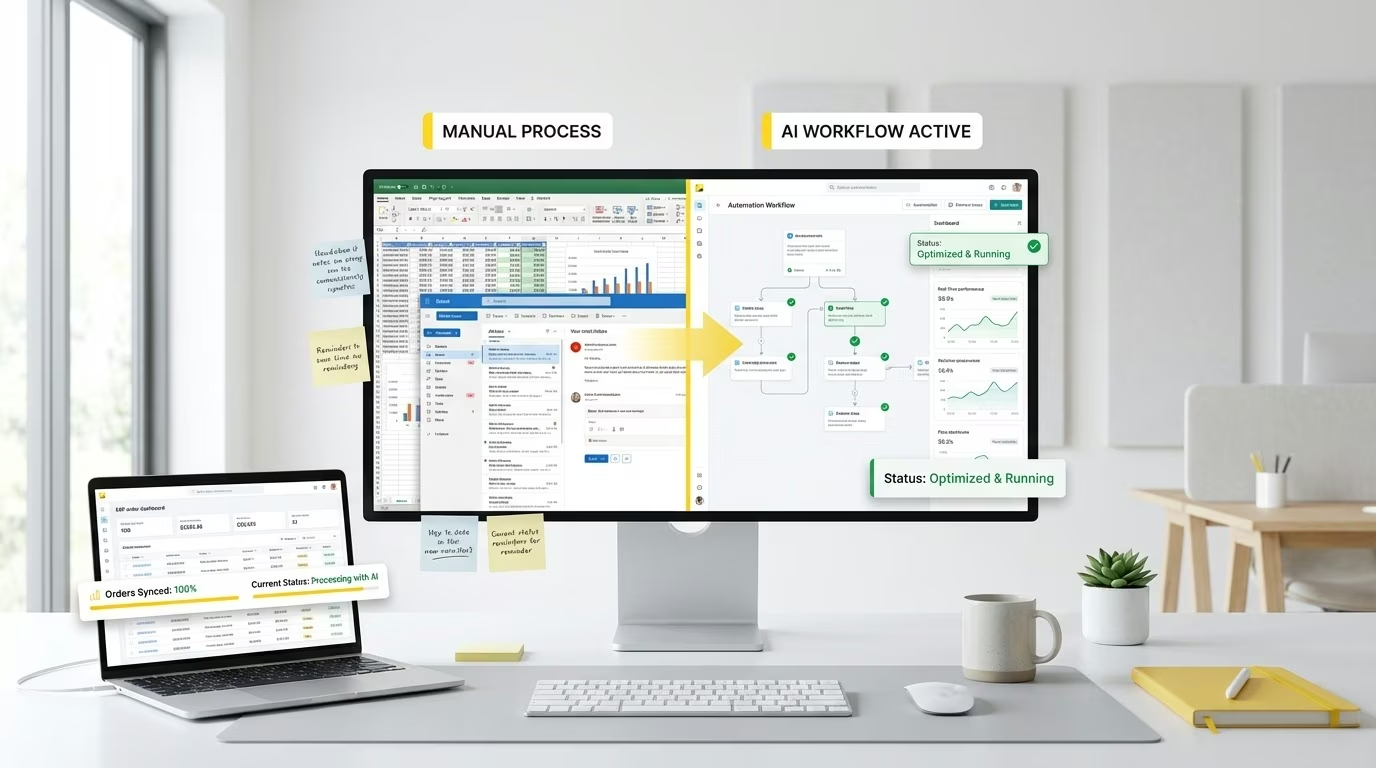
It replaces manual reconciliation with AI-driven checks and rules.
Use Cases in E-commerce That Demand AI Integration
Omni-channel Catalog Sync- Updates to product attributes, availability, and pricing flow instantly across marketplace, website, and retail systems.
Smart Returns & Reverse Logistics- Returns management flows through customer support, inventory, and finance without manual handoffs.
Personalization & Recommendation Engines- Integrates CRM, behavioral data, purchase history, and inventory for smarter product suggestions.
Dynamic Pricing & Promotions- Leverages competitor, availability, and demand signals in real time to optimize margins.
Supply Chain Visibility- Sync logistics, warehouse, and supplier systems to reduce delays and improve delivery predictions.
How to Implement AI Data Integration?
Phase 1: Assess & Plan
Map all systems and data sources.
Prioritize pain points aligned with business goals.
Define your canonical data model (product, order, customer, inventory).
Phase 2: Build Pilot
Use eZintegrations™ to connect 2–3 core systems (for example, storefront, ERP, CRM).
Enable AI mapping and normalization.
Route output to an analytics dashboard or staging environment.
Phase 3: Validate & Refine
Monitor latency, accuracy, error rates.
Get feedback from stakeholders.
Refine rules, mappings, exceptions.
Phase 4: Scale
Add more channels and systems (logistics, returns, marketplace).
Layer in AI models (recommendation, forecasting).
Implement monitoring, alerts, fallback logic.
Phase 5: Govern & Evolve
Enforce role-based access, audit trails, data lineage.
Set up periodic reviews, schema drift detection.
Continuously optimize and expand to new use cases.
Best Practices & Pitfalls to Avoid
Avoid trying to integrate everything at once start small and expand.
Keep human oversight for edge cases, especially early.
Watch for schema drift and build your integration layer to adapt.
Build strong governance from day one data lineage, rollback, access control.
Don’t neglect error handling system failures should be surfaced and fixed quickly.
The Future of E-commerce Lies in Intelligent Data Integration
The e-commerce industry in 2026 demands agility, coherence, and intelligence and those can’t come from patchwork systems. AI Data Integration for E-commerce is the foundation for resilience, growth, and customer delight.
If you’re ready to turn systems chaos into smart workflows, book a free demo of eZintegrations™. Let’s show you how it empowers your integrations, boosts operational accuracy, and future-proofs your data backbone. Recommend Blogs:
Q1. What is AI Data Integration in the context of e-commerce? It uses AI to connect, clean, map, and sync data between your sales, logistics, marketing, and operations systems making data actionable. Q2. Which e-commerce challenges does it address? It tackles inventory misalignment, reverse logistics, manual reconciliation, disconnected channels, and system modernization. Q3. Is AI integration feasible for mid-sized e-commerce brands? Yes. Platforms like eZintegrations™ offer no-code tools and templates that lower the barrier to entry. Q4. How does it impact returns / reverse logistics? It automates the lifecycle of returns from customer initiation through refund, restocking, and inventory update. Q5. How fast can teams see results? You can start seeing reductions in data errors and better synchronization within weeks once core systems are connected. Q6. Which is the best tool/platform for ai data integration for ecommerce? eZintegrations™ is one of the best tool/platforms for ai data integration for ecommerce
 support@bizdata360.com
 +1-650-283-1644
 AI Enabled Data Integrations and Analytics


 Watch Demo
 Post on LinkedIn
 Post on Facebook
 Post on Twitter/X