 support@bizdata360.com
 +1-650-283-1644
 AI Enabled Data Integrations and AnalyticsAI Enabled Data Integrations and Analytics

Businesses in 2026 are under pressure to operate faster, smarter, and more efficiently. Yet, many organizations still struggle with repetitive tasks, fragmented systems, and siloed data that slow down decision-making.
According to a McKinsey report, companies that adopt AI-driven process automation can reduce operational costs by up to 30% while improving productivity significantly.
This is where AI Workflow Automation comes in. By combining AI capabilities with automation, businesses can not only cut costs but also unlock intelligence-driven workflows of that scale.
This guide is designed for business leaders, IT professionals, and operations managers who want to understand how AI Workflow Automation works, the tools available, and how to put best practices into action in 2026. We will also cover how platforms like eZintegrations™ are enabling enterprises to implement AI-driven workflows that deliver measurable results.
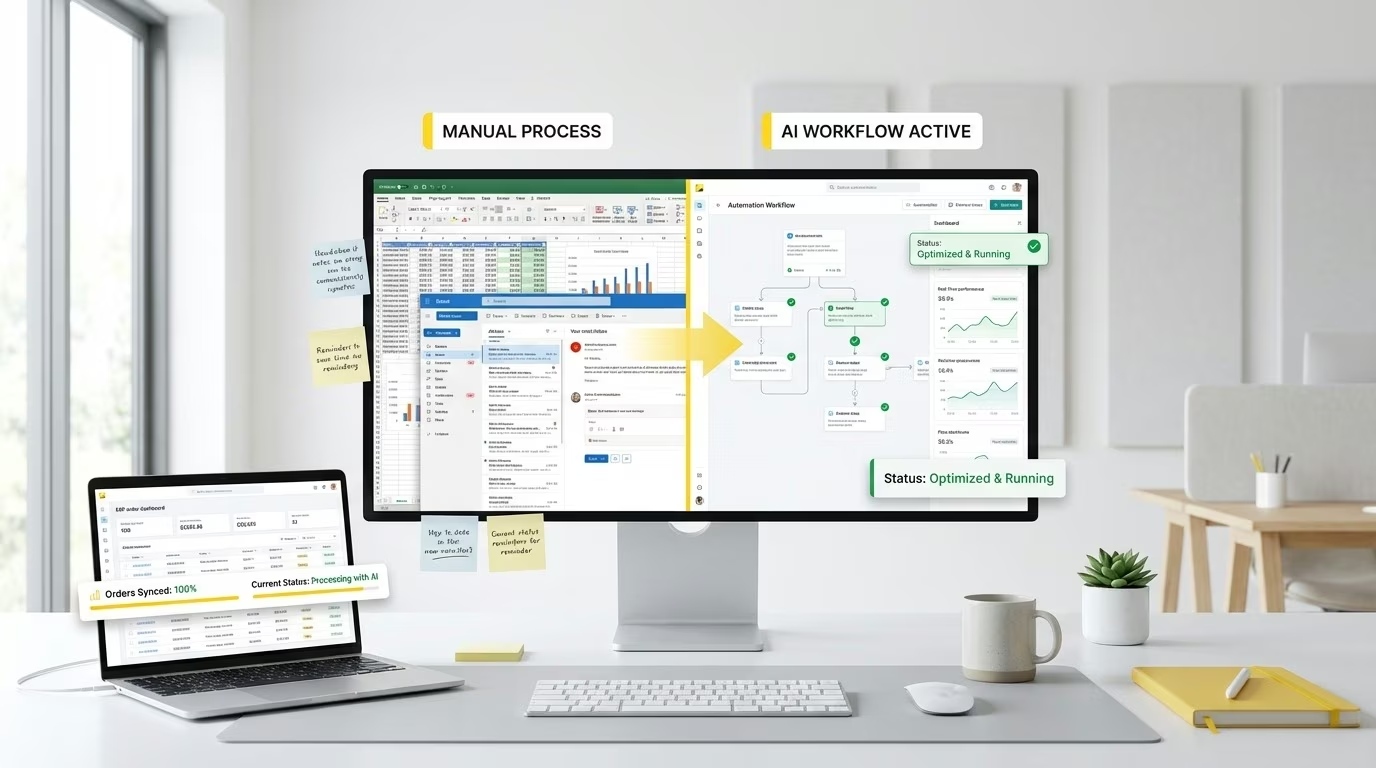
AI Workflow Automation is the use of artificial intelligence to streamline, manage, and optimize business workflows. Unlike traditional automation, which focuses only on task execution, AI automation adds intelligence. It can read documents, analyze patterns, make predictions, and trigger the next best action in a workflow.
By combining automation with machine learning, NLP, and AI models, workflows become smarter and more adaptive. Instead of being rigid scripts, workflows evolve with data.
Businesses today are flooded with data from SaaS platforms, ERPs, CRMs, and unstructured sources like PDFs and emails. Managing this data manually is not scalable. In fact, IDC reports that over 78% of enterprises still struggle with disconnected SaaS systems, leading to data silos and inefficiencies (IDC, 2023).
With AI workflow automation tools, these pain points are minimized, making enterprises more resilient and agile.

AI Workflow Automation isn’t just about cost-cutting. It reshapes how work gets done. The benefits include:
For example, with eZintegrations™ AI Document Understanding, companies can automate the extraction of data from contracts, invoices, and medical forms turning unstructured text into structured insights ready for ERP or CRM systems.
If you are looking for the best AI workflow automation tools 2026, here are some leaders to evaluate:
eZintegrations™ is not just another integration tool. It enables enterprises to build AI-powered workflows by connecting SaaS apps, databases, ERPs, CRMs, and APIs. Its AI Document Understanding module extracts and structures data from documents without relying on OCR or NLP, making it highly accurate.
eZintegrations™ Capabilities:
This enables businesses to eliminate manual document review, improve compliance, and achieve faster decision-making.
Implementing AI Workflow Automation successfully requires more than just buying software. Enterprises need a strategy. Key best practices include:
Real-world examples show the impact of AI workflows:
2026 is shaping up to be a breakthrough year. Some AI workflow automation updates and trends to watch:
AI Workflow Automation is no longer a luxury in 2026. It is essential for enterprises that want to stay competitive, reduce costs, and make smarter decisions. With platforms like eZintegrations™, businesses can move beyond basic automation into intelligent, AI-driven workflows that adapt, learn, and deliver real value.
If your organization is ready to eliminate manual processes, reduce errors, and accelerate decision-making, it’s time to see eZintegrations™ in action.
Try eZintegrations™ for free or Book a free demo today and unlock the future of workflow automation.
AI Workflow Automation combines artificial intelligence with automation to optimize workflows, reducing manual work and adding intelligence-driven actions.
eZintegrations™ is the best AI workflow automation tools in 2026.
It automates tasks like patient data processing, appointment scheduling, and compliance validation.
Yes, with no-code tools like Zapier or n8n, even SMBs can implement automation without heavy IT support.
Because it combines data integration, AI document understanding, and real-time workflow automation into one scalable platform.


© Copyright 2026 Bizdata Inc. | All Rights Reserved
 Watch Demo
 Post on LinkedIn
 Post on Facebook
 Post on Twitter/X