 support@bizdata360.com
 +1-650-283-1644
 AI Enabled Data Integrations and AnalyticsAI Enabled Data Integrations and Analytics

Healthcare organizations are drowning in paperwork. Clinicians often spend more time entering data than seeing patients. Clinicians spend up to 55% of their workday on documentation and EHR tasks, and they can spend two hours on data entry for every hour of direct patient care. This imbalance drives burnout and slows care delivery.
That’s were AI workflows for healthcare come in. By turning unstructured documents such as clinician notes, referral letters, imaging reports and lab results into EHR-ready structured data, these workflows save time, reduce errors and give clinicians more time to focus on patients. This post is for healthcare leaders, IT professionals, and digital transformation teams who need practical insights on adopting AI in documentation and data workflows.
In this blog we’ll answer the questions healthcare teams are asking about AI, including what it is, how it works, why it matters, and how to implement it successfully with tools like eZintegrations™.
What Are AI Workflows for Healthcare?
AI workflows for healthcare automate the transformation of raw clinical documents into structured, standardized data that can feed Electronic Health Records (EHRs) and other clinical systems. Instead of clinicians manually typing notes, coding diagnosis details, or looking up data elements, smart systems:
These workflows rely on technologies like machine learning, natural language processing (NLP), and document AI to parse complex text and extract relevant fields accurately. This approach replaces tedious manual entry with automated, accurate data capture.
Documentation can consume over half of a clinician’s time, and much of that is repetitive data entry. AI workflows cut that time by extracting structured data from notes, forms and scanned documents, freeing clinicians to spend more time with patients.
Manual entry invites typos, misclassification, and incomplete records. AI can minimize these issues by consistently extracting the correct data points according to predefined rules and standards. Structured data also improves interoperability and downstream analytics.
AI-extracted clinical information helps coding and billing teams by reducing errors and speeding up claim approvals. Some studies suggest AI-assisted workflows can cut manual coding mistakes by up to 40%.
AI workflows help unify data from disparate systems and formats. Standardized data such as FHIR or HL7 makes it easier to share information across EHRs and other clinical systems, breaking down silos that hamper care coordination.
Accurate documentation not only supports patient care but also helps with regulatory audits, quality reporting, and value-based care measures.
Step 1: Input Capture
Documents enter the system from multiple sources: scanned forms, clinician notes, PDFs, faxed records, and more.
Step 2: Intelligent Parsing
AI algorithms read the unstructured content, identify clinical concepts, and tag data elements (e.g., patient name, diagnoses, medications).
Step 3: Normalization & Validation
Extracted data is normalized according to clinical standards and validated against rules to ensure accuracy.
Step 4: Structured Output
Clean, structured output is generated in a format that EHR systems understand, such as FHIR, and then pushed into the EHR or other systems.
Step 5: Continuous Feedback
AI systems learn from corrections and new data patterns, improving over time.
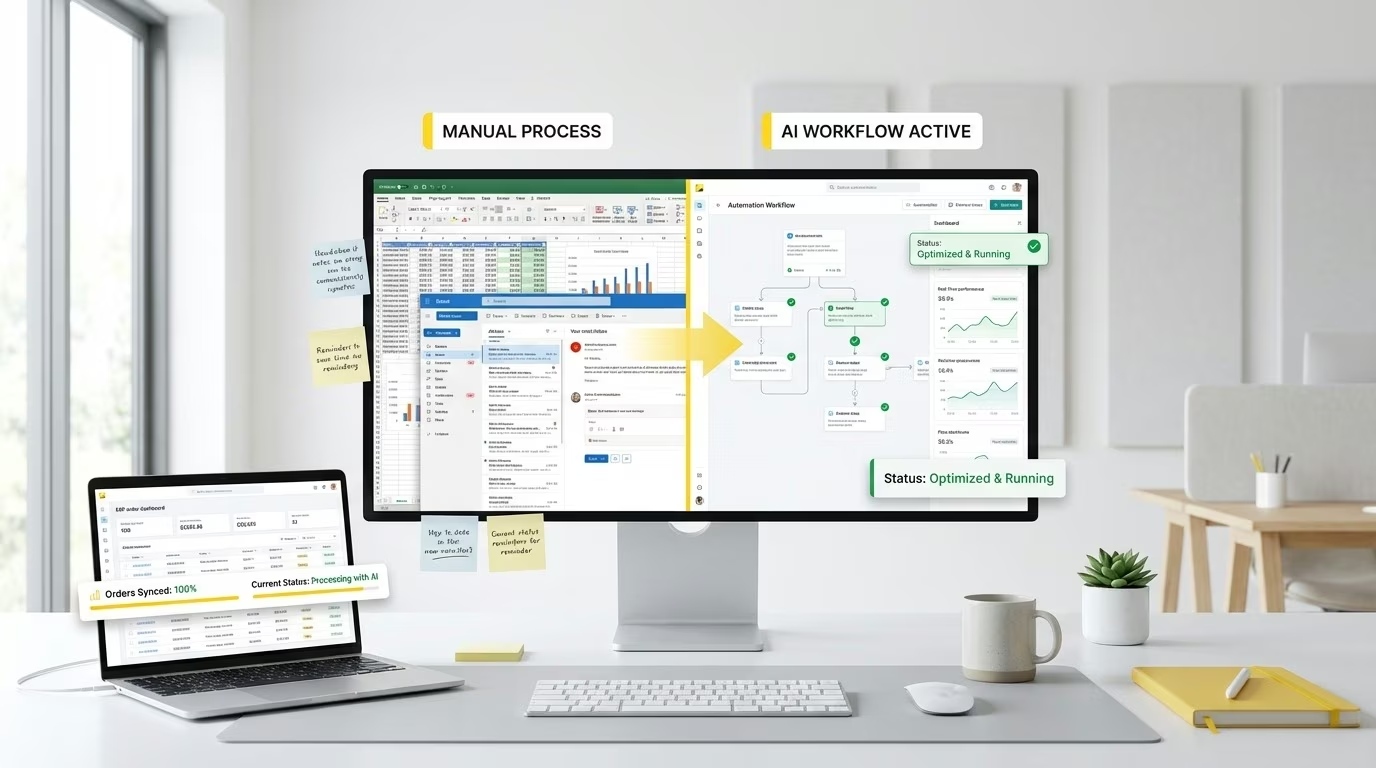
This workflow reduces cycles from manual entry to automated integration and aligns data into a single source of truth.
AI workflows are powerful, but they come up with real challenges that teams must plan for.
Data Quality and Bias
AI systems depend on good input. Messy, incomplete, or biased data can lead to inaccurate outputs. Strong governance and validation are essential.
Interoperability and Legacy Systems
Healthcare IT ecosystems often include a mix of old and new systems that don’t communicate well. Overcoming this requires connectors and middleware that can bridge formats and standards.
Security and Compliance
Handling protected health information (PHI) means strict adherence to HIPAA and other regulations. Encryption, access controls, and auditing workflows are a must.
User Adoption
Clinicians and staff must trust technology. Without proper training and workflow alignment, adoption stalls.
While many solutions promise document automation, eZintegrations™ offers a practical, enterprise-ready approach that goes beyond point tools. It enables healthcare organizations to:
eZintegrations™ connects systems and workflows so data flows where it needs to go, helping healthcare teams reduce manual work and improve accuracy.
Healthcare teams handle a constant flow of PDFs, scans, referral letters, discharge summaries, and compliance documents. Most of this content sits in unstructured form, which means someone has to manually read it, interpret it, and type the key details into the EHR. That is slow, error-prone, and frustrating for clinicians and back-office teams.
This is exactly eZintegrations™ AI Document Understanding fits into AI workflows for healthcare. It converts unstructured clinical documents into clean, structured, EHR-ready data without coding or complex setup.
Before AI, teams struggled with:
With eZintegrations™, healthcare organizations can automatically extract critical information such as:
The data is validated, normalized, and pushed straight into the EHR or downstream systems through secure integrations.
Healthcare data transformation is happening now. Teams that adopt AI workflows for healthcare win time, accuracy and better patient care. The manual way isn’t sustainable. If your clinicians are still bogged down in documentation and your data lives in silos, it’s time to rethink how you work.
See how eZintegrations™ can automate your workflows and turn documents into EHR-ready data.
Download Free Healthcare Workflows.
Book a quick demo today and start your journey to smarter, faster, more accurate healthcare operations.
Recommend Resources:
FAQs About AI Workflows for Healthcare
What problems do AI workflows solve in healthcare?
AI workflows reduce manual data entry, improve accuracy, decrease billing errors, and speed up clinical documentation.
Can AI workflows work with existing EHR systems?
Yes. Modern AI solutions like eZintegrations™ support API-based integration and standards compliance to connect with legacy EHRs.
How much time can AI save clinicians on documentation?
Studies show clinicians can save several hours per week on documentation when AI workflows are implemented effectively.
Are AI-generated data outputs reliable for clinical use?
With robust validation and clinician review loops, AI outputs can achieve accuracy comparable to human data entry.
Is AI safe to use with patient data?
Yes, when systems adhere to HIPAA, encryption and proper access controls.


© Copyright 2026 Bizdata Inc. | All Rights Reserved
 Watch Demo
 Post on LinkedIn
 Post on Facebook
 Post on Twitter/X