 support@bizdata360.com
 +1-650-283-1644
 AI Enabled Data Integrations and AnalyticsAI Enabled Data Integrations and Analytics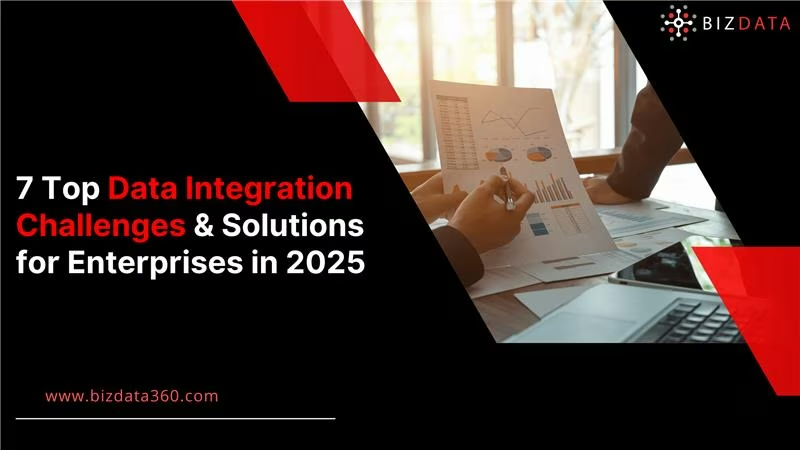

Data is the fuel of enterprise growth. Yet most organizations struggle with fragmented systems, messy data, and rising compliance demands. These issues have real business costs. Poor data quality alone can lead to lost revenue, missed opportunities, and failed AI initiatives.
Reports show that most enterprises face data quality and integration hurdles that directly impact productivity and decision-making.
These Data Integration Challenges affect CIOs, IT leaders, compliance teams, and AI project owners. The result is slower insights, higher costs, and increased risk. This blog breaks down the seven biggest challenges enterprises face in 2026 and explains how eZintegrations™ helps solve them.
When data is inaccurate or inconsistent, decisions suffer. Enterprises often rely on multiple systems that capture information in different formats. Without controls, errors spread across the organization.
Solution: eZintegrations™ offers automated validation rules, profiling, and dashboards that detect and correct issues at the source. With better quality checks, you reduce errors and increase confidence in your analytics.
Enterprises today use hundreds of applications across departments. Each system has its own APIs, schemas, and formats. Connecting them all becomes complex and time-consuming.
Solution: eZintegrations™ provides a library of prebuilt connectors, drag-and-drop workflows, and templates that reduce integration time. This helps teams quickly connect even large portfolios of enterprise applications.
Enterprises no longer want overnight reports. They expect real-time dashboards, live analytics, and instant updates. Traditional batch processing often cannot keep up.
Solution: eZintegrations™ supports real-time data sync using Change Data Capture, micro-batching, and streaming. This ensures systems remain updated without performance slowdowns.
Different systems often use different field names, definitions, or units of measure. These semantic mismatches create confusion and break integration.
Solution: eZintegrations™ lets teams define canonical schemas and mapping rules. It automatically translates mismatched terms into standardized formats, creating a unified view across systems.
Data sovereignty, industry regulations, and privacy laws are becoming stricter. Enterprises need traceability, audit logs, and secure data handling at every step.
Solution: eZintegrations™ provides full audit trails, encryption, masking, and governance templates. Compliance with regulations like GDPR and HIPAA is built into the workflows, reducing risk for enterprises.
Cloud-based integration models are powerful but can lead to unpredictable costs. Without monitoring, expenses increase as data volumes and workloads grow.
Solution: eZintegrations™ includes real-time cost monitoring and alerts. Budget controls ensure teams know exactly where resources are going and prevent unnecessary overruns.
Enterprises deal with structured, semi-structured, and unstructured data from multiple sources. Unstructured data like documents, images, and logs is particularly underutilized. Scaling integration across these formats is difficult.
Solution: eZintegrations™ uses AI-powered classification, tagging, and enrichment tools to unify diverse datasets. It helps enterprises make unstructured data usable for analytics and AI projects.

Every stakeholder in the enterprise feels the impact of data integration challenges differently. When solved effectively, the benefits ripple across strategy, operations, compliance, and innovation.
Enterprises in 2026 face rising complexity in integrating data across applications, formats, and regions.
These seven challenges highlight the need for a modern approach. eZintegrations™ provides a cloud-native, AI-powered platform that simplifies workflows, improves quality, and ensures compliance.
If you are ready to future-proof your data integration strategy, book a free demo of eZintegrations™ today and see how it can solve your enterprise data challenges.
10 Enterprise Integration Trends Set to Disrupt 2026
Why AI Agents Are Reshaping Enterprise Workflows in 2026?
10 AI Workflow Trends Transforming Enterprise Automation in 2026
Q1: What are the most common data integration challenges in enterprises?
They include poor data quality, application sprawl, real-time sync needs, compliance issues, high costs, semantic mismatches, and scaling difficulties.
Q2: How does eZintegrations™ help improve data quality?
It provides automated validation, profiling, and dashboards that catch and fix errors before they spread.
Q3: Can eZintegrations™ handle compliance and governance needs?
Yes. It offers audit logs, masking, encryption, and compliance templates to meet global regulations.
Q4: What makes real-time data integration important in 2026?
Businesses need instant insights for decisions, customer experience, and AI models. Real-time integration eliminates delays.
Q5: Is eZintegrations™ suitable for unstructured data?
Yes. It enriches, tags, and unifies unstructured data, making it usable for analytics and AI.


© Copyright 2026 Bizdata Inc. | All Rights Reserved
 Watch Demo
 Post on LinkedIn
 Post on Facebook
 Post on Twitter/X