 support@bizdata360.com
 +1-650-283-1644
 AI Enabled Data Integrations and AnalyticsAI Enabled Data Integrations and Analytics

In today’s hyper-connected, rapidly evolving business environment, Operations and Supply Chain Management (OSCM) is no longer just a backend function, it’s a strategic powerhouse that can make or break a business. From startups to multinational enterprises, companies across the globe are rethinking how they design, manage, and optimize their supply chains.
VP’s, Directors & C-suite executives are now recognizing that building agile, resilient, and data-driven supply chains is not just a competitive edge, it’s a business imperative. As markets shift and digital transformation accelerates, operations and supply chain leaders are stepping into the spotlight to deliver sustainable growth and long-term value.
Operations and supply chain management (OSCM) is the lifeblood of any business that produces and delivers goods or services. It includes everything from sourcing raw materials to final delivery to the customer. Think of it as the end-to-end system that ensures your favorite product arrives on your doorstep on time, in perfect condition, and at the right price.
But OSCM goes deeper than logistics. It involves strategic planning, process optimization, quality control, risk management, resource allocation, and continuous improvement, all aligned to create a seamless, efficient customer experience.
Operations and supply chain management oversee the entire production and delivery ecosystem. From planning and procurement to manufacturing, inventory management, transportation, and final delivery, OSCM ensures that every cog in the machine is working in sync.
Together, they bridge the gap between production and performance—ensuring businesses run like well-oiled machines.
To better understand its scope, here’s what OSCM typically includes:

Today’s supply chains are full of opportunity but let’s be real, they’re also packed with challenges. Businesses are navigating a maze of internal bottlenecks, unpredictable risks, and customers who expect more and faster, every single day. It’s not easy. Here’s a closer look at some of the biggest hurdle’s operations and supply chain leaders are up against right now:
You can’t fix what you can’t see. Many organizations still deal with scattered data and siloed systems, making it tough to get a real-time, full-picture view. Without end-to-end visibility, teams are stuck reacting to problems instead of getting ahead of them.
Natural disasters, political instability, labor shortages, global pandemics you name it, supply chains have faced it. These disruptions aren’t just inconvenient; they can delay shipments, increase costs, and damage hard-earned brand trust if not managed quickly.
The cost of doing business keeps climbing whether it’s materials, labor, or transportation. Margins are getting tighter, and without smart cost control strategies, staying competitive becomes a serious uphill battle.
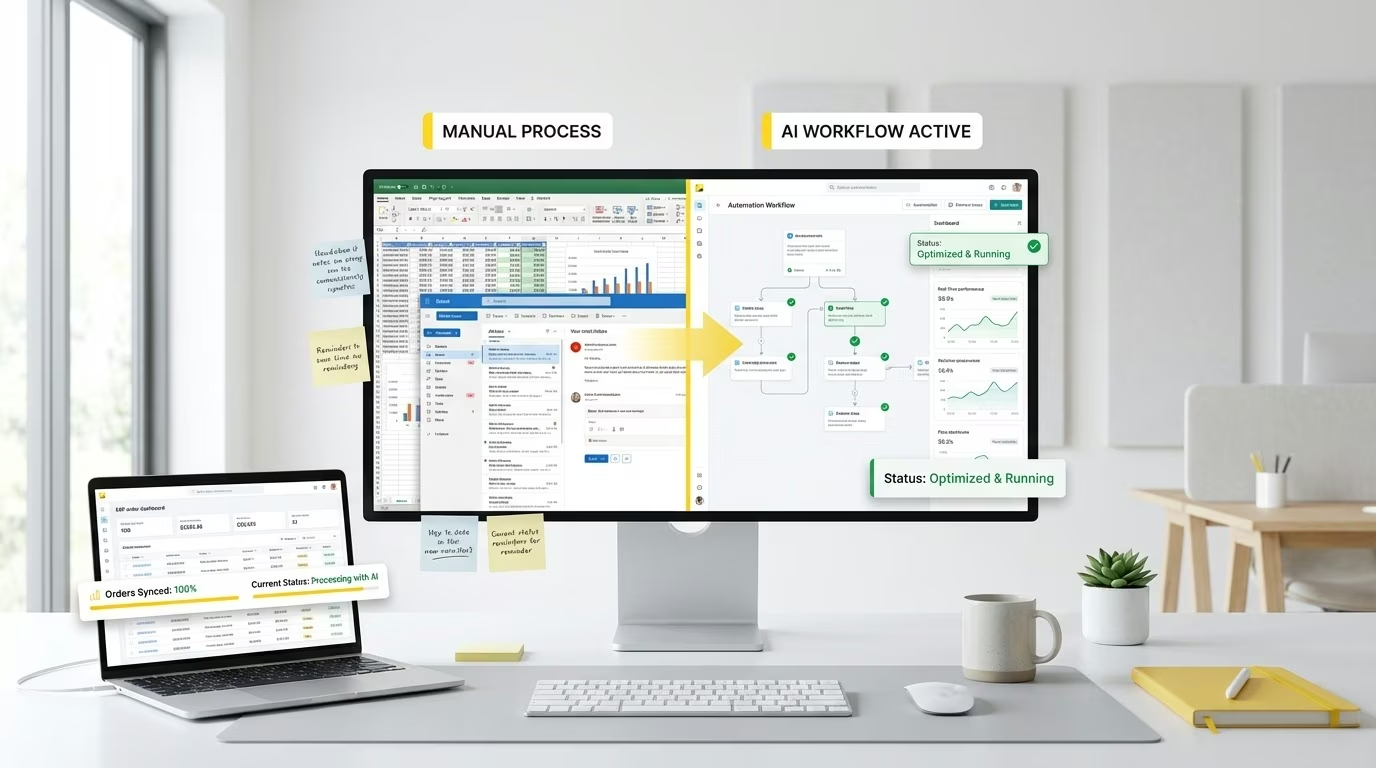
Believe it or not, a lot of supply chains still run on spreadsheets, email threads, and disconnected tools. It slows everything down, leads to mistakes, and makes scaling feel like trying to run a marathon in flip-flops.
Today’s regulatory landscape is no joke. From environmental standards to labor laws, businesses are under growing pressure to stay compliant and transparent. Missing a step can mean fines, delays, or worse, a hit to your reputation.
Guesswork isn’t a strategy. Without strong forecasting and inventory management tools, businesses risk overstocking (wasting cash) or stockouts (losing sales). Accurate predictions require powerful analytics not just gut instinct.
With so many different systems — ERPs, CRMs, WMS, IoT devices getting them to work together smoothly can feel almost impossible. When your tech doesn’t talk, your data stays trapped, and operations slow to a crawl.
The global business landscape is experiencing unprecedented disruption from geopolitical instability and inflation to climate-related risks and labor shortages. Meanwhile, customers expect more: faster deliveries, personalized experiences, and transparent practices.
According to recent forecasts, the global supply chain management market is expected to grow from $21.95 billion in 2023 to over $30.91 billion by 2026. The retail segment alone is projected to reach nearly $58.87 billion by 2030. These numbers reflect not just growth, but transformation an acknowledgment that intelligent, tech-enabled supply chains are foundational to business success.
So, how can today’s business leaders’ future-proof their operations? Here’s a strategic operations supply chain management playbook for success:
AI, cloud-based supply chain platforms, and digital twins are game-changers. By 2028, AI in supply chains will become a $20 billion industry, growing at an annual rate of 20.5%. Tools like no-code and low-code platforms democratize tech adoption allowing teams to build, test, and deploy integrations without IT bottlenecks.
Artificial Intelligence is no longer a futuristic concept it’s actively optimizing supply chains today. AI can reduce forecast errors by up to 50%, prevent stockouts, and cut excess inventory by up to 50%. Robotics, machine learning, and automation are also accelerating operations while reducing human error and labor costs.
ERP, CRM, Blockchain, Internet of Things (IoT), augmented reality, and advanced data platforms are delivering real-time, end-to-end visibility. Businesses can now track every unit from factory to doorstep boosting accountability, reducing fraud, and enabling proactive issue resolution.
Leaders need to act fast but with clarity. Real-time data ingestion and orchestration across systems (ERP, CRM, IoT, APIs, etc.) ensures better decision-making. Whether it’s optimizing a delivery route or adjusting procurement due to weather conditions, having accurate, up-to-the-minute data is essential.
COVID-19 taught the business world a harsh lesson: over-reliance on single-source suppliers or regions is a vulnerability. Now, over 90% of American companies are adopting supplier diversification strategies, spreading risk across regions, vendors, and even continents to ensure continuity.
From multi shoring strategies to AI-driven supplier management, businesses must be ready to pivot. Investing in flexible manufacturing systems, alternative logistics routes, and dynamic vendor relationships can turn disruptions into opportunities.
Sustainability is no longer a buzzword it’s a boardroom priority. From eco-friendly packaging and carbon-neutral logistics to ethical labor practices, leaders are embedding ESG principles into supply chain strategies. Not only does this meet compliance standards, but it also enhances brand trust and attracts purpose-driven consumers.
Use tech that enhances transparency and simplifies compliance checks. Automating ESG reporting, auditing labor practices, and tracking carbon outputs helps businesses avoid fines, meet regulatory requirements, and build goodwill with consumers and stakeholders alike.
One of the biggest challenges in operations today? Silos.
Data stuck in isolated systems slows decisions, creates blind spots, and drives up costs. This is where smart integration platforms like eZintegrations™ shine.
Imagine being able to connect any system APIs, cloud apps, databases, even email and have the data flow seamlessly into your dashboards, machine learning models, or reporting tools. That’s the kind of intelligence eZintegrations™ brings.
It’s a no-code/low-code, AI-powered platform designed for speed and simplicity, enabling operations teams to build data pipelines with drag-and-drop ease.
With eZintegrations™, You Can:
This level of integration doesn’t just streamline processes—it enables enterprise agility, allowing leaders to orchestrate complex operations and unlock new revenue streams without adding technical debt.
We are living in an era where supply chain and operations excellence is a key determinant of business survival. For C-level executives, Directors and other top-level management, the mandate is clear: embrace innovation, champion resilience, and invest in platforms that empower your people and processes.
With tools like eZintegrations™, organizations can turn fragmented data into a strategic asset, accelerate digital transformation, and unlock new levels of performance.
Whether you’re navigating market uncertainty, scaling globally, or leading a digital overhaul, the future of operations and supply chain management lies in smart integration, intelligent automation, and purposeful leadership.
Ready to future-proof your operations and supply chain management business?
Request a demo of eZintegrations™ today and discover how seamless integration can help you build the supply chain of tomorrow—today.
Operations and Supply Chain Management (OSCM) is the coordination of all activities involved in sourcing, producing, and delivering products or services. It ensures efficiency, cost-effectiveness, and customer satisfaction throughout the business process.
Common challenges include lack of visibility, global disruptions, supplier dependency, increasing costs, and rapidly evolving customer expectations.
They can adopt automation, integrate real-time data platforms, diversify supplier networks, and utilize predictive analytics powered by AI.
Yes. Even small businesses benefit from automation by reducing manual errors, improving inventory management, and responding faster to demand changes.
AI helps forecast demand, optimize inventory, identify supply risks, and enable dynamic decision-making across the value chain.


© Copyright 2026 Bizdata Inc. | All Rights Reserved
 Watch Demo
 Post on LinkedIn
 Post on Facebook
 Post on Twitter/X