 support@bizdata360.com
 +1-650-283-1644
 AI Enabled Data Integrations and AnalyticsAI Enabled Data Integrations and Analytics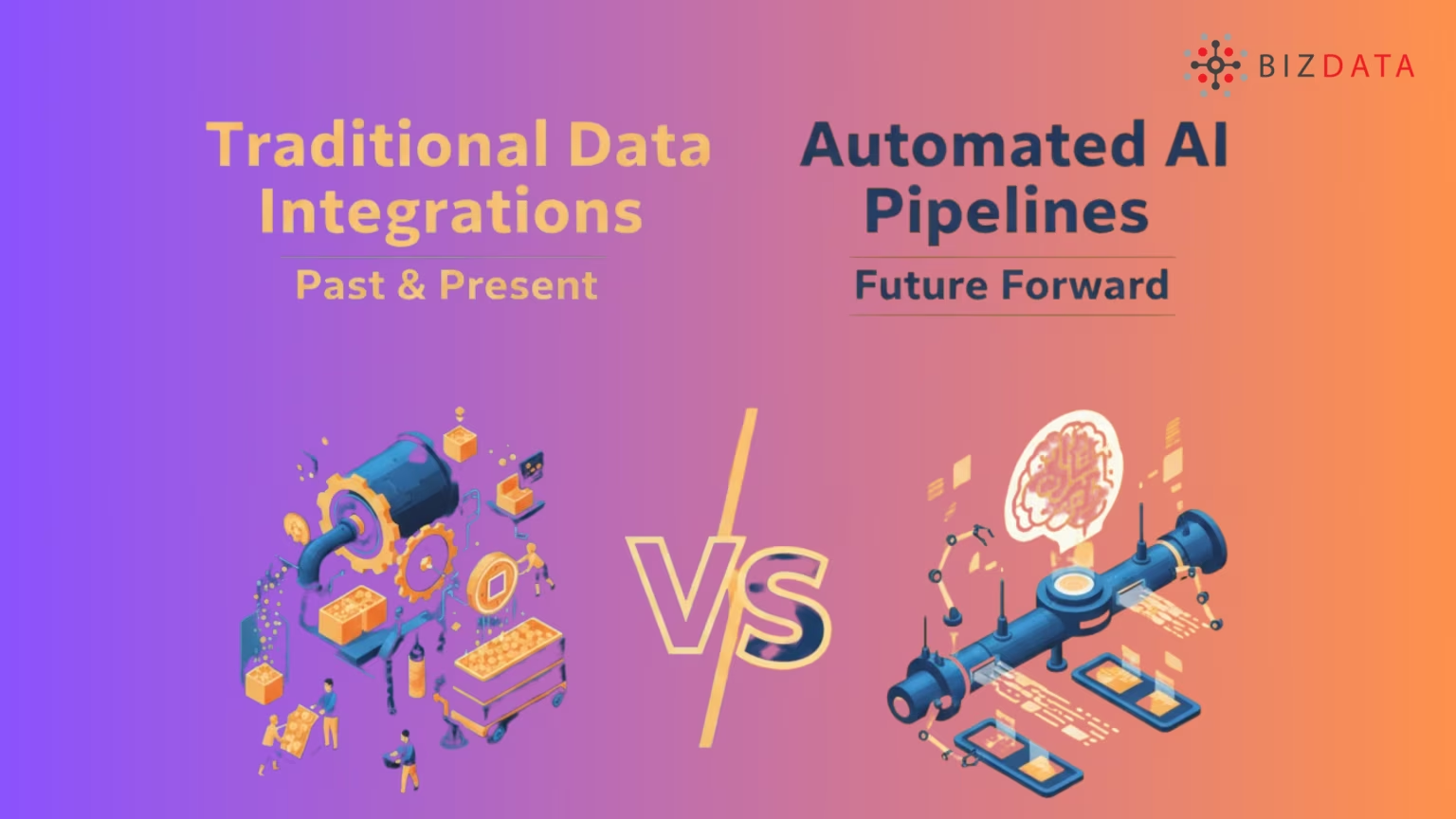

Traditional Data Integrations vs Automated AI Pipelines is one of the most important debates for data, engineering, and IT leaders today. As companies race to keep up, many teams remain stuck managing brittle scripts, point-to-point connectors, and batch jobs. The pressure to move faster, handle more data, and scale has never been greater.
According to a recent survey, 64% of organizations report that their data teams spend more than half their time on repetitive or manual tasks such as building and maintaining data pipelines.
At the same time, adoption of AI across enterprises skyrockets McKinsey’s 2026 global survey found that 88% of companies now use AI in at least one business function, up from 78% a year earlier.
That combination sets up a stark choice. Stick with traditional integrations and risk falling further behind. Or embrace automated AI pipelines that scale with your needs and free your data teams to focus on insight, not plumbing. In the rest of this post, we lay out the trade-offs and show why many forward-looking companies are shifting to AI-powered automation using platforms such as eZintegrations™.
This post is aimed at IT leaders, data engineers, analytics managers, and workflow automation teams in the US who are evaluating their long-term data strategy.
Traditional data integrations rely on custom scripts, point to point connectors, middleware appliances, batch processes, or manually maintained ETL jobs. Teams usually follow a step-by-step workflow that involves human intervention and routine updates.
These setups were perfectly fine when data volumes were stable, and system changes were infrequent. In 2026, that environment looks very different.
Most US enterprises now rely on dozens of SaaS tools, multi cloud data sources, and near real-time data updates. Maintaining traditional integrations in this environment becomes hard. Teams end up managing connectors, handling schema changes, rewriting mapping logic, and keeping batch jobs alive.
Traditional models place a heavy maintenance load on already stretched teams. They also create bottlenecks because every update requires technical effort and regression testing.
Common issues with traditional integrations include:
Before long, the integration layer becomes a blocker instead of an enabler.
Automated AI data pipelines use machine intelligence to handle mapping, routing, reconciliation, enrichment, and workflow execution without manual intervention. Instead of relying on scripts or custom connectors, the pipeline learns patterns, detects system changes, and adapts automatically.
In 2026, AI is not just an add-on. It is becoming the operating layer for enterprise data workflows. Platforms like eZintegrations™ combine AI workflow automation capabilities with no code integration to help teams move away from manual maintenance.
AI pipelines remove a significant amount of manual effort. They also reduce the need for custom code and allow teams to launch integrations faster.
Key advantages include:
AI also helps with anomaly detection so teams can spot issues faster.
The comparison below uses the primary keyword naturally and helps readers understand where each model performs better.
Teams often choose AI pipelines because they can go live quickly. Traditional models require coding, platform specific expertise, and infrastructure planning. This increases project timelines.
AI pipelines improve time to value through:
With eZintegrations™, teams often launch workflows in days instead of months because the platform handles API connectivity and routing internally.
Traditional setups come with long-term operational costs. Maintenance hours add up. Teams need to update scripts, fix mismatches, and manage security patches. As systems grow, so does the cost.
AI pipelines lower the total cost of ownership by automating most of the repetitive work. They also reduce the amount of custom code needed. Platforms like eZintegrations™ handle updates, add new connectors, and give teams flexibility to add more applications without heavy development.
Traditional integrations are prone to human errors. Mistyped mappings, outdated schemas, and connector mismatches can break workflows. Troubleshooting consumes valuable time.
AI pipelines offer more reliability because the system monitors patterns and can self-correct in many cases. They also add intelligent validation and anomaly detection, so data does not break silently. eZintegrations™ uses AI based enrichment and transformation to ensure clean data flows into target systems.
US organizations are storing and collecting more data every year. Statista shows that enterprise data generation in the US continues to grow at double digit rates. Traditional models struggle to keep up with this pace.
AI pipelines scale naturally. As new systems are added, the platform adapts. eZintegrations™ supports SaaS tools, data lakes, ODATA, REST, GraphQL, SQL, and NoSQL systems without adding complexity for the team.
Traditional pipelines depend heavily on senior engineers. When those engineers are busy, projects slow down.
AI pipelines shrink the load by:
This shift frees engineers from focusing on strategic work instead of maintenance.
If you want to move from Traditional Data Integrations vs Automated AI Pipelines toward a modern workflow, eZintegrations™ gives you the building blocks. It is not just a connector platform. It is an AI workflow automation system that helps launch integrations without writing code.
You get:
The platform also works with Goldfinch AI to extract data from unstructured sources and convert it into structured formats that can flow into pipelines.
AI pipelines are seeing strong adoption in sectors such as healthcare, insurance, legal operations, ecommerce, and logistics. These industries use multiple systems and require real-time data exchange.
Typical use cases include:
Teams using eZintegrations™ benefit from end-to-end visibility and fewer operational blockers.
If you are evaluating both options, consider your workloads, data volume, and long-term growth. Traditional setups may work for small, predictable projects. AI pipelines are better for dynamic, multicloud, and scale-driven environments.
Questions to help you decide:
If most of these apply, AI pipelines are the better option.
The shift from Traditional Data Integrations vs Automated AI Pipelines is well underway in the United States. Traditional models have created value for many years, but they struggle to keep up with the demands of modern data environments.
AI-driven automation improves speed, reduces cost, enhances reliability, and scales with your growth. Platforms like eZintegrations™ make the transition easier with no code integration, API marketplace support, and AI workflow automation.
If you want faster, cleaner, and more reliable integrations, book a free demo of eZintegrations™ and see how automated AI pipelines can fit your roadmap.
Recommend Blogs:
Traditional setups depend on scripts and manual ETL work. AI pipelines automate mapping, routing, and monitoring, so workflows run with little human effort.
They adapt faster, handle real time data, reduce maintenance, and scale easily as companies add more systems.
Yes, for most use cases. AI handles transformations and exceptions, so teams rely less on hand built ETL.
It connects enterprise systems through no code of AI workflows, automates mapping and schema changes, and supports real time sync across apps and APIs.
Not usual. Platforms like eZintegrations™ simplify onboarding with guided setup and drag and drop workflows.
Yes. They support SaaS apps, databases, ERPs, CRMs, and custom APIs including REST, GraphQL, and ODATA.


© Copyright 2026 Bizdata Inc. | All Rights Reserved
 Watch Demo
 Post on LinkedIn
 Post on Facebook
 Post on Twitter/X